A bill is making its rounds in the California Legislature and calls for increases in the state minimum wage, which is currently at $8 an hour. AB 10, introduced by Assemblymember Luis A. Alejo, D-Salinas, sets an incremental increase on the minimum wage to $8.25 per hour in 2014, then to $8.75 per hour in 2015 and $9.25 per hour in 2016.
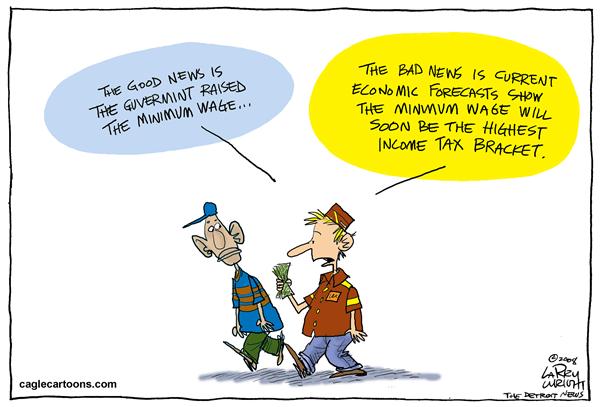 Similarly, President Obama, in his State of the Union Address, made a strong call for increasing the minimum wage to $9.00 per hour and indexing it to inflation. His argument is that “a family with two kids that earns the minimum wage still lives below the poverty line. That’s wrong.” So the President believes that Congress should make it illegal for anyone to sell their labor services to an employer for less than $9 per hour.
Suppose that I agree — why stop there? Anyone who works full time should be able to save for retirement, send their kids to college, pay for private pre-school, have a decent car, and take a vacation every now and then. Let’s just raise the minimum wage to $300 per hour. If raising the minimum wage to $9 per hour “would raise the incomes of millions of working families,” how many more millions of working families would have their incomes raised by going to $300 per hour?
It might now be obvious to the reader that having either the state or federal government set the minimum wage will cause unemployment; otherwise we could follow my suggestion and make all of us wealthy. It is just a matter of how much unemployment it will cause and who will become unemployed.
In a market-based economy, I cannot pay workers more than the additional value they provide by working for me. If by hiring you my company’s net revenue goes up by $8 an hour because you produce $8 an hour’s worth of value to consumers, then I cannot pay you $9 per hour. Eventually I will go out of business paying more for my workers than I get from my customers.
So raising the federal minimum wage from its current $7.25 an hour to $9.00 per hour will make it illegal for anyone who cannot make at least $9.00 an hour to become employed. Who are these people who will no longer have jobs? They will be the less-skilled. Demographically, they will be people who have less access to quality education and have less job experience. The unemployment rate for black teenagers in this country is 37.8%. Do we believe that the President’s suggestion will improve this situation?
New entrants into the labor market will be especially burdened. The jobs that would have allowed them to get employment experience and move up the ladder of economic opportunity will no longer be available. The increase in the minimum wage will drive some of these workers into the underground economy, including the drug trade, where there is no minimum wage.
And how many families are in the situation the President is concerned about — families relying on one full-time worker that earns minimum wage? We know that more than half of workers that earn minimum wage are under age 25. We also know that 95 percent of all workers who have a high school diploma earn more than the current minimum wage. Two percent of married workers earn the minimum wage, and two percent of full-time workers earn minimum wage.
So the picture the President paints of a head of a family earning minimum wage while working full time is a tiny fraction of the American public. And some of these will be harmed by increasing the minimum wage to $9 per hour, as they will lose their jobs.
Even the President’s statement that “for businesses across the country, it would mean customers with more money in their pockets,” is not necessarily correct. While those workers who retain their jobs will have more money, those who lost their jobs will have less money. The net effect depends upon what economists call the elasticity of demand for labor. While it is possible that the wage increase for those who keep their jobs would offset the loss of wages for those who lose their jobs, would you like to be the person who lost their job?
Rather than increasing the unemployment rate for the lowest-skilled, least-well-off amongst us, while trying to address a problem that occurs in only a tiny fraction of the population, why not address the fact that 12.3 million people are unemployed and another 8 million are employed part time who would rather be working full-time?
(Gary Wolfram is the William Simon Professor of Economics at Hillsdale College and author of A Capitalist Manifesto: Understanding the Market Economy and Defending Liberty.)


Speak Your Mind