There is an organization in San Fran that is teaching rapists and murderers how to protect themselves from government agents and law enforcement’s. They are learning their “rights”, how to get an attorney and how taxpayers will finance their cases. I should mention if you are an American born criminals, you are not allowed to attend—this is only for criminals from foreign countries—usually called illegal aliens.
“Melgarejo, an organizer with a Latino activism group in the Mission called PODER, has been busy preparing undocumented immigrants for an encounter with U.S. Immigration and Customs Enforcement officials since President Donald Trump signed an executive order heightening deportation efforts on Jan. 25.
“I don’t want to scare you,” Melgarejo told the audience in Spanish. “But so you know, this is something we will see more now.”
On a recent Tuesday, she was at Mission High teaching nearly 150 people about their rights. Whether eating in a restaurant, resting at home or sitting at a bus stop on Mission Street when confronted by ICE, Melgarejo said undocumented immigrants should remain silent and refrain from signing anything.”
When ICE puts them up there is only one question. When the ICE deportation hearings are held there is only one question. Simple question? Where are the documents proving you are here legally? After a couple of minutes the hearing should end—and if no documents, within the hour on a bus, train or plane back to your native land. Then you can fight your case from your real home.
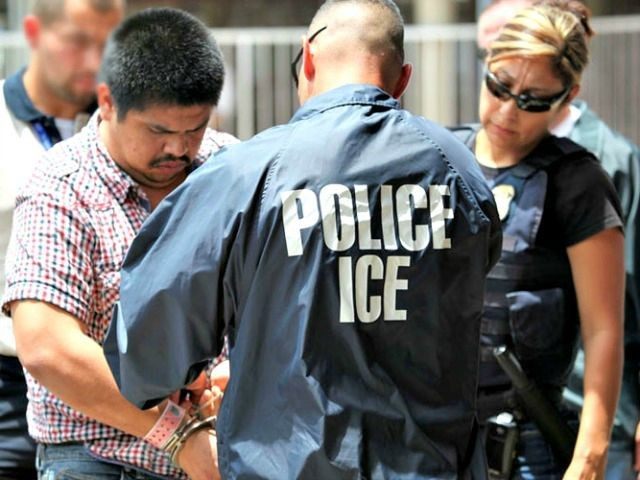
Living in the ICE age: SF’s undocumented prepare for interactions with immigration authorities
By Michael Barba, SF Examiner, 3/26/17
Bang, bang, bang!
Bang, bang, bang!
Laura Melgarejo pounded on a cafeteria table at Mission High School, pretending an immigration agent was knocking on the front door of a home.
“La migra, la migra!” she shouted, the Spanish word for “immigration,” as a crowd of mostly women and children looked to her for answers on how to respond.
Melgarejo, an organizer with a Latino activism group in the Mission called PODER, has been busy preparing undocumented immigrants for an encounter with U.S. Immigration and Customs Enforcement officials since President Donald Trump signed an executive order heightening deportation efforts on Jan. 25.
“I don’t want to scare you,” Melgarejo told the audience in Spanish. “But so you know, this is something we will see more now.”
On a recent Tuesday, she was at Mission High teaching nearly 150 people about their rights. Whether eating in a restaurant, resting at home or sitting at a bus stop on Mission Street when confronted by ICE, Melgarejo said undocumented immigrants should remain silent and refrain from signing anything.
“Whatever you do, you can faint, but don’t speak,” Melgarejo said. “Everything you say is going to be used against you.”
Mission High is home to the Migrant Education Program, a federal program in the San Francisco Unified School District that supports the children of farmworkers at schools around the district.
There are about 300 children in the program this year. Many of the children have papers because they were born in the U.S., but their parents are mostly undocumented, according to educators in the program.
Melgarejo is teaching undocumented immigrants their rights at a time of widespread fear for undocumented immigrants, who Trump characterized as criminals during his presidential campaign.
Though the president has said he plans to target undocumented immigrants who are dangerous felons for deportation, others have been caught in the web.
Jessica Chavez, who has two children in the Migrant Education Program, said this is unfair for undocumented immigrants like herself.
“I would like to take my children to go to Disneyland, but I am scared to take them and I want them to explore but I am scared of traveling,” Chavez said in Spanish, though that is not her real name. “My fear is that there will be immigration stops along the way.”
Chavez is a soccer mom. She volunteers at her children’s school, is involved in her community and even went door-to-door to campaign for a local ballot measure in November.
“The president generalizes that all immigrants are criminals, when really there are some but it doesn’t pertain to all immigrants,” Chavez said. “What the president is saying is not who I am. There are a lot of people like me.”
Chavez said she is scared. She hiked through the mountains without any family by her side to get to San Francisco 13 years ago, and met her husband here. If she is deported back to Mexico, she will have to find someone to take care of her children.
“This is my son’s country,” she said.
In cases like these, the Consulate of Mexico in San Francisco is recommending that undocumented immigrants apply for their children to have dual-citizenship in Mexico.
Parents who are afraid of deportation should also find a legal guardian for their child in the U.S., said Julio Huerta, a representative of the Consulate of Mexico in San Francisco.
Huerta said the consulate has “strengthened” its outreach efforts since Trump’s election. He has offered this advice to immigrants around the Bay Area almost every day in recent weeks, visiting schools and community centers where fearful parents have gathered.
“We’re working harder,” Huerta said.
Huerta said the consulate has also beefed up its legal resources.
City officials also decided to spend additional money next fiscal year for nonprofits to provide more legal advice to undocumented immigrants and for attorneys from the Public Defender’s Office to work deportation cases.
“It’s kind of a similar effort,” Huerta said of the consulate’s extra resources. “Our duty as consulate is to look after our people and one of those areas we are going to help them with is with legal advice, legal information and with lawyers.”
The consulate works with a network of lawyers who sometimes work pro-bono in cases including deportation proceedings, Huerta said, though he could not confirm how many.
The Consulate of Guatemala in San Francisco is also offering advice to its citizens in The City. Consul General Patricia Lavagnino said those without papers should get their assets in order as soon as possible.
“It’s like a tornado,” Lavagnino said, speaking to parents at Mission High. “What would you do if a tornado was approaching. You would protect yourself. You would protect your valuables. It’s the same thing here. Pretend a big tornado is coming.”
 About Stephen Frank


Speak Your Mind