The Jeb Bush Super PAC? Not Really

502px-Jeb_Bush_by_Gage_SkidmoreThe news that Jeb Bush’s official presidential campaign account is running out of money may have been taken as bad news by some in the Republican Party.

They have been concerned about the surprising rise of outsider Donald Trump, while at the same time the expected GOP pack leader, Bush, has been unable to gain even half as much support in the national polls as compared to top dog Trump. And the concern of so-called “establishment” Republicans was likely only compounded when it was just disclosed that three key, seasoned Bush fundraising operatives have departed the campaign.

“Troubling Signs” is how Politico headlined the news of the recent Bush campaign personnel changes. There was some uncertainty over whether the fundraisers had resigned or were let go, but it was clear that Bush’s official campaign is having serious problems raising enough of its own money in the wake of the Trump juggernaut.

The Bush campaign is clearly going through a round of belt-tightening as Trump continues to rise in the polls. According to the New York Times, just before the three fundraisers made their departure, the Bush campaign had gone through an additional round of staff and salary reductions.

Bush supporters have minimized the apparent growing financial problems of Jeb’s presidential campaign. They say there is plenty of pro-Bush campaign money in the bank.

Politico observes that “Bush’s Super PAC,” which must be legally independent of the official campaign, has had “massive success raising money.” According to Breitbart, “Bush’s Super PAC,” the Right to Rise PAC, raised $103 million in the first six months of 2015, while Bush’s official campaign raised $11 million. The “Bush Super PAC” success in fundraising has even inspired catcalls from billionaire Trump, who has charged that Jeb is hardly independent of the many wealthy donors who have given to it, calling Jeb a “puppet” of its donors during a speech at the Iowa State Fair.

Yet as Jeb’s official campaign fundraising and spending appears to be in some degree of turmoil, a key point missing from news reports about the well-funded independent “Bush Super PAC” that Bush supporters are relying on, is the word “independent.”

Super PACs are a fairly recent phenomena, and an outgrowth of a string of federal court decisions that establish that the Federal Election Commission’s former restrictions on the amount of money and sources of campaign finances to candidate committees cannot be extended to so-called “independent expenditures.”

In return for maintaining independence from an official campaign of a candidate, a Super PAC is allowed to collect contributions in excess of the limits on contribution amounts imposed by the FEC on official campaigns, and can raise funds from sources that are otherwise prohibited by the FEC, such as corporations and unions. But the Super PAC must operate independently from the candidates it chooses to support.

The truth is, the “Right to Rise” PAC is not Jeb Bush’s PAC. Rather, it is an independent political committee of organizers and donors who, for the time being, are Jeb Bush supporters. All it takes to create a Super PAC like “Right to Rise” is to file a simple Statement of Organization, FEC Form 1, under a cover letter that promises the following to the FEC:

“This committee intends to make unlimited independent expenditures, and consistent with the U.S. Court of Appeals for the District of Columbia Circuit decision in SpeechNow v. FEC, it therefore intends to raise funds in unlimited amounts. This committee will not use those funds to make contributions, whether direct, in-kind, or via coordinated communications, to federal candidates or committees.”

Thus, “Right to Rise” really isn’t Jeb Bush’s Super PAC. It is rather, an independent expenditure committee of operatives and donors that Trump sarcastically refers to as the “puppeteers,” who favor Bush right now. And since it is indeed legally independent of Jeb Bush, it is not legally committed to support him. An amount like $103 million is not a sum to be invested unwisely.

The “Right to Rise” PAC could decide to support or oppose any of the 17 candidates currently running for the GOP nomination, not just Bush. Should Bush continue to fail to gain traction in the polls, if his support further erodes, and as the primary process proceeds to what some political veterans are suggesting will be a “brokered convention,” this observer suggests that six months from now the “Right to Rise” PAC may not continue to be referred to as the “Bush Super PAC” in the press.

Originally published by The Blaze

James V. Lacy, a frequent guest of Fox Business News Channel’s “Varney & Company,” is author of “Taxifornia” which is available at Amazon.com

CA voters could be players in GOP race for the White House

VotedThe easiest way to tell whether you’re in California or New Hampshire is to walk into a coffee shop. If you don’t see a presidential candidate, you’re in California.

Our state’s presidential primary in June usually takes place in what the NBA calls “garbage time,” that final few minutes of play after the outcome is beyond any doubt.

But 2016 could be different.

On Wednesday, 15 Republican candidates for president were at the Ronald Reagan Presidential Library for two televised debates. An astounding 23 million people watched the CNN telecast, making it the No. 10 cable TV show of all time, behind eight college football games on ESPN and the GOP debate last month on Fox.

CNN’s previous ratings record for a presidential debate was set on Jan. 31, 2008, when an average of 8.3 million viewers tuned in. On Wednesday, even the early debate for four low-polling candidates drew an audience of over 6 million people.

The reason for the skyscraping ratings, of course, is Donald Trump. “Will they send me flowers?” he tweeted on Thursday.

“Trump deserves a lot of credit” for drawing tens of millions of viewers to the debates, said Shawn Steel, who represents California on the Republican National Committee. “Some candidates would give up organs for coverage like that.”

California’s primary could be actively contested, Steel believes, if four or five candidates are still in the race at the beginning of April.

“Eighty percent of the delegates will have made up their mind after March,” he said. But he predicted that as long as the debates continue to have “the JV table,” candidates are likely to stay in the race for the TV coverage. The RNC scheduled a total of nine debates, spaced about a month apart. The next one is Oct. 28 in Boulder, Colo.

A year ago, a prediction that the Republican presidential debates were going to break TV rating records would have won you the Brian Williams Award for Outstanding Achievement in Fantasy.

“Trump has brought a whole new dynamic to the Republican brand,” Steel said, by attracting alienated voters, independents and Democrats.

“His poll numbers in the African-American community are better than any Republican’s in the past 50, maybe 70 years,” Steel said. “And in the Latino community, where you might expect that he’d be polling at 5 percent, he’s at 25 percent. That’s Gallup. It’s quite a shocker.”

Steel said it’s evidence of illegal immigration’s “impact on working folks,” including Latinos who are legal immigrants. “You can’t dismiss it,” he said.

At a Kiwanis Club meeting in West Hills Thursday morning, the usual ban on political talk was lifted for a discussion of the debates. Republican Doris Panza said Trump would not be her choice for president, but she thinks he is saying what people have been itching to hear, and what everyone else is afraid to say. Panza, whose husband served in the military for 38 years, liked what Sen. Lindsey Graham said about fighting ISIS. “I think he’s right that if we don’t fight them there, they’ll be over here,” she said.

Janet Lucan, a Democrat, said she liked the way Carly Fiorina “put Trump in his place” and was impressed with her as a person. She said she likes Jeb Bush and, to her surprise, she liked what Rand Paul had to say.

Ron Guilbert described himself lightheartedly as a “far right-wing Republican” and said he would vote for Marco Rubio if the election were held today.

At a Constitution Day event Thursday at Pierce College, associate professor of political science Anthony Gabrielli also gave high marks to Rubio.

“I think he had the strongest performance of the ‘insiders,’” he said, “and Carly Fiorina was the strongest of the ‘outsiders.’”

California Republican Party Chairman Jim Brulte said during a break between the debates Wednesday that the GOP candidates are “head and shoulders above what the Democrats have to offer.” Steel called the field the “finest quality candidates in our lifetime.“

They’re getting a good long look from the voters, courtesy of Donald Trump. According to Nielsen data, millions of people who never watched a presidential debate before are watching now.

Could California’s political landscape be affected if new voters register in the Republican Party to cast a vote for Trump, Rubio, Fiorina or another candidate in the GOP primary?

A year ago, a prediction that a New York real estate developer would rebuild the California Republican Party would have won you another Brian Williams Award.

Takeaways From Second GOP Debate

As usual, there are so many polls, opinions and scorecards examining who did well during last night’s Republican debate at the Reagan Library. Here are my takeaways – not so much on what happened but where things might lead after the debate performances.

Carly Fiorina impressed those voters looking for outsiders to run the government and she will move up at the expense of Ben Carson and Donald Trump.

Trump, however, probably didn’t damage himself with his base of support and will remain relatively steady although the establishment GOP will still search for ways to make him disappear.

Meanwhile, the establishment will remain splintered for the time being. Jeb Bush showed some spunk (Code name: Eveready) and might reassure his backers to a degree but the establishment is still wary about him. Ohio Gov. John Kasich held steady and could be around to emerge if the Bush doesn’t catch fire. New Jersey Governor Chris Christie delivered another good debate performance but still will find himself stalled behind Bush and perhaps Kasich.

Wisconsin Governor Scott Walker did better than the first debate but will probably not move the needle much.

Marco Rubio showed good knowledge on foreign affairs and will remain in the multi-candidate fray to the end (whenever that may be.) He might also be setting himself up for a VP nod, depending how the primaries break.

Ted Cruz demonstrated his debating skills. He made sure he looked at the camera nearly all the time instead of looking at the questioners. Still, his strategy as the outsider working from the inside has the problem of Trump, Carson and now Fiorina blocking his path as true outsiders.

Mike Huckabee and Rand Paul showed that the GOP is certainly made up of different types but neither will break out to a wider audience with their performances.

The biggest move in the polls the next few days will belong to Carly Fiorina. Many of the debate watchers didn’t see her in the first round when she participated in the JV event.

I missed more questions from radio talk host and attorney, Hugh Hewitt, who along with CNN’s Dana Bash, had a subordinate role to CNN’s Jake Tapper on the moderator panel. Hewitt got into the politics of running for office and winning when he noted that Kasich didn’t seem to want to attack potential Democratic nominee Hillary Clinton whereas Fiorina would bring up Clinton without being asked.

Kasich explained people were still getting to know him so he was spending time explaining his record. Fiorina picked up on that saying she wanted to talk about records — Clinton’s — and attack it for lack of accomplishments.

At any rate, not enough time for Hewitt who I found was an excellent interviewer when he was one of the hosts as I did his Los Angeles PBS TV show, Life and Times, on numerous occasions in the 1990s.

That’s my reaction. There are many others, of course, from pundits and spinners. Old friends Mike Murphy and Todd Harris were firing off tweets and re-tweeting comments that supported their candidates, Jeb Bush and Marco Rubio, respectively.

The three-hour debate was Lincoln-Douglas like in length if not in format. The Lincoln-Douglas debates also lasted three hours but had no back and forth arguments or a moderator attempting to gain control. Rather the first speaker talked for an hour, the second speaker for an hour-and-a-half and the first speaker came back for a 30-minute rejoinder.

Not exactly a made for television event.

Originally published by Fox and Hounds Daily

Hispanics Should Favor Border Security to Protect the American Dream

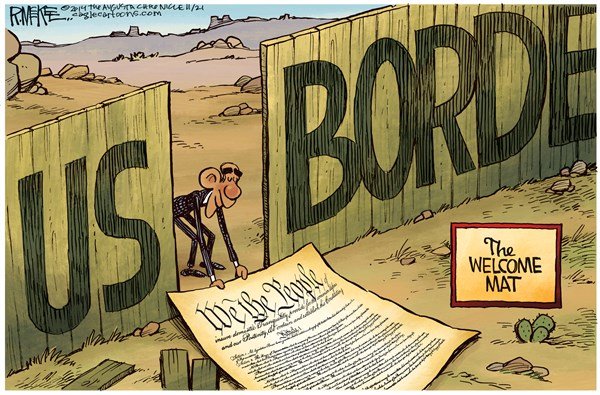
Immigration ObamaLately, there has been a lot of hype about Donald Trump’s comments on illegal immigration. I’ve seen post after post on Facebook from Hispanics saying they’ll do everything in their power to make sure Trump isn’t elected president because of his tough stance on immigration. People who were otherwise uninterested in politics are suddenly becoming engaged.

While I don’t agree with everything Trump says and does, I have to agree with him on this one issue: America’s border with Mexico needs to be secured. Hispanics across the nation should agree with that concept, even if they don’t agree with his reasoning.

Whenever people – Hispanics in particular – talk about illegal immigration, most cite the American Dream as the reason illegal aliens cross the border.

“They want a better life for themselves.”

“They want their kids to have better opportunities.”

“They contribute to our nation.”

“They do the jobs no one else wants to do.”

Those are all common phrases that have been regurgitated beyond recognition. It’s the mantra we’ve been exposed to for generations. It’s as if we’re supposed to agree with this notion because it’s been repeated so many times. Maybe if we keep repeating it, we’ll eventually believe it, we tell ourselves.

Hispanics, however, should want the border to be secure. They should strive to protect America. You can’t achieve the American Dream without accepting all of America, including our laws.

What makes our nation so great is the number of opportunities we’re presented with. The reason we’re presented with these opportunities is because of America’s unique position in the world. We allow people to make their own decisions, about what’s best for them, often without judgment. As long as we’re not causing harm to someone else, we’re often left to our own devices. If we were a lawless nation, we wouldn’t be as prosperous as we are. Instead of working hard to get a leg up, citizens would steal and loot from businesses. There would be no incentive to have a job. If we were a lawless nation, we would be as corrupt as other countries. Americans would be afraid to walk down the street. They would fear for their safety.

Cubans who fled from the Castro regime are often thankful to call America home. Our nation shielded them from persecution by a horrific dictator.  We opened our arms – and our hearts – to those in need. We were a safe haven for those who were being harmed. We were able to provide that life to these refugees because our laws dictated our lifestyle and the society we’ve built.

Securing our borders ensures that we protect the society we’ve built. Having the right of passage into the United States – done through the legal channels – is the very first test of the American Dream. If you don’t come to America by applying for a visa or citizenship and you decide to cross the border illegally, you’ve automatically denied yourself the American Dream, the same American Dream you set after. By breaking America’s laws, you’re bringing the lawlessness of your homeland with you.

Beth Baumann is a public relations professional in Southern California and a contributor for PolitiChicks.

CA Epicenter of National ‘Anchor Baby’ Debate

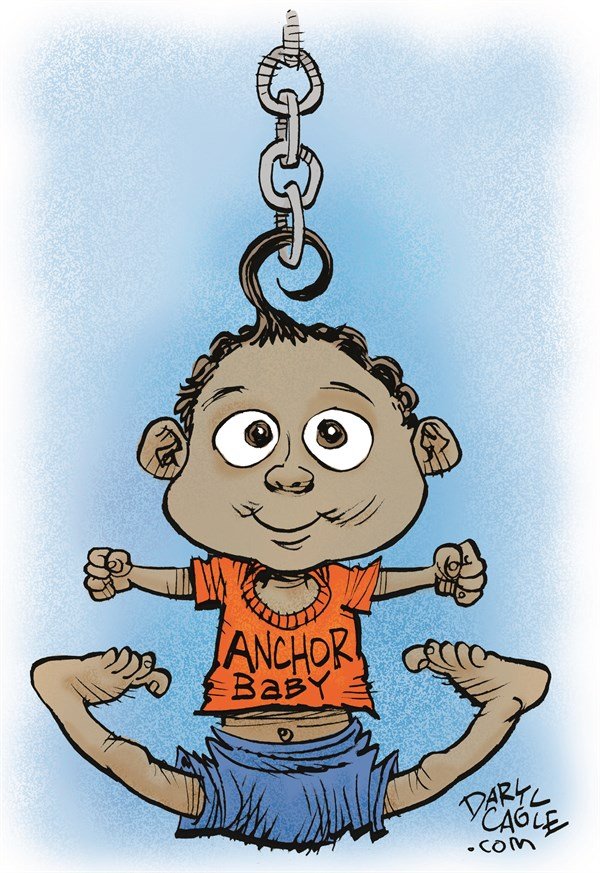
Anchor BabyRepublican presidential candidates were drawn deeper into the immigration controversies centered on California, as Donald Trump’s leading opponents sought a way to blunt his apparent advantage among voters with his tough talk on birthright citizenship and deportation.

The numbers game

Clarifying his stance, Trump campaign manager Corey Lewandowski recently took to CNN to criticize the current population of so-called anchor babies.

“If you think of the term ‘anchor baby,’ which is those individuals coming to our country and having their children so their children can be U.S. citizens,” he said. “There’s 400,000 of those taking place on a yearly basis. To put this in perspective, that’s equivalent of the population of Tulsa, Okla.”

Those numbers were immediately disputed, but not entirely discounted. According to Politfact, the figure cited by Lewandowski was “slightly exaggerated,” taking into account dipping rates of illegal immigration in recent years, and the difficulty involved in proving intent among unlawful immigrant mothers giving birth on U.S. soil.

So-called birth tourists, who use travel visas with the secret intent to have a baby delivered in the U.S., contribute to a much smaller fraction of ‘anchor babies,’ Politifact added — “around 8,600, or 0.2 percent of all births, in 2013, according to the Centers for Disease Control and Prevention.”

A growing problem

Nevertheless, the anchor baby story has gained steam this summer, reaching a broader audience than GOP primary voters. In a significant new report at Rolling Stone, Benjamin Carlson investigated Rowland Heights, a Los Angeles-area community with a reputation as “the center of Chinese birth tourism in southern California, if not the whole United States.” 

Several years ago, Carlson noted, “the county of Los Angeles opened an investigation into maternity hotels after receiving a deluge of public complaints,” although in the end “no new ordinance targeting maternity hotels was passed in the area. The task force decided that ‘complaints beyond the scope of local zoning powers’ would be referred to state and federal agencies.” According to estimates cited by Carlson, California has become the epicenter for many of the 10,000-60,000 Chinese tourist births the U.S. hosts per year. 

Campaign controversy

With the anchor baby story gaining national traction, several of Trump’s leading competitors for the Republican nomination appeared to size up the issue as a way to toughen up on immigration without undermining their credibility with pro-immigration constituents. Asked by Bill O’Reilly whether “the anchor baby law” is “destructive to the country,” Marco Rubiocalled the issue a “legitimate” one, as RealClearPolitics recounted. “I of course have read about how that happens in California, wealthy Chinese people are hedging their bets, in case something goes wrong in China they can come here,” he explained. 

Jeb Bush, meanwhile, allowed the term — seen by many Democrats and others as at least implicitly derogatory — to escape his lips in an interview. “Given Bush’s close connections to the Latino community — his wife is from Mexico, he speaks fluent Spanish, he’s written a book on immigration and he lives in the Miami area — it was surprising to hear Bush use the phrase,” CNN suggested. “But he defended his word choice, telling reporters the following day that he didn’t regret it.”

“‘What I said is that it’s commonly referred to that. I didn’t use it as my own language,’ he said. ‘You want to get to the policy for a second? I think that people born in this country ought to be American citizens.’”

Later, Bush attempted to clarify that his concern was closer to Rubio’s than Trump’s. “Frankly it’s more Asian people,” he suggested, urging critics to “chill out” about his phrasing, according to NBC News.

Choosing agendas

Conservatives have grappled over whether to frame birthright citizenship primarily as a question of immigrants’ potential upward mobility or the potential downward mobility they often believe government dependency fosters. “Inflation-adjusted figures from the U.S. Department of Agriculture projected that a child born in 2013 would cost his parents $304,480 from birth to his eighteenth birthday,” as National Review’s Ian Tuttle noted. “Given that illegal-alien households are normally low-income households (three out of five illegal aliens and their U.S.-born children live at or near the poverty line), one would expect that a significant portion of that cost will fall on the government.”

Originally published by CalWatchdog.com

Does Hillary Earn More Money Than America’s Top CEOs?

In an effort to drum up populist support for her presidential campaign Hillary Clinton is painting herself as a middle-class warrior, but the image she’s trying to build doesn’t exactly jive with the lavish fees she commands to speak at events.

Clinton’s shillary-clinton-biopics-cancelled-ftrpeaking fee of $300,000 per speech puts her hourly wage far ahead of America’s top-paid CEOs when taken into account that one speech generally runs for about an hour, the Washington Examiner reported.

Clinton makes a massively larger sum per hour than the highest paid CEO, John Hammergren of the pharmaceutical company McKesson. Hammergren makes $63,077 an hour.

She is paid per-hour more than the top five CEOs combined, and almost the 6th, which comes out to be $302,116 total, compared to her $300,000.

By this hourly measure, Clinton is slaying the salaries of America’s CEOs, who bring in a measly per-hour average of just over $54,000, which is about one-sixth of Clinton’s $300,000.

In terms of politician’s speaking fees, Clinton is topped only by Donald Trump who reportedly earned a staggering $1.5 million per speech while speaking at “real estate wealth expos” in 2006 and 2007. Her husband is typically paid around $200,000 per speech, but was once paid $750,000 for one speech in 2011.

For reference, former president George W. Bush earns between $100,000 and $150,000 per speaking engagement, and back when she was relevant, Sarah Palin asked for around $100,000.

If Clinton were to give a speech every hour for a 40-hour work week, that would net her around $624 million per year. That is larger than the annual salaries of the 10 highest paid CEOs in the country combined. Hammergren makes roughly $131 million a year, with the rest of the top 10 pulling in between $43 and $67 million.

Obviously Clinton isn’t giving speeches full-time. So, if she needs roughly four hours to prepare for and travel to a speech location, that still puts her hourly wage at around $75,000, or nearly $20,000 above the average pay of America’s top 10 CEOs.

The Democratic presidential candidate doesn’t discriminate in terms of who she is speaking to, either. She’s spoken before industry groups ranging from private-equity managers and business executives to travel agents and car dealers, but always collects more than $200,000 per appearance.

She’s spoken at events directed at both Republicans and Democrats, according to the Washington Post. Clinton gave the keynote address at an event for the Economic Club of Grand Rapids in 2013 that was honoring Amway President Doug DeVos, a prominent Republican donor. Earlier that year, Henry Kissinger introduced her at a black-tie gala for the Atlantic Council in Washington, D.C.

Clinton sparked a bit of an uproar in the summer of 2014 when she charged a Nevada college $225,000 shortly after officials in the state signed off on a plan to raise tuition at the school by 17 percent. The invitation-only fundraiser charged guests $200 each for a seat, with premium seating ranging from $3,000 to $20,000 for reserved tables.

Clinton attempted to quell the flames by agreeing to direct the funds to the Bill, Hillary and Chelsea Clinton Foundation, rather than her own pocket, but even that raises some questions, since contributions to the $2 billion tax-exempt charitable foundation could result in tax deductions for the Clintons.

Originally published by the Daily Caller News Foundation

Follow Josh on Twitter