Independent voters on track to surpass state’s GOP voters

As reported by the Orange County Register:

California Republicans found a moment to celebrate last year when they broke Democrats’ two-thirds supermajority in the Legislature. But that may prove a fleeting diversion from ever-growing signs of doom.

Democrats hold every partisan statewide elected post, as well as large majorities in the Legislature and among the state’s congressional delegation.

New data shows that if current voter registration trends continue, the state’s independent voters will outnumber Republicans within four years.

Voters with no party preference now account for …

Click here to read the full article


Don’t Tax Independent Expenditures, Eliminate Candidate Donor Limits

The bill authored by Assemblyman Marc Levine (D-San Rafael) to tax independent expenditure campaign spending has a point, although the measure itself is likely to find resistance in both the halls of the legislature and in the courts. Levine’s goal is to see campaigns conducted by candidates who would be accountable for the political messages delivered during a campaign.

With independent expenditures, which legally cannot consult or inform a candidate’s campaign of its activity, messages sent out on behalf of a candidate may not represent the candidate’s view, or his or her opinion of an opponent. Yet, the candidate often has to answer for this unsolicited “help.”

Assembly Bill 1494 would try to discourage use of independent expenditures (IE) by taxing the money spent in an IE campaign. Such a tax is probably unconstitutional. As election law expert Rick Hasen of UC Irvine told the Los Angeles Times, “You can’t design a tax with the purpose of trying to suppress speech. …The clear import of something like this would be to discourage people from making independent expenditures.”

Before such a law would face a legal challenge it would have to maneuver through a field of obstacles in the legislature. Well-off groups such as labor and business with sway under the capitol dome want to keep their ability to influence elections. Legislators themselves are likely to be concerned that the tax will limit the money that would be spent in their future campaigns.

Independent expenditure spending on campaigns has greatly increased since a 2000 ballot measure limited the amount of money that can be given directly to a candidate.

One goal of that measure was to increase the influence of political parties, according to supporters. However, independent expenditures arose and as Sacramento Bee columnist Dan Walters wrote there was a more cynical reason politicians supported the ballot measure:“(l)aundering campaign money to disguise its source is exactly what state legislators intended when they wrote Proposition 34 a decade ago. Its “strict limits” were designed to give the appearance of reform while encouraging money-laundering and so-called “independent expenditures” so that candidates wouldn’t be accountable to voters for their sources of campaign funds.”

A solution to the problem of beefing up candidate-controlled committees is to end the donation limits. Let candidates receive as much as a donor wants to give, report the donations immediately so that the public is aware of the donors, and let the candidate and his or her consultants fashion the campaign messages and be accountable for any promises or outrageous claims made during the campaign.

Joel Fox is Editor of Fox & Hounds and President of the Small Business Action Committee

Originally published by Fox and Hounds Daily

The Unintended Consequences of CA’s Top Two Primary System

California’s new “top-two” primary system has some Golden State Democrats worried. Though they’re confident about holding onto the seat being vacated by departing U.S. Senator Barbara Boxer in 2016, Democrats may come to rue the new set-up, which allows the two top vote-getters to advance to the general election, regardless of party affiliation. In a low-turnout primary crowded with vote-splitting Democratic candidates, it’s not out of the question that two Republicans could lead the field. That almost happened in one of last year’s statewide primaries.

In the June 2014 primary for state controller, two Republicans squared off against three Democrats and a Green Party candidate. Republican David Evans, an unknown accountant from Central California, spent just $600 on the race but managed to garner 850,109 votes thanks to his bare-bones ballot statement—“Most qualified for Controller”—and the clever ballot designation he put after his name: “Chief Financial Officer.” Fresno mayor Ashley Swearengin (a Republican) eventually won the primary, but Evans held the second-place spot for several days while votes were counted—putting him ahead of the two leading Democrats—until he was finally edged out. He finished fourth, with less than one percentage point separating him from the second-place finisher, Democrat Betty Yee. If Evans had held on, two Republicans would have competed in the general election, ensuring the first statewide GOP victory in almost a decade. Yee went on to beat Swearengin in November.

For Democrats, it was an uncomfortably close call. Democratic political consultant Garry South summarized the implications: “One of the lessons we’ve learned in ’12, and now in ’14, is that in a very low turnout primary, which this was, with a disproportionate share of Republicans turning out, Democrats have to be careful they don’t overload the ballot with candidates splitting too few Democratic voters.” These are the conditions of almost every California primary, however.

Reformers had hoped that the top-two primary structure would put more moderates on the general election ballot. It’s not yet clear that this is occurring. What’s certain is that the system is proving problematic for California’s Democrats, who have long dominated statewide offices. The reasons are two-fold. First, as South describes, with lower turnouts and higher percentages of Republicans participating, primaries are more challenging for California Democrats. Total voter participation figures still favor Democrats in these races, but it’s a much closer split than in the general election. Second, with a deeper bench of potential candidates, California Democrats have too many contenders for a limited number of statewide offices.

Even in traditional primaries, operatives of both parties have long practiced the art of “clearing the field” to limit the number of candidates on the ballot. The top-two primary amplifies the importance of field-clearing. Paradoxically, the new system was meant to weaken the political parties’ sway over the primary process, but it may wind up strengthening it. A reform intended to increase options for voters might actually reduce them.

The 2016 Senate primary is already exposing potential cleavages on the Democratic side. The first Democrat to declare for the seat being vacated by Boxer is state attorney general Kamala Harris, a woman of Jamaican-American and Indian descent. But discontent is mounting among Latino Democrats. The California Latino Legislative Caucus recently made a public call for a Latino to run for the Senate seat. Former Los Angeles mayor Antonio Villaraigosa contemplated a run but bowed out this week. Latino attentions have shifted to Orange County congresswoman Loretta Sanchez and Los Angeles congressman Xavier Becerra.

As Los Angeles Times Sacramento columnist George Skelton recently wrote, “Latinos feel insulted by blacks. Angelenos are suspicious of San Franciscans. Democrats are squabbling. It’s inevitable. It’s the unintended consequence of a one-party dominated state.” And the unintended consequence of a top-two primary system may well be to exacerbate these conflicts.

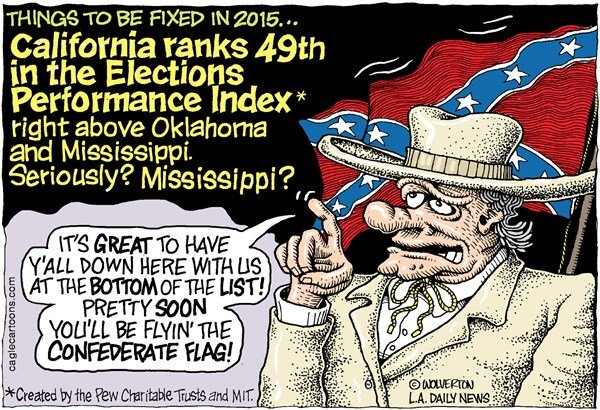
CARTOON: CA Election Index Bottoms Out

Election Index

Wolverton, Cagle Cartoons

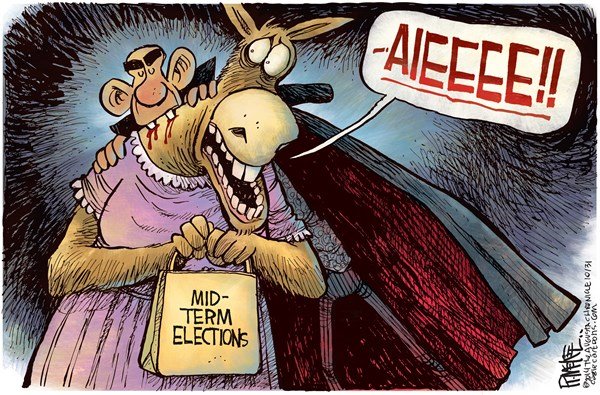
The Obama Vampire

Obama vampire

Rick McKee, The Augusta Chronicle

Southland voters to cast ballots in dozens of races


From the LA Times:

Elections are scheduled Tuesday in dozens of cities, school districts and other jurisdictions throughout Southern California. Voters will choose city council and school board members and weigh in on a handful of ballot measures designed to augment campus or municipal purses.

In San Bernardino, for example, voters will decide on four City Council members, a city attorney, city clerk, city treasurer and a school board member. Palm Springs voters will pick a mayor; six candidates are trying to defeat incumbent Steve Pougnet. Six others are vying for two seats on the City Council.

(Read Full Article)