Guess who pays if Obama’s plan to defer deportations is upheld

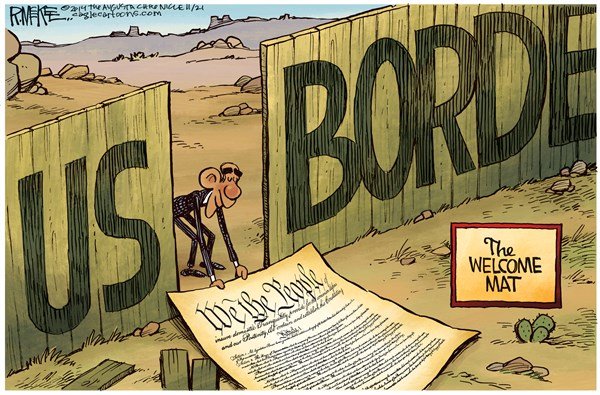
Immigration ObamaBy the end of June, the U.S. Supreme Court will decide whether President Obama really has the power to defer the deportation of 4 million people who are in the United States illegally.

The justices have agreed to hear the case of United States v. Texas, in which 26 states are suing the federal government to stop the president’s deferral policy from going forward.

The first issue to be decided is whether the states have “standing” to sue. They’ll have to show that they are harmed by the president’s actions.

Former California Gov. Pete Wilson says there’s no doubt about it.

“The states continue to feel the heavy impacts and the very high costs of federal failure to deal rationally and adequately with immigration policy,” Wilson told a meeting of the Federalist Society recently at the Reagan Library in Simi Valley.

In 1994, Wilson said, California spent “more than $3 billion, or 7 percent of the entire state operating budget” to provide health care and education to illegal immigrants and to incarcerate alien felons.

Wilson unsuccessfully sued the federal government to recover the costs that state taxpayers were bearing. The Ninth Circuit Court of Appeals rejected all his arguments, even the claim that the federal government ought to pay the costs of incarcerating criminals who should have been stopped at the border.

The court said, “California can simply exercise discretion not to prosecute and imprison alien felons and thus not incur the expense,” Wilson recalled sardonically.

No discretion is allowed in education. In 1982, the Supreme Court ruled in Plyler v. Doe that states must provide free public education to all children, regardless of immigration status.

Wilson said one reason he backed Proposition 187 — the 1994 ballot measure that prohibited state funding of public benefits for undocumented California residents — was that he wanted to challenge the Plyler ruling.

“I was convinced that if we could get 187 before a notably less liberal Supreme Court a decade later, there was a good chance that the court would overturn Plyler,” Wilson said, describing it as a “weak” 5-4 decision. But because of a long delay in the lower court, time ran out for Wilson, and his successor, Gov. Gray Davis, dropped the appeal.

“The people of California were cheated of their day in the Supreme Court,” Wilson said.

Today, the cost of illegal immigration is embedded in state and local budgets.

In 2014, the Los Angeles County Board of Supervisors approved a $61 million program called My Health L.A. to provide free medical care to undocumented immigrants ineligible for Obamacare.

California’s new system of distributing education money, the Local Control Funding Formula, gives more money to districts with high concentrations of students classified as “English learners.” The LCFF replaced a system that provided “categorical funding” for specific programs, including the arts and music block grant, gifted and talented education, and the school safety block grant.

Californians will pay $132 million a year for a new state law that provides free health coverage to undocumented residents under the age of 19.

And if Obama prevails in the Supreme Court, California may feel it in the Medi-Cal program, which already serves 13.5 million people. The state has considered deferred immigration status to be a category eligible for full Medi-Cal coverage.

However, the outcome of this case is completely unpredictable. What happens if the court upholds the president’s use of executive orders to change immigration policy, and Donald Trump is elected president?

Maybe the Supreme Court will hear a challenge to the law of unintended consequences.

Boom in Driver’s Licenses Issued to Illegal Immigrants

As reported by the Los Angeles Times:

Judith Benitez had gone most of her adult life without knowing how to drive.

The 35-year-old woman from Mexico who is in the U.S. illegally would ask family members for rides to pick up her children from school. Trips to the grocery store or the doctor’s office were complicated.

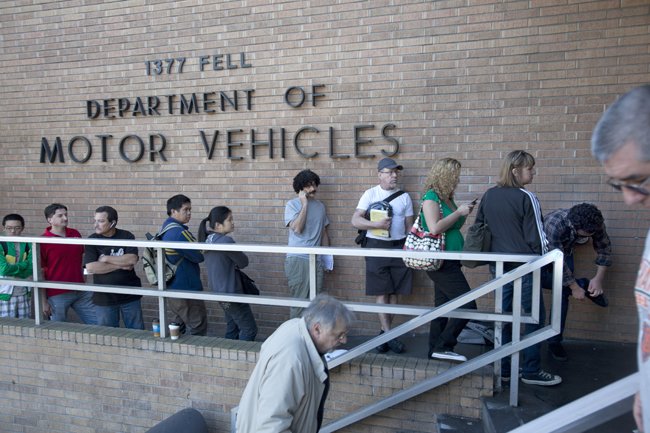
That changed last year when Assembly Bill 60 was implemented, granting people in the country illegally the right to obtain driver’s licenses in California. Benitez, who lives in Lemon Grove, learned to drive and was among those in line at the Department of Motor Vehicles the day the law took effect.

“Truthfully, it was an extremely emotional time because having a [driver’s] license isn’t just any little thing,” she said. “We feel a little more protected.”

An estimated 605,000 licenses were issued under the law last year, accounting for nearly half of all new licenses, according to the California DMV. Nearly 400,000 of the licenses were issued during the first six months. …

Click here to read the full article

Half-Million Driver’s Licenses Granted to Illegal Immigrants

DMVRoiled by immigration fears on both sides, California supplied drivers licenses to big numbers of the otherwise undocumented, further sharpening the statewide debate.

“California issued more than a half-million driver’s licenses under a new law granting the identifying documents to immigrants who may be in the country illegally,” the Associated Press noted. “The Department of Motor Vehicles announced Wednesday that 605,000 licenses were issued since AB60 took effect last January. That’s out of 830,000 applications.”

The Orange County Registerreported that reaching and processing that group would cost an estimated $141 million spread over three years. “Seniors were particularly hard hit because anyone over 70 has to appear in person at a DMV office to have a license renewed,” according to the Register. But 76-year-old Kent Moore told the Register that he had “mixed feelings” about spending hours at the Costa Mesa DMV despite holding an appointment. “These folks have jobs. And they support families. If they go through the credential process, they shouldn’t be denied,” he said. “But I paid my dues. I’ve been a model citizen. I don’t feel I should have to wait in line for hours, behind newly arrived people who are here illegally.”

No residency permits

Although opposition to the licensing plan has been steady, it has not produced a groundswell strong enough to roll back the problem. But a proposed initiative that would have ushered in a residence permit system for those who unlawfully entered and remained in the state failed to collect enough signatures to meet the requirements for inclusion on the ballot this election year. The so-called California Immigration Reform Act “would also have created a new state department to administer the permit system, require permit holders to pay state income taxes and make permit holders eligible for certain public benefits,” MyNewsLA noted. “The initiative would also have prohibited state and local governments from using public funds to support or otherwise participate in federal immigration enforcement against permit holders.”

Immigration has remained a sharply divisive issue, with state officials seeking to pursue an accommodating course while many residents remain on edge. Late last month, the Golden State was virtually alone in responding favorably to the federal government’s request for help in housing immigrant children on their own. “California and Virginia told the National Guard Bureau they have facilities that could be used but they would require additional funding if asked to meet federal requirements,”according to the Associated Press. California Guard spokesman Brandon Honig told the AP that “all state facilities would require work for fencing or other items to meet the requirements.”

Raid fears

But this month, passions have run high amid a spate of federal immigration raids both real and imagined. In events that sent tremors through California politics, “Democrats, led by the Congressional Hispanic Caucus, have protested a number of raids carried out in southern states by Immigration and Customs Enforcement officers against illegal immigrants from Central America — 121 adults and children who had been ordered to leave the country by a judge,” ABC News reported. “Rep. Zoe Lofgren, D-California, who has been in constant communication with White House officials and attended the Tuesday meeting with the White House council, said she was not aware of any imminent ‘pause’ to the operations.” Senate Minority Leader Harry Reid, D-Nev., had predicted a reprieve, although he couldn’t speak to when the White House might announce it, according to The Hill.

Rumors quickly caught fire in California that deportation raids were underway on the west coast too. As Fusion noted, “there were multiple reports of immigration officials lingering in front of a San Francisco elementary school. Tweets, Facebook updates, and even Instagram posts reported immigration checkpoints at grocery stores all over the Bay Area. There were also reports of immigration agents rounding up day laborers at a Home Depot in Hayward. But all of the reports turned out to be false, according to immigration officials and other social media users who went looking for the raids with the intent to share pictures and video.”

Originally published by CalWatchdog.com

CA Congressmen Push for Immigration Reform

Bucking their newly minted party leadership, several members of California’s congressional delegation have resolved to push ahead with a new bill that would reform immigration law by loosening it up.

Reps. Jeff Denham, R-Turlock, and David Valadao, R-Hanford, expressed confidence that they can secure a vote on the so-called ENLIST Act, which has been stalled in committee for months. The Act, as the Los Angeles Times reported, “would allow people brought to the United States illegally as children before 2011 to become lawful alien residents if they complete a term of military service.”

Although Denham and Valadao, the Times added, rank “among the most outspoken members of their party pushing for comprehensive immigration overhaul,” their focus on ENLIST reflected a broader unwillingness among House Republicans to tackle the issue this election season — whether in pieces or as a whole.

Running out the clock

The hands-off position was freshly cemented by newly elected House Speaker Paul Ryan. To help secure the backing of the House Freedom Caucus, which has depicted comprehensive immigration reform as a concoction of big business and big government, “Ryan pledged he would not move an immigration reform overhaul to the floor unless it was backed by a majority of House Republicans,” as The Hill recalled.

Ryan, The Hill noted, “was loosely involved with talks about immigration reform in the House in 2013. At the time, a bipartisan group of House lawmakers was working to put together a comprehensive immigration overhaul. Ryan wasn’t part of the core group, but did have conversations with its members.” Leading Republicans have sometimes been burned by their support for that effort. Sen. Marco Rubio, for instance, has had to pivot away in order to shore up his right flank and seize an advantage against main primary season rival Gov. Jeb Bush.

Balance and blame

Paul RyanRyan, for his part, did not disavow outright his preference for a so-called “pathway” to citizenship for many unlawful and undocumented immigrants. But in recent remarks on the CBS program Meet the Press, he tried to indicate that he actually preferred a path to “legal status” instead of outright citizenship, as the Associated Press noted:

“Legal status versus citizenship is an important distinction, partly because only citizenship confers the right to vote. His office said Ryan supports ‘earned legal status,’ noting that this could eventually lead to citizenship through existing channels.”

At the same time, Ryan blamed president Obama for his reluctance to proceed with immigration legislation. “Look, I think it would be a ridiculous notion to try and work on an issue like this with a president we simply cannot trust on this issue,” he said. “He tried to go it alone, circumventing the legislative process with his executive orders, so that is not in the cards.”

The response from the White House was swift. Press Secretary Josh Earnest “accused new House Speaker Paul Ryan of ‘pandering to the extreme right wing’ of his party on immigration,” the Associated Press reported, labeling his comments “preposterous.”

Bicoastal politics

Although the testy rhetoric suggested little room for lawmakers to maneuver, California Republicans like Denham and Valadao have taken advantage of unusual personal circumstances to pursue their agenda. Hispanics make up a significant percentage of voters in both representatives’ districts, as the Hill observed, while both currently lean Republican, the Cook Political Report determined.

In other words, although their districts remained competitive heading into 2016, both lawmakers boasted enough support at home to seek to expand their vote by sticking their neck out politically in Washington. Of late, California has racked up numerous and generous programs for unlawful immigrants. Measures passed this year, the AP noted, “to help immigrants in the U.S. illegally by improving their access to health care, opposing discrimination and enabling more people to apply for legal status. One measure aims to help immigrant crime victims apply for federal government visas.”

Originally published by CalWatchdog.com

Brown Signs Bill Creating Automatic Voter Registration at DMV

VotedSecretary of State Alex Padilla has succeeded in his quest to automatically register Californians to vote.

Partisan privileges

The bill he sponsored, passed by the Legislature and signed into law by Gov. Jerry Brown, touched off a fresh round of controversy over the wisdom and benefits of the approach to increasing turnout, which in California has sunken to historic lows. Last year, the state’s midterm elections mustered a 42 percent turnout, as NPR observed.

Recent polling by the Public Policy Institute of California indicated that, while two thirds of respondents supported the legislation, “49 percent lean toward the Democratic Party and 22 percent toward the Republican Party; 29 percent lean toward neither party or are unsure.” The imbalance has led many Republicans to express frustration that Democrats were supporting automatic registration for their own benefit. Slightly complicating the picture, however, the PPIC poll also indicated an ideological tilt to the right among unregistered adults: “37 percent are conservative, 31 percent are liberal, and 31 percent are moderate.”

Easing the vote

Proponents of the law argued that its mechanics were straightforward and efficient. “Eligible citizens are registered to vote when they show up at a Department of Motor Vehicles office to obtain a driver’s license or state ID,” as the Huffington Post explained. “The DMV gives the eligible voter a chance to opt out if they prefer not to register. If the person does not opt out, the DMV electronically transfers their voter registration information to the Secretary of State’s office, rather than making election officials enter data by hand from paper registration forms.”

“Citizens should not be required to opt-in to their fundamental right to vote,” Padilla said in a statement. “We do not have to opt-in to other rights, such as free speech or due process. The right to vote should be no different.” Voters, NPR noted, “retain the right to opt out, cancel or change party affiliation at any time,” adding that Padilla’s office pegged the number of eligible but unregistered potential California voters at 6.6 million.

Brown signed the bill in conjunction with a suite of others, including “a bill permitting county elections officials to offer conditional registration and provisional voting at satellite locations during the 14 days immediately preceding election day,” another that will install secure ballot drop boxes “at shopping malls, libraries and other spots,” and one billing the cost of election recounts to the state, the Los Angeles Times reported.

Rights and risks

Together, the new laws were intended, the governor’s office said, “to help improve elections and expand voter rights and access in California.”

But critics said the law wouldn’t properly distinguish between citizens and noncitizens during the registration process — a point of contention amid the ongoing debate over efforts to reduce the legal consequences of unlawful entry into the state. Catherine Engelbrecht, founder of True the Vote, warned that state databases “lack the necessary safeguards to keep noncitizens off the voter rolls,” according to The Washington Times. True the Vote spokesman Logan Churchwell went further, the Times added, asserting that California officials “specifically chose not to make noncitizen license holders searchable in their DMV database.”

On Fox News, Judge Andrew Napolitano, a libertarian commentator, raised the specter of mass voting by noncitizens. “So if you are an illegal alien in California, get a driver’s license, register to vote, you can vote in local, state and federal elections in California and those votes count,” he said.

But other libertarians have claimed that the changes would heighten virtually the opposite sort of risk. The American Civil Liberties Union joined Republican lawmakers in opposing the bill. “Since California’s DMV now issues driver’s licenses to immigrants who are living in the country illegally, the group fears those drivers will be registered to vote mistakenly, risking their ability to stay in the country,” reported the San Jose Mercury News. “State and federal laws strictly forbid illegal immigrants from voting.”

The bill, passed as Assembly Bill 1461 and authored by Assemblywoman Lorena Gonzalez, D-San Diego, will take effect this coming January.

Originally published by CalWatchdog.com

CARTOON: New Pro-Immigration GOP

CA GOP cartoon

Hispanics Should Favor Border Security to Protect the American Dream

Immigration ObamaLately, there has been a lot of hype about Donald Trump’s comments on illegal immigration. I’ve seen post after post on Facebook from Hispanics saying they’ll do everything in their power to make sure Trump isn’t elected president because of his tough stance on immigration. People who were otherwise uninterested in politics are suddenly becoming engaged.

While I don’t agree with everything Trump says and does, I have to agree with him on this one issue: America’s border with Mexico needs to be secured. Hispanics across the nation should agree with that concept, even if they don’t agree with his reasoning.

Whenever people – Hispanics in particular – talk about illegal immigration, most cite the American Dream as the reason illegal aliens cross the border.

“They want a better life for themselves.”

“They want their kids to have better opportunities.”

“They contribute to our nation.”

“They do the jobs no one else wants to do.”

Those are all common phrases that have been regurgitated beyond recognition. It’s the mantra we’ve been exposed to for generations. It’s as if we’re supposed to agree with this notion because it’s been repeated so many times. Maybe if we keep repeating it, we’ll eventually believe it, we tell ourselves.

Hispanics, however, should want the border to be secure. They should strive to protect America. You can’t achieve the American Dream without accepting all of America, including our laws.

What makes our nation so great is the number of opportunities we’re presented with. The reason we’re presented with these opportunities is because of America’s unique position in the world. We allow people to make their own decisions, about what’s best for them, often without judgment. As long as we’re not causing harm to someone else, we’re often left to our own devices. If we were a lawless nation, we wouldn’t be as prosperous as we are. Instead of working hard to get a leg up, citizens would steal and loot from businesses. There would be no incentive to have a job. If we were a lawless nation, we would be as corrupt as other countries. Americans would be afraid to walk down the street. They would fear for their safety.

Cubans who fled from the Castro regime are often thankful to call America home. Our nation shielded them from persecution by a horrific dictator.  We opened our arms – and our hearts – to those in need. We were a safe haven for those who were being harmed. We were able to provide that life to these refugees because our laws dictated our lifestyle and the society we’ve built.

Securing our borders ensures that we protect the society we’ve built. Having the right of passage into the United States – done through the legal channels – is the very first test of the American Dream. If you don’t come to America by applying for a visa or citizenship and you decide to cross the border illegally, you’ve automatically denied yourself the American Dream, the same American Dream you set after. By breaking America’s laws, you’re bringing the lawlessness of your homeland with you.

Beth Baumann is a public relations professional in Southern California and a contributor for PolitiChicks.

CA Epicenter of National ‘Anchor Baby’ Debate

Anchor BabyRepublican presidential candidates were drawn deeper into the immigration controversies centered on California, as Donald Trump’s leading opponents sought a way to blunt his apparent advantage among voters with his tough talk on birthright citizenship and deportation.

The numbers game

Clarifying his stance, Trump campaign manager Corey Lewandowski recently took to CNN to criticize the current population of so-called anchor babies.

“If you think of the term ‘anchor baby,’ which is those individuals coming to our country and having their children so their children can be U.S. citizens,” he said. “There’s 400,000 of those taking place on a yearly basis. To put this in perspective, that’s equivalent of the population of Tulsa, Okla.”

Those numbers were immediately disputed, but not entirely discounted. According to Politfact, the figure cited by Lewandowski was “slightly exaggerated,” taking into account dipping rates of illegal immigration in recent years, and the difficulty involved in proving intent among unlawful immigrant mothers giving birth on U.S. soil.

So-called birth tourists, who use travel visas with the secret intent to have a baby delivered in the U.S., contribute to a much smaller fraction of ‘anchor babies,’ Politifact added — “around 8,600, or 0.2 percent of all births, in 2013, according to the Centers for Disease Control and Prevention.”

A growing problem

Nevertheless, the anchor baby story has gained steam this summer, reaching a broader audience than GOP primary voters. In a significant new report at Rolling Stone, Benjamin Carlson investigated Rowland Heights, a Los Angeles-area community with a reputation as “the center of Chinese birth tourism in southern California, if not the whole United States.” 

Several years ago, Carlson noted, “the county of Los Angeles opened an investigation into maternity hotels after receiving a deluge of public complaints,” although in the end “no new ordinance targeting maternity hotels was passed in the area. The task force decided that ‘complaints beyond the scope of local zoning powers’ would be referred to state and federal agencies.” According to estimates cited by Carlson, California has become the epicenter for many of the 10,000-60,000 Chinese tourist births the U.S. hosts per year. 

Campaign controversy

With the anchor baby story gaining national traction, several of Trump’s leading competitors for the Republican nomination appeared to size up the issue as a way to toughen up on immigration without undermining their credibility with pro-immigration constituents. Asked by Bill O’Reilly whether “the anchor baby law” is “destructive to the country,” Marco Rubiocalled the issue a “legitimate” one, as RealClearPolitics recounted. “I of course have read about how that happens in California, wealthy Chinese people are hedging their bets, in case something goes wrong in China they can come here,” he explained. 

Jeb Bush, meanwhile, allowed the term — seen by many Democrats and others as at least implicitly derogatory — to escape his lips in an interview. “Given Bush’s close connections to the Latino community — his wife is from Mexico, he speaks fluent Spanish, he’s written a book on immigration and he lives in the Miami area — it was surprising to hear Bush use the phrase,” CNN suggested. “But he defended his word choice, telling reporters the following day that he didn’t regret it.”

“‘What I said is that it’s commonly referred to that. I didn’t use it as my own language,’ he said. ‘You want to get to the policy for a second? I think that people born in this country ought to be American citizens.’”

Later, Bush attempted to clarify that his concern was closer to Rubio’s than Trump’s. “Frankly it’s more Asian people,” he suggested, urging critics to “chill out” about his phrasing, according to NBC News.

Choosing agendas

Conservatives have grappled over whether to frame birthright citizenship primarily as a question of immigrants’ potential upward mobility or the potential downward mobility they often believe government dependency fosters. “Inflation-adjusted figures from the U.S. Department of Agriculture projected that a child born in 2013 would cost his parents $304,480 from birth to his eighteenth birthday,” as National Review’s Ian Tuttle noted. “Given that illegal-alien households are normally low-income households (three out of five illegal aliens and their U.S.-born children live at or near the poverty line), one would expect that a significant portion of that cost will fall on the government.”

Originally published by CalWatchdog.com

CA City Appoints 2 Illegal Immigrants to Commission

Huntington ParkThe city of Huntington Park, perhaps best known as being the home town of Rosario Marin, former treasurer of the United States, made news recently by appointing two people who are in this country illegally to its city commissions.

According to a Los Angeles Times article, the two appointees have to successfully complete Live Scan background checks before they can assume their positions.

The article further states that commissioners have to be residents of Huntington Park, though the city can allow up to two commissioners to be nonresidents.

These appointments are understandably controversial and they raise some interesting questions, the first of which is: To what extent should we allow noncitizens (and possibly nonresidents) to participate in local government? The second would be: How should we differentiate between legal and illegal immigrants?

There are some countries, such as Sweden, in which resident noncitizens who are in the country legally are entitled to vote in state and municipal elections. Indeed, a resident noncitizen who is entitled to vote in a Swedish state and municipal election can also be elected to both of those governing bodies.

It should be noted, though, that people who are in Sweden illegally can’t register a domicile and can’t get a Swedish ID number (which is similar to our Social Security number, but with many more practical uses). In other words, people who are in the country illegally can’t vote or serve as elected officials.

Makes sense.

In Beverly Hills, we have a residency requirement for our commissioners that applies to citizens and noncitizens alike. Both citizens and noncitizens have to be legal residents of Beverly Hills prior to being allowed to serve on a commission. So someone who has an address in Beverly Hills, but doesn’t actually live here, would not legally and/or legitimately be considered a resident and would not be permitted to serve on a commission.

I would argue that somebody who is not in the country legally is by definition neither a legal nor legitimate resident of this city, and therefore should not be allowed to serve on a commission.

Big Problem — The big problem with the Huntington Park situation is illustrated in a quote by former Huntington Park mayor, Ric Loya, who supports the appointments and who said: “A lot of people who came here legally or illegally, they’re going to say this is great. Everybody can be involved in government, as long as it’s done legally.”

On the one hand, Loya says everyone can be involved in government, as long as it’s done legally. On the other hand, his statement effectively tries to erase any difference between legal and illegal. Legal, illegal: We should all participate, as long as it’s legal. Sorry, there has to be a difference between the meaning of the words “legal” and “illegal,” both as a matter of fairness and common sense.

If we try to eliminate the distinctions between “legal” and “illegal,” we might as well change the meanings of “right” and “wrong.” Neither should we treat those who have broken the rules the same as those who have played by them.

Who ultimately gets to decide which rules, which laws we can break without any consequences?

The notion that someone who is in this country illegally can pass a background check seems somewhat absurd – unless the check’s sole purpose is to exclude felons who have been convicted of violent crimes.

What, in the background check, aside from the obvious violent crimes and felonies, would disqualify someone from serving on a commission in Huntington Park? A prior conviction for which someone had already served his time? Civil financial infractions? A failed drug test? Whatever the case, it seems that people whose very presence in this country is predicated on a violation of our laws should not be allowed to serve on municipal commissions within a governmental entity.

Those who feel that breaking immigration laws is either a “victimless infraction” or a “trivial offense” would need to create a full list and specify which crimes, offenses or misdemeanors should disqualify people from serving on city commissions and why.

Beyond the issue of city commissions, the attempt to render the distinctions between the words “legal” and “illegal” meaningless – as is often done by polemicists who refuse to acknowledge the difference between anti-immigrant positions and anti-illegal-immigration views – is very dangerous from both a linguistic and a public-policy perspective.

A misappropriation of the terms could effectively justify a selective following of and enforcement of any number of laws as well as, conversely, encourage vigilantism.

While the Huntington Park decision might be motivated by pure populism, it is extremely problematic in its obvious disregard for federal law; the city shouldn’t complain when its own residents start deciding which municipal laws they themselves do and don’t want to obey.

John Mirisch is the Vice Mayor of Beverly Hills and an occasional contributor to CityWatch.

Originally published by L.A. City Watch

California and the GOP Debate

Republican presidential candidate businesswoman Carly Fiorina stands on stage for a pre-debate forum at the Quicken Loans Arena, Thursday, Aug. 6, 2015,  in Cleveland. Seven of the candidates have not qualified for the primetime debate. (AP Photo/Andrew Harnik)

Looking for California in the GOP debate presented some challenges even with one candidate who has tentative ties to the Golden State and the state’s Democratic governor who tried to put himself into the debate via a letter to the candidates on climate change.

There was only one Californian (sort of) in the field of 17 — Carly Fiorina who made her name as CEO of Hewlett-Packard and was handily defeated by Barbara Boxer for the California U.S. Senate seat in 2010. She now lives in Virginia.

She did fairly well in the first debate, many pundits declaring her the winner. And it appeared that former Texas governor Rick Perry has Fiorina lined up for the Secretary of State job if he becomes president. In criticizing the Iran nuclear deal Perry said, “I’d rather have Carly Fiorina over there doing our negotiation rather than (Secretary of State) John Kerry.”

Major California companies Google and Apple also made it into the first debate with Fiorina saying they should cooperate with the government on investigations that might prevent terrorism.

Apparently, Jerry Brown sent his letter to the wrong recipients for the main debate. California’s Democratic governor tried to work his way into the debate when he sent a letter asking GOP candidates how they would address climate change. He should have sent his letter to the Fox News Channel debate moderators. They didn’t bother to engage the candidates on climate change in the debate featuring the 10 leading candidates.

There was a reference to climate change in the first debate held for candidates in positions 11 to 17 in the polls. South Carolina Senator Lindsey Graham responded that if he debated presumptive Democratic Party nominee Hillary Clinton on climate change she would argue cap-and-trade that would ruin the economy while he would focus on energy independence and a clean environment. Cap-and-trade is a key strategy in Brown’s camapign on climate change.

Immigration was a big issue at the debate although nothing specific to California. However, the situation on sanctuary cities was raised in both the earlier and later debates. The sanctuary cities issue gained headlines after the shooting death in San Francisco of Kate Steinle by an illegal immigrant who had been deported many times but still came back. Candidates from Jeb Bush to Ted Cruz, to Bobby Jindal said they would eliminate federal funds to sanctuary cities.

There are a number of presidential candidates working with individuals with strong California ties. To name a few: Jeff Miller is campaign manager for Rick Perry, Mike Murphy is a strategist for Jeb Bush and Todd Harris is communication director for Marco Rubio.

While California didn’t have a big role in the debates one of her favorite sons was mentioned frequently –Ronald Reagan. And that will carry over with the next Republican debate scheduled for the Ronald Reagan Presidential Library in Simi Valley September 16.

Originally published of Fox and Hounds Daily