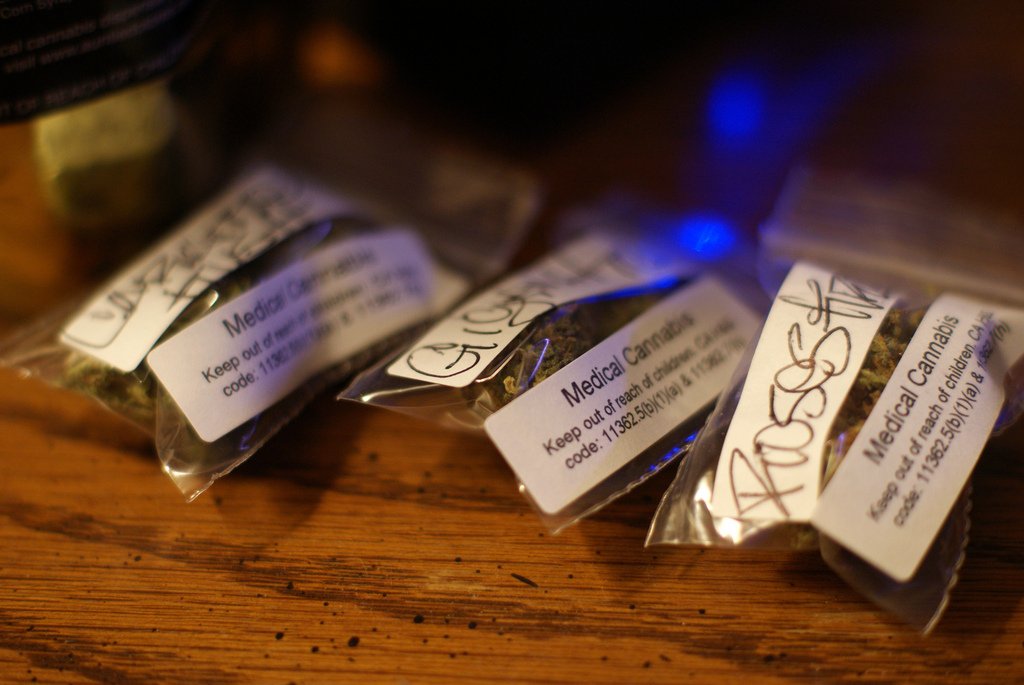
Pot tax goes down in flames in California Legislature

As reported by the Los Angeles Times:

A bill to put an excise tax on medical marijuana in California was killed Thursday by a Senate panel after advocates for cannabis users said it would put a financial burden on patients.

The Senate Appropriations Committee shelved AB 2243 with knowledge that California voters will consider a 15% pot tax on Nov. 8 when they take up Proposition 64, which would also legalize recreational use of cannabis.

The legislation by Assemblyman Jim Wood (D-Healdsburg) would have charged up to $9.25 per ounce of marijuana flowers, $2.75 per ounce of pot leaves and $1.25 per ounce of immature pot plants.

Wood said the funding is needed to help cover enforcement and environmental costs under a new system approved last year that will license the growing, transport and sale of medical marijuana. …

Click here to read the full article

Legalizing Marijuana … While Cracking Down on Tobacco

cigarette smoking ashesGovernor Jerry Brown just signed a package of tobacco regulatory bills sent to him by the California Legislature which is being billed as a “major victory for public health.”

Among the bills signed yesterday, was an increase in the age at which one can consume tobacco products from 18 to 21 and banning the use e-cigarette vaporizers in public places.

What is the point? In case the Legislature has not gotten the memo, the state is poised to legalize the recreational use of marijuana in California on the November 2016 ballot. So we’re legalizing marijuana but cracking down on tobacco – doesn’t that strike anyone around the Capitol as being a bit odd.

Based on polling, we know the public’s favorability of legalizing marijuana has dramatically increased over the last several decades. But is there is there any evidence that the California public is now all of a sudden demanding tougher tobacco regulation? I don’t think so.

As for controlling the use of tobacco by minors, the California Legislature is about 30 years too late. This type of legislation may have mattered in 1988 when California voters passed the first of its kind Prop. 99 which increased taxes on tobacco to fund public health programs. At that time, the Legislature was completely captured by the tobacco industry, and it has taken about 40 years to wean state lawmakers off campaign contributions from “big tobacco.”

Prop. 99 was found to have significantly reduced tobacco use and fatalities in California. At this time, public health advocates were calling for the California Legislature to send a message to the tobacco industry to quit targeting are kids and do something about the tobacco epidemic.

But 30 years later, this type of restriction is basically meaningless, and done more for appearances than any actual public policy benefit.

In the meantime, the Legislature has collected large amounts of tobacco campaign contributions, most of it funneled through the California Democratic Party, for a very long time. And now that those campaign contributions are starting to dry up, they decide it is now time to “get tough on tobacco.”

This is another example of the California Legislature trying to create a major legislative victory out of nothing, so it looks like they are doing a good job on policy issues such as “protecting public health,” and “standing up to big tobacco” in the run up to the 2016 election.

The reality is that raising the smoking age will not do much if anything to curb tobacco use. Research shows that most kids start smoking before age 18, and that restricting use to age 18 is not effective at preventing use to begin with.

According to the National Survey on Drug Use and Health, more than 80 percent of all adult smokers begin smoking before the age of 18; and more than 90 percent do so before leaving their teens.

So what’s the Legislature’s solution, increase the smoking age to 21, even longer after teens have already started smoking. Moreover, making it illegal to smoke could even enhance its appeal to teens, and serve to be counter productive.

As for banning the e-vaporizers in public. These are intended to help people stop smoking by providing a smoke-less alternative. The smoking cessation industry has already criticized the banning of these instruments as being counterproductive to reducing tobacco use.

In California, individuals are considered to be “adults” at age 18, so why shouldn’t they be able to make their own decisions at that age regarding tobacco use. Does the California Legislature really need to tell legal adults everything that they should and should not be doing?

The last thing California needs is the California Legislature trying to act as the “responsible adult” on every marginal issue. Adding insult to injury, is California lawmakers “declaring victory” against an industry that has been one of their core supporters for the last 40 plus years.

Kersten Institute for Governance and Public Policy

This piece was originally published by Fox and Hounds Daily

Momentum’s building to legalize pot in California

As reported by the Orange County Register:

There are increasing signs that 2016 might just be the year the largest state in the nation legalizes recreational marijuana.

Polls have shown from 56 percent to 60 percent of California’s likely voters in the November presidential contest support legal pot. And due in part to hefty financial backing from a Silicon Valley billionaire, the leading pro-marijuana measure – the Adult Use of Marijuana Act – has gotten off to one of the strongest starts among dozens of proposed initiatives on different topics being pitched for the Nov. 8 ballot.

“We believe that AUMA has a very strong chance of passing in 2016,” said Chris Beals, chief strategy officer for Irvine-based Weedmaps, which has donated $500,000 to the campaign. “While there is still much work to be done to further educate voters on the issue, support for ending prohibition is strong in California.”

Of course, much could change between …

Click here to read the full article

California lawmakers send Brown bill to fix marijuana mistake

As reported by the San Francisco Chronicle:

SACRAMENTO — The California Legislature moved quickly this week to pass a bill that corrects a mistake in the state’s historic medical marijuana laws passed last year.

AB21 deletes a provision that lawmakers inadvertently left in the legislation that said cities and counties had to create their own medical marijuana regulations by March 1 or the state would assume the responsibility. Lawmakers did not mean to set a deadline.

The deadline, however, caused local governments to panic at the prospect that they would lose local control of medical marijuana regulation — and many cities simply banned cultivation.

On Thursday, the Assembly passed AB21 in a 65-0 vote after the Senate passed …

Click here to read the full article

State Legislatures Consider Medical Marijuana

Marijuana cartoon

For marijuana in California, line between legal and illegal gets hazy

SONY DSC

California’s medical marijuana industry may soon be craving pain relief instead of selling it.

The state Legislature recently passed the Medical Marijuana Regulation and Safety Act, a combination of three laws that together will impose a massive, multi-agency regulatory framework on the cultivation, distribution and sale of cannabis.

Nate Bradley, executive director of the California Cannabis Industry Association, said his group lobbied Sacramento for “sensible regulations.” In a panel discussion presented by the Republican Liberty Caucus of California at the recent state GOP convention, Bradley said he tells his members it’s better than “having your doors kicked in.”

The new laws abolish collectives and cooperatives. Instead there will be state licenses for commercial growers, distributors and sellers, and additional licenses required in cities and counties that choose to be “wet” jurisdictions instead of “dry.”

The Wild West days are over. From now on, the medical marijuana industry will have to answer to the Department of Fish and Wildlife, the State Water Resources Control Board, the Department of Food and Agriculture, the Board of Equalization, the Department of Public Health, the Department of Consumer Affairs, Cal OSHA, the Department of Pesticide Regulation and the new chief of the Bureau of Medical Marijuana Regulation.

Growers will be assessed fees and fines for any impact on streams, rivers, lakes, fish or wildlife. They’ll be required to label each plant with a government-assigned “unique identifier,” part of a “track and trace” program that follows every product from seed to sale.

Weighing and measuring devices will be strictly regulated. Facilities will be required to have adequate security systems to prevent theft. New tax reporting requirements will log the movement of commercial cannabis and cannabis products through the distribution chain, capturing names, addresses, license numbers, transaction dates and taxes due.

There will be new regulations for production and labeling, pesticide standards, requirements for inspections, batch testing and tamper-evident packaging, workplace safety standards, and enforcement measures against doctors who engage in “excessive recommending.”

And unions have entered the picture. Licensed facilities with more than 20 employees will be required to enter into a “labor peace agreement” and all growers are required to use a “licensed transporter” to get their products to the market.

All government departments may charge fees to cover the cost of implementing the new regulations, and that’s on top of license fees and taxes.

Welcome to California.

The new laws have complicated plans for a 2016 ballot initiative to legalize marijuana completely. Dale Gieringer, director of the California chapter of the National Organization for the Reform of Marijuana Laws, said two teams of lawyers are working on drafting the language for the initiative, which now has to be written “over” the new medical marijuana regulations.

But the regulations may not survive in court. A lawsuit announced by the American Medical Marijuana Association says the new laws illegally modify Proposition 215, the voter initiative which legalized medical marijuana in 1996.

Making the situation even more tangled, marijuana remains illegal under federal law. That means a licensed California business can comply with environmental and health regulations, safety and packaging rules, union contracts, tax collections, and laws against marketing to children — and still have the doors kicked in by federal agents.

Here’s a prediction: This story ends with a thriving, statewide, tax-free, illegal drug trade.

Or, as the Sundance Kid said to Butch Cassidy, “Well, we’ve gone straight. What do we try now?”

Plan to regulate medical marijuana heads to Jerry Brown

As reported by the Sacramento Bee:

After years of false starts and nearly two decades after California legalized cannabis for medical purposes, lawmakers Friday sent Gov. Jerry Brown a legislative package to regulate the billion-dollar industry.

Medical marijuana would be newly defined as an agricultural product with rules for water use, discharge and pesticides, and would be tracked and tested through the process.

The trio of bills would allow for testing and labeling of edible marijuana, overseen by the Department of Public Health, and prevent environmental degradation like water diversion via the Department of Food and Agriculture, which would also manage cultivation.

Click here to read the full story

Marijuana Farmers Stuck in Middle of Increased Scrutiny and Cooperation

marijuana-leafCalifornia’s protracted drought has upended business as usual for many of the Golden State’s marijuana farmers, who now face both increased scrutiny and increased cooperation from regulators.

An uneasy partnership

With the prospect of a big ballot initiative on recreational marijuana coming next year, attention in Sacramento has resulted in new regulations and designated regulators. “Amid the state’s prolonged drought, Gov. Jerry Brown last year approved $3 million in funding to dispatch oversight officers and environmental scientists to identify and inspect water-thirsty pot gardens in sensitive natural settings,” the Sacramento Bee reported. “Officials from the State Water Resources Control Board and Department of Fish and Wildlife so far have visited 150 sites with growers’ approval. They have issued instructions on water conservation and filed 50 notices of environmental violations.”

The changes inaugurated a new compliance program that draws together officials from the state water board and the Department of Fish and Wildlife, according to the Bee. “Under pending legislation, the program stands to be expanded statewide,” although its reach is restricted to private farmers, not “outlaw growers surreptitiously using public lands[.]” Those illicit growers have come under fire in recent months for their very high rates of water consumption.

Trial by fire

Other drought-related circumstances have helped push the pot industry and state officials into closer company. Wildfires, for instance, have extended the threat of economic destruction to growers, who face their own particular problems as gray-market producers. “Marijuana farms suffer the same risks as other farmers in California — facing the potential loss of their crop, on top of the strain of the drought,” according to Alternet.

“The profitable Napa wine industry, too, is threatened by wildfires, with winemakers concerned that smoke-infused grape skins will alter the flavor of the wines. But some of those impacts are exacerbated for marijuana growers, who won’t get subsidies from the state if their crop is lost, and whose value per plant is much higher than that of many other plants.”

In from the shadows

At the same time, some California officials have set about trying to incorporate marijuana farms into a system of standardized water regulations. “California’s four-year drought has prompted authorities to broaden their approach to regulating cannabis cultivation with the aim of protecting sensitive watersheds,” the Bee noted. “In addition to the environmental compliance program, the state has begun issuing marijuana water permits and ramped up efforts to target environmental offenders through civil lawsuits.”

This month, the North Coast Regional Water Quality Control Board overwhelmingly voted in fresh rules requiring farms in excess of 2,000 square feet either to register with itself or approved third-party agency or organization, the Guardianreported. “A number of issues including erosion control, water and wetlands buffers, irrigation runoff, chemical contamination and waste will be regulated under the new rules.”

Although the rules announced another substantial regulatory advance into marijuana farming, which has long operated under the radar, they also reflected the state’s increasingly accommodating attitude toward the once-illegal crop. “Those who don’t register but are discovered to qualify will be notified with 30 days to enroll before enforcement actions, including financial penalties, are pursued, board personnel said,” according to The Press Democrat.

Although some growers welcomed the opportunity to come out from the regulatory shadows at the state level, others cautioned that the apparent liberalization could have more dangerous consequences. “A major concern is that due to marijuana being illegal on the federal level, those farms prepared to comply and register could expose their activities to criminal charges on a federal level,” added the Guardian.

Notably, the regulations do not distinguish medical from recreational marijuana. Expectations have already arisen that the North Coast pilot program will “serve as a model for other regions, beginning with the neighboring Central Valley, whose board takes the matter up next month,” The Press Democrat noted.

Originally published by CalWatchdog.com

CA Congressmen Urge Federal Reform of Marijuana Laws

marijuanaThe federal government’s understanding of its own marijuana regulations are willfully “tortuous” and “an obvious stretch,” warned a bipartisan duo of California Congressmen in a sternly-worded letter to the Department of Justice.

An abuse of power

In the letter, obtained by the Huffington Post, Reps. Sam Farr, D-Calif., and Dana Rohrabacher, R-Calif., requested that DOJ Inspector General Michael Horowitz open an internal investigation into the department’s continued prosecutions of marijuana dispensaries, against what they said was the clear letter and intent of the law.

In its Appropriations Act for 2015, Congress had passed a provision introduced by Rohrabacher and Farr designed and intended to ward off federal interference with marijuana-related businesses operating legally under state law.

“We, the authors of the language, and our many colleagues — including those who opposed the amendment — laid on the record repeatedly that the intent and the language of the provision was to stop DOJ from interacting with anyone legitimately doing business in medical marijuana in accordance with state law,” wrote the Congressmen.

Signed into law by president Obama, the amendment received a second vote of approval from Representatives this summer. “As the marijuana provision is part of an annual funding bill that will expire,” noted the Huffington Post, “the lawmakers introduced an identical version again in June, which was reauthorized by the House of Representatives.”

In April, Farr and Rohrabacher had also demanded that Attorney General Eric Holder “stop prosecution of state-authorized medical marijuana dispensaries” in observance of the same provision, as the Orange County Register reported.

Federal legalese

But the Department of Justice chose to interpret the law in the most hostile manner possible, the lawmakers suggested, citing an April statement by DOJ spokesman Patrick Rodenbush. As the Los Angeles Times reported, Rodenbush said Rohrabacher-Farr, as the appropriations amendment was known, didn’t apply to prosecutions directed at persons or groups:

Rather, he said, it stops the department from “impeding the ability of states to carry out their medical marijuana laws,” contrary to some claims from people being prosecuted that the amendment blocks such prosecutions.

As the Times then observed, this “narrow interpretation of the law” had particularly strong implications in the San Francisco Bay Area, “where the Justice Department has initiated forfeiture proceedings against three medical marijuana dispensaries it considers to be in violation of federal law.”

Outgoing U.S. Attorney for Northern California Melinda Haag had become notorious among pro-pot advocates and businesspeople, joining “the three other regional U.S. attorneys in California in cracking down on medical marijuana dispensaries perceived to be large-scale commercial enterprises,” as Pleasanton Weekly recounted. One dispensary facing the brunt of Haag’s crusade, Harborside Health Center, met the news of her departure with what executive director Steve DeAngelo called “great relief and great satisfaction.”

“In Ms. Haag’s parting statement she said she felt her office had ‘accomplished most of our goals’ during her tenure,” DeAngelo said in a statement. “The one goal she most assuredly has not accomplished is closing down Harborside Health Center. We hope her successor will have a more finely tuned understanding of compassion and justice than Ms. Haag has displayed, and allow Harborside to focus on serving our patients instead of battling a court case that should never have been started.”

Conflicting actions

Although the Department of Justice could opt to ignore the mismatch between its conduct and the law, the law itself would hold them to account for doing so. At stake is the applicability of the Anti-Deficiency Act, as Farr and Rohrabacher argued; as Reason indicated, that law “makes it a crime to use federal money for purposes that are not approved by Congress.”

Originally published by CalWatchdog.com

Can Unionized Police Be Held Accountable for Misconduct?

“We thought [the employees we fired] were inappropriate to be employees of the city.”

– Los Angeles Police Chief Bernard Parks (ret.), in reference to the termination of corrupt police officers, Rampart scandal (late 1990’s)

police-badgeAbout a year ago UnionWatch.org published an editorial asking this question, “How much does professionalism cost,” using as an example the tragic death of Kelly Thomas. In that case, six police officers repeatedly struck with batons and tased an unarmed man, who died a few days later of his injuries. Since that tragedy back in 2011, numerous cases of police misconduct have surfaced, many of them with equally tragic consequences. The latest one, while inexcusable, is more farce than tragedy, involving a team of Santa Ana police officers who recently raided a marijuana dispensary in that city.

The misconduct didn’t involve murderous violence, but it did involve blatantly unprofessional behavior. Once the officers secured the dispensary and ejected the staff and customers, they proceeded to disable the security cameras, and, at least according to the video recording from the camera they neglected to destroy, some went on to gobble up marijuana “edibles.” Watch this video and make up your own mind whether or not these individuals are engaging in conduct appropriate for employees of the Santa Ana police department.

Former Sacramento County Sheriff John McGinness, on his radio talk show, has frequently discussed the issue of police misconduct. He makes an observation that bears repeating – in a population of over 1 million police officers in the United States, it is inevitable that you will have bad apples. It is statistically impossible to have a group of humans that large, where every single individual will be beyond reproach. There will always be a percentage of crooks and thugs who slip through. It can’t be helped.

Critics of police fall roughly into two camps – those who are concerned about police respecting civil rights, and those who are concerned about excessive police pay and benefits. While there’s overlap, these are very distinct concerns. But those who are concerned police overstate the risks of their job in order to justify increasing their pay are often the same ones who overlook the fact that police misconduct can also be overstated. Critics can’t have it both ways. Police fatalities are rare. Police misconduct is also rare.

What can be helped, however, is how police who do cross the line are held accountable.

According to a source at an Orange County blog that covered the pot bust, the supervising officer on the scene was Alex Sanchez, a police sergeant with the city of Santa Ana who in 2013 made $107,952 in regular pay, $27,205 in “other pay,” $16,184 in overtime pay, and earned employer paid benefits of another $68,820. In other words, this officer earned pay and direct benefits during 2013 of $221,162. This rate of pay is not unusual. Take a look at the pay for Santa Ana city employees – note how nearly all of the high paying positions are for police officers.

Citizens have a right to expect better behavior from a police officer who makes this much money. And a police officer who makes this much money should be prepared to be held accountable. In the corporate world, on-the-job drug use, vandalism, or insults directed at a member of a protected status group are all grounds for instant termination. And in the corporate world, despite repeated claims to the contrary by government union propagandists, total compensation packages in excess of $200,000 per year are very unusual. Notwithstanding that incessantly cited handful of rapacious and untouchable Wall Street bankers, corporate managers and executives who make $200,000 or more per year have little or no job security, and are held accountable, and terminated, for transgressions of far less import.

There’s more. When critics of police conduct say police should not consider themselves above the law, they’re right, but they don’t go far enough. Police should not merely obey the law, they should be role models. By their words and deeds they should inspire the rest of us. The destruction of cameras, the needless vandalism, the profanity, and the insults undermine respect for law enforcement, which is the human face of the laws we must obey.

Police unions not only highlight the risk officers face as the reason they deserve excellent pay and benefits, they highlight the professional requirements of the job. Police perform an incredibly difficult job that goes well beyond the physical risk they live with. Every day, they have to deal with uncertain, volatile situations, with agitated individuals and groups, with hostility and disrespect, and with violent criminals. Police work in 2014 America requires more professionalism than ever. That’s why they’re paid like professionals. But with professionalism comes accountability.

Police officers depend on the trust and solidarity of their colleagues. That is a necessary and proper element of an effective police force. But police unions overlay onto that solidarity an us-vs-them mentality, as well as a layer of protection against individual accountability, that at the least may be described as problematic. Police unions, like teachers unions, may consciously proclaim their commitment to the broad public interest, but their organizational agenda invariably pulls them away from the people they serve.

*   *   *

Ed Ring is the executive director of the California Policy Center.