Orange County Supervisors Narrow Down New District Maps

Orange County supervisors Tuesday narrowed down their choices for new district maps from eight to three.

One map is favored by Republicans, another by Democrats and the third is considered more neutral, some political observers say.

The five supervisorial districts are up to be redrawn based on the census, which is conducted every 10 years.

Nicole Walsh of the County Counsel’s Office told the supervisors all the districts need to have roughly equal population and must be “geographically contiguous.”

“We believe that while all of the proposed maps are likely defensible… maps 2, 4 and 5 are the most defensible overall,” Walsh said.

All the maps the board settled on create a Latino majority district and all contain at least one district with nearly more than 30% Asian residents, or what’s known as an “influence district,” Walsh said.

In three of the proposed maps the Latino community would be divided in a way that could lead to a Voting Rights Act challenge, Walsh said.

“Maps 2 and 5 certainly keep communities of interest together,” Walsh said.

For instance in maps 2 and 5 Little Arabia in Anaheim is kept together, Walsh said.

Click here to read the full article at mynewsla.com

How Local Independent Commissions Are Changing California Redistricting

Long Beach is home to one of the busiest ports in the U.S., a city-owned airport, the birthplace of rapper Snoop Dogg and, of course, the beach. 

It’s also home to many different communities: a Cal State campus, young professionals and senior citizens downtown in need of affordable housing, a 45% Hispanic population and the largest Cambodian community outside of the Southeast Asian nation. 

How these communities are grouped into new election districts could reorder the city’s priorities. For decades, the Long Beach City Council drew its own districts. But this year, redistricting is in the hands of a new independent commission, aimed at preventing council members from drawing maps to their own political advantage. 

The new commission is hearing from residents, including environmental justice advocate Theral Golden, who spoke about Long Beach’s “kill zone” — also known as the “diesel death zone,” or “asthma alley.” 

Golden and others argued that because the corridor north of the port is currently divided into four council districts, residents can’t be as effective in fighting port-caused pollution.

“We are looking for something that will give someone who will represent us in a manner in which we can solve some problems,” Golden told the commission in June.  

California has a dozen new local independent commissions in this round of redistricting, a process that will create districts for elections from 2022 to 2030 based on the 2020 Census, the once-a-decade nationwide population count. 

These new panels are coming up with districts that in some places have never been redrawn, or have not been altered significantly, despite changing populations. Taking redistricting power away from office holders could mean changes in representation and city priorities.

This local movement was preceded by a state-level independent commission created by voters in 2008. That commission is busy holding public hearings and working on new boundaries for congressional and legislative districts that, in some areas, could impact who is elected. It is getting the lion’s share of attention. 

But the city and county commissions demonstrate, again, that all politics is local.   

Reforming redistricting’s ‘wild, wild West’ 

The new local independent redistricting commissions were authorized by the 2019 Fair MAPS Act, passed by the Legislature and signed by Gov. Gavin Newsom as a way to prevent political gerrymandering. 

The push in Long Beach for an independent panel came mostly from the city’s Cambodian community, whose political power was diluted when it was split into four council districts by the city council’s last redrawing in 2011.  

Despite that division, in December 2020, Suely Saro, a community advocate born in a refugee camp in Thailand, became the first Cambodian American on the Long Beach City Council and one of a few in the nation.

In 2018, a community group, Equity for Cambodians, teamed up with California Common Cause, a government reform group that pushed for the Fair MAPS Act, to lobby for the new commission. Later that year, voters changed the city charter to create the panel.

Click here to read the full story at CalMatters.com

Exporting California’s Redistricting Change

VotedIt is an old adage that California is a bellwether for the nation. Policy changes that happen here often flow eastward from tax revolts to climate strategies. Newly elected governor Gavin Newsom boldly predicted that recent California policies are the future for the rest of the country. Time will tell, but the idea that California political ideas will move the rest of the country is being tested currently, led by another of the Golden State’s governors.

Last week, former governor Arnold Schwarzenegger hosted a Terminate Gerrymandering Summit at his USC Schwarzenegger Institute. On hand were leaders of four states, Michigan, Utah, Colorado, and Missouri, that saw successful ballot propositions approved in recent elections to take the power of drawing districts from legislators and give it to independent committees.

Calling the art of Gerrymandering (the word comes from an 1812 Massachusetts state senate district drawing signed by Governor Gerry with one district shaped like a salamander) a “200-year old scam,” Schwarzenegger celebrated the electoral victories, which he said, now means that one-third of congressional districts nationally are no longer drawn by politicians.

The exuberant former governor went a bit overboard in declaring that redistricting is now “hip.” However, it’s not a stretch to understand that when people listen to arguments about politicians choosing their own voters under Gerrymandering that the fairness issue weighs heavily on the side of change.

Both political parties have practiced the art of Gerrymandering—drawing districts that would guarantee safe party seats.

There are efforts in Texas and North Carolina to undo Republican Gerrymanders and in Maryland to end a Democratic Gerrymander.

The success of the Utah proposition in a solid Republican state was built on campaign material quoting Republicans Ronald Reagan and Schwarzenegger on the undemocratic aspects of Gerrymandering.

Schwarzenegger was a principal supporter of California’s Proposition 11 in 2008 to draw electoral boundaries for state assembly and senate districts. That was followed two years later by Proposition 20, filed by Charles Munger, Jr., to add the task of redistricting congressional seats to the newly created commission’s responsibilities.

Schwarzenegger reminisced about leaders of Democratic and Republican caucuses fighting fiercely when he was governor over some policy issue only to call him later and say they were united in their opposition to his effort to support the initiative to end Gerrymandering. He said then (and now) Speaker of the House Nancy Pelosi spearheaded an effort that supplied millions of dollars to defeat the measure.

Kathay Feng of Common Cause, one of the lead organizations attempting to end Gerrymandering around the nation, recalled once receiving a call from a San Francisco legislator (unidentified but a Democrat, of course—San Francisco) demanding that no more Asian voters be put in her district.

Schwarzenegger intends to continue the effort to push his California message nationally during the 2020 elections. He set a goal that two-thirds or more of the congressional districts drawn after the 2020 census will be in the hands of independent commissioners.

This article was originally published by Fox and Hounds Daily

How Democrats Plan to Take Over Local Elected Offices Through Redistricting

Democrat DonkeyA new law setting up a redistricting commission in Los Angeles County is the first move by Democrats hoping to take as tight a grip on local elected offices as they have under the capitol dome.

Dan Walters’ Monday column in the Sacramento Bee did an excellent job of dissecting the flaws in Senate Bill 958 authored by Sen. Ricardo Lara and signed into law by Gov. Brown. The statute sets up a 14-member redistricting commission for Los Angeles County with the commission membership reflecting partisan makeup of county voters. As Walters rightly notes, “It’s a recipe for officially bringing party politics into what officially has been, for many decades, nonpartisan local government.” 

Why the move? Because Republicans who have a terrible track record of electing statewide officers, have fewer and fewer representatives in the Legislature and whose percentage of total voters has dropped to an all time low, do pretty well on the local level. Just under half of locally elected officials in county and city government and other local agencies are Republicans.

Local races don’t designate which party a candidate represents. The Republican brand has taken a hit in California. However, when local officials deal with issues, local voters often embrace solutions offered by Republicans and they are elected to office.

How to undercut this trend of Republicans showing strength at the local level? Change the rules of the game and create a system that favors Democrats. That’s what SB958 does. Expect more of the same as Democratic political strategists attempt to choke off the building of a Republican bench, the goal of Republican party state chairman Jim Brulte, who is attempting to rebuild the party from the bottom up.

This piece was originally published by Fox and Hounds Daily

Supreme Court Justices Are About To Tip The Scales In California Politics

Photo courtesy Envios, flickr

Photo courtesy Envios, flickr

California politics could be shaken up this spring when the U.S. Supreme Court hands down its decisions in two potentially landmark cases.

The framers of the U.S. Constitution thought they were keeping the judiciary out of politics, but it hasn’t worked out that way. Today the Supreme Court exercises so much power over our lives that if one of the justices mentions retirement, half the country experiences chest pains. And the stress is not unwarranted: Policies that were created by judges can be reversed by judges.

Right now the Supreme Court is considering whether to change the rules that control state redistricting, and whether to abolish mandatory union dues for public employees. The impact of the two decisions could make California’s predictable elections a lot less predictable.

In the redistricting case, Evenwel v. Abbott, the issue is whether Texas should be allowed — perhaps even required — to draw its legislative district boundaries based on eligible voters instead of total population.

For example, an Assembly district might have a population of half a million people but far fewer citizens who are eligible to vote. The court’s ruling could result in the district’s boundaries being redrawn to take in new geographical areas with more citizens and fewer immigrants. The decision could scramble the political map in Texas and potentially in other states with a high proportion of non-citizens, including California.

Until the mid-20th century, the federal courts stayed out of state redistricting. That changed when Chief Justice Earl Warren decided to get involved.

As governor of California in the 1940s, Warren had opposed a plan to draw district lines based on population instead of geographical area. At the time, rural Senate districts with fewer voters had the same political power as urban districts jammed with voters. The votes of city residents were, in a sense, unequal to the votes of rural residents. Los Angeles was outvoted on everything.

As chief justice, Warren had second thoughts about the fairness of that arrangement. In two landmark decisions, Baker v. Carr and Reynolds v. Sims, the court imposed a “one person, one vote” standard that required voting districts to have roughly equal populations.

But the Evenwel case could be a new landmark.

The second case that could shake up California politics, Friedrichs v. California Teachers Association, may determine whether public employees have the right to refuse to pay union dues. Ten California teachers are suing the CTA over the automatic deduction from their paychecks of “agency fees,” or what unions call “fair share fees.”

Public employee unions have had the power to collect fees from non-members ever since the Supreme Court ruled in a 1977 case, Abood v. Detroit Board of Education, that mandatory dues were legal as long as no one was forced to pay for a union’s political activities. But the teachers argue that everything the union does is a political activity, because it negotiates with government officials for salaries and benefits paid from tax dollars.

If the court rules against the union, the continuous stream of cash that has flowed from teachers’ paychecks to the California Teachers Association could slow to a trickle. That may limit the CTA’s campaign spending, which for decades has flooded the political landscape to elect union-friendly lawmakers. Other public employee unions could find themselves in the same boat.

The Supreme Court’s decisions could unsettle California politics virtually overnight.

We’ve had some low-turnout elections, but this must be some kind of record. Thirty-eight million people live in California and its future may be decided by nine voters.


California officials praise Supreme Court ruling on independent redistricting commissions

A reported by the Los Angeles Times:

Political reformers in California and Arizona and the voters who supported them won a big round at the Supreme Court on Monday, when the justices upheld the use of independent redistricting commissions to draw election districts for members of Congress.

In a 5-4 decision, the justices said the Constitution did not prevent states from taking this power away from elected politicians and lodging it in the hands of a nonpartisan board.

The goal is to prevent partisan gerrymandering where lawmakers draw safe seats for their friends and allies. Arizona’s Republican Legislature went to court to challenge the decision of their voters, but they fell one vote short at the high court. …

Click here to read the full article

Court Case Pits Voting Rights of ‘Citizens’ Against ‘Residents’

From the San Diego Union-Tribute, written by Steven Greenhut:

California legislators have over the years been softening the distinction between citizens and noncitizens through a variety of measures that make it harder to deport unauthorized immigrants — and provide them with access to state programs.

While a U.S. Supreme Court case won’t affect a state’s right to pass such measures, it could force state officials to make a firm distinction between citizens and noncitizens in divvying up electoral districts. This Texas voting-rights case, known as Evenwel v. Abbott, could shift power away from poorer, immigrant-heavy urban areas to wealthier and more Republican counties — and from Southern California to the San Francisco Bay Area.

Legal experts were surprised when, last month, the court decided to accept the case. Critics of that decision, including Senate President Pro Tempore Kevin de Leon, D-Los Angeles, argue it “could lead to a system of political segregation that only counts three-fifths of our population — and essentially ignores the rest.”

…

Click here to read the full column

High Court to Decide Whether Legislators Must Draw District Lines

As reported by the San Francisco Chronicle:

The U.S. Supreme Court is about to dissect an obscure constitutional provision that could prohibit independent commissions from drawing district lines for congressional elections and reassign the task to partisan state legislatures — not just in Arizona, where the case originated, but in California as well.

A broad ruling in favor of the Arizona Legislature, which challenged the redistricting commission created by state voters in 2000, also could overturn other voter-approved state laws that govern federal elections, such as California’s “top two” initiative that established open primary elections followed by runoffs between the two leading vote-getters, regardless of party.

The case is more about power than partisanship. Lining up behind Arizona’s Republican-controlled legislature is the National Conference of State Legislatures, which includes California’s Democratic-dominated state house.

On the other side, along with the Obama administration …

Click here to read the full article

Redistricting commission dodging questions

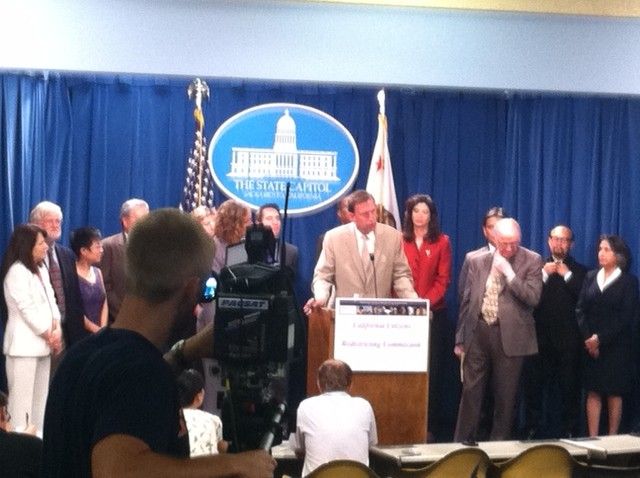
During its press conference Friday announcing the release of redistricting maps, the Citizens Redistricting Commission evaded tough questions and refused to explain why one commissioner, Michael Ward of Fullerton, voted earlier in the day against moving all of the final maps to the public for review.

At the podium, Ward declined to explain his vote, but in a short interview with CalWatchdog afterwards said that he had explained his concerns at the appropriate time earlier in the day and was not sure about the legal ramifications of his sharing his concerns. According to published reports, Ward said “I’m sad to find myself compelled to vote no. In my opinion, the commission failed to fulfill its mandate to strictly apply constitutional criteria and consistently applied race and ‘community of interest’ criteria and sought to diminish dissenting viewpoints.”

Ward made it clear to CalWatchdog that he stands by such concerns and is waiting to see how the process proceeds. The commission will vote to adopt what they call “preliminary final maps” in an Aug. 15 meeting. Other commissioners who spoke said that the commission has exhausted its public review process and will indeed vote to approve the new district lines for U.S. Congress, state Senate, Assembly and Board of Equalization.

As the commission explains on its Web site, “In November 2008, California voters authorized the creation of the Citizens Redistricting Commission when they passed the Voters FIRST Act, which appeared as Proposition 11. Prior to 2008, California legislators drew the districts.” The goal was to take partisanship out of the redistricting process, yet the new commissioners have been dogged by allegations of inappropriate political activism and conflicts of interest.

An exclusive CalWatchdog series by reporter John Hrabe “reveals that at least one commissioner, Dr. Gabino T. Aguirre, has made multiple political campaign contributions to Democratic candidates — contributions that were previously undisclosed to the Commission; a long history of political activism in support of Latino causes; and an extensive web of connections to a special interest group that has submitted its own redistricting proposals to the commission.”

Hrabe also revealed that “a second member … ,  Jeanne Raya, failed to disclose financial contributions made within the past 18 months to a state political campaign committee . …” Somehow, a commission designed to be nonpartisan and charged with designing fair election districts, allowed left-wing political activists with an apparent political agenda to be among its members and to allegedly use the process to create districts that favor their political outlooks.

Based on the CalWatchdog revelations, California Republican Party Chairman Tom Del Beccaro called on Aguirre to resign from the post for what he termed “gross misconduct in office.” Del Beccaro questioned the fairness of a commission that failed to disclose the political activism of its members.

When one reported asked about allegations of impropriety by Aguirre, Galambos Malloy said, “All of our commissioners have conducted themselves with the utmost integrity and impartiality.” They did not address any of the specific concerns raised by the news reports and by the Republican leadership.

The commission also has been criticized by minority activist groups for not putting together enough Latino-dominant districts and not paying sufficient attention to African-American “communities of interest,” even though the commission must legally follow the federal Voting Rights Act, which dictates rules that enhance minority voting power.

At the press conference, commissioners refused to answer tough questions and focused mainly on their own sacrifices. “If anything was sacrificed in the process, it was our personal lives,” said Michelle DiGuilio of Stockton, referring to the long hours and the time spent away from her children. Vincent Barabba of Santa Cruz added that the rewards were worth the sacrifice and told a touching story about the way that Californians have embraced their diversity.

But when it came to questions about dissent, they kept repeating the mantra about this being an open and transparent process. It seemed more like a photo op than an opportunity to provide details about the inner workings of a commission that has much to say about the future politics of this state.

Jon Fleischman, publisher of the conservative Flashreport, argued Friday morning that the “The commission is likely to spend a good portion of today patting themselves on the back for a job well done. They certainly do deserve credit for spending as much time as they did on this project over the past eight months . …  However, the process was not a smooth one at all.” Fleischman points to self-interested agendas of commission members, unclear handling of Voting Rights Act rules and cast doubts on the much-touted openness of the process.

Commissioners seem to be gearing up for legal challenges and public scrutiny, and those surely will come in the ensuing weeks. Barabba argued that if the lines are that bad, then Californians can challenge them through the state Supreme Court or can launch a referendum drive. Those challenges surely are coming, and it will be interesting to hear what Ward has to say as redistricting critics get into gear.


This was originally posted and investigated by our friends over at CalWatchdog.