UCI Students Blow Taxpayer Dollars on DREAM Act Lobbying

The Associated Students of UC Irvine, a student government entity that acts almost like a massive, bloated vestige of the College Democrats, has taken an official stance in support of the DREAM Act. Yes, that’s right: a supposedly representative student government that is supposed to deal with projects such as new construction or improving students’ experiences is focused on lobbying for the controversial transfer of taxpayer dollars. ASUCI is its own completely politicized entity, and it should be of concern to students and CA taxpayers that considerable time and money is being spent on supporting and promoting blue legislation. It is unnerving to know that student government can act as a catalyst for a singular agenda and consequently, become vulnerable to misrepresenting the true interests of its student body.

A successful country is built upon the understanding that those who enter the boundaries of civil society (those who choose to leave the “savage state”) are tacitly agreeing to the concept that members can reap its benefits if they agree to follow the rules and laws that bind society together. It’s not a concept beyond the realm of common sense; if you benefit from a society, you agree to be a part of it—legally, that is.

What’s most shocking is that those who illegally enter the great society that is America still believe that they’re entitled to the same benefits as those who are legal and actual citizens. What would a country be if there weren’t a mutually beneficial and symbiotic relationship between that country and its people? The answer is quite simple: it would be an ineffective and unstable entity without the ability to sustain itself. It’s a matter of give and take—you can grab all the fruits, but the catch is that you’re supposed to go make pies (or jam, or juice, or something) with them and return that back to society in the form of capital exchange. Or better yet, you can start a little fruit pie business and hire workers. In this case, you’ll be creating jobs and creating revenue for the society you benefited from.

The argument that we must provide for illegal aliens so they do not become the uneducated and inefficient burden of society is unfounded—they become a burden to society the minute the step foot into it without agreeing to legally be a part of it. They are automatically become liabilities to society when they hinder the availability of resources for the citizens who pay and give to the country they live in. To say that everyone deserves a chance to find success in America is idealistic, but unrealistic. There are millions of legal immigrants in America who migrated through great hardship and experienced tragedies in hopes of finding new opportunities for themselves and their families. Our country is not unfamiliar with the tale of the foreigner yearning to accomplish the American dream. I am sympathetic to this tale—as I’m sure anyone else could understand a person’s longing for a better life. But there are consequences to breaking the law, no matter how good the intentions that lined that pathway were in the beginning. The end does not justify the means—history has told us that.

So what’s left of the American Dream when we are given the scenario of illegal aliens being granted the opportunity to freely take much of what legal citizens pay for, but have the ability to leave and give nothing back in return? – The California Dream Act of 2011, Part II. We’re talking about rewarding criminal behavior and creating a magnet for more illegal interest to be invested in America’s great society. Because of the current magnitude and depth of this problem, we can no longer linger around an indecisive position on education rights as a repercussion of illegality. Education has never been a constitutional or inalienable right; to make education a right for individuals who aren’t even here legally is beyond constitutional protection.

It’s puzzling for a student government entity like ASUCI to blatantly ignore the ethics of bipartisanship by promoting certain pieces of legislation that are so controversial. It’s even more bewildering that ASUCI would support this piece of legislation. In the midst of such a terrible financial crisis, we need to protect what little funds are directed towards the UC education system. UCI is essentially dedicating student tuition and state funds to advance legislation that is both detrimental and injurious to our education system and the state we live in. UCI students and CA residents alike would be better served if ASUCI removed its deeply rooted nose out of politics and blue legislation.

Facebook IPO to Enrich State Treasury

California’s budget is described as being on a rollercoaster the last decade-plus streaming to great heights when the economy is good and bottoming out with a rush when the economy dips. There was no better expression of the California budget rollercoaster ride than this week when we went from the low of the state controller telling us Tuesday that the state would run out of cash by March to the giddy response from state officials yesterday that the Facebook Initial Public Offering could flood the treasury with as much as a billion dollars.

Let’s not get ahead of ourselves.

There is no certainty when or how much the IPO will bring in. Building budgets around an anticipated flood of revenue could put the state in the same fix as the current budget that was balanced on a supposedly miraculous new $4 billion in revenue that did not appear.

Depending on the date the newly minted millionaires from the IPO decide to sell stock will determine when the state gets its share. Factors such as whether federal income tax rates expire or if the voters increase state income tax rates could well influence the actions of the Facebook beneficiaries.

For example, if the governor’s temporary tax increase passes, some of the young new millionaires who work for Facebook might decide to wait out the five years and avoid the higher tax rate. Facebook founder Mark Zuckerberg is only 27 years old and many of the young people who work for him might decide they can afford to wait for the higher tax rate to expire and reap a larger benefit.

The real debate within the state is what to do with the new money once it arrives.

Republican legislative leaders say spend it on education to avoid potential cuts the governor is threatening if his tax proposal fails at the polls. Democratic politicians want to stall cuts to social welfare or use revenue to reduce debt.

What the state should not do is follow the example of legislative actions during the dot com boom a decade ago. No massive spending on on-going programs or creating new programs. Gushing revenues were used to build up state spending that could not be sustained.

The so-called “Facebook Effect” on the state budget is a good thing if managed well. It speaks to allowing a growing economy to fill in state budget needs and argues for encouraging a business environment for entrepreneurs to thrive, benefiting the state treasury in the long run.

Given the history of legislative actions when money unexpectedly flows into the treasury, this episode reminds us it would be wise to have a strong law in place that directs unexpected revenue to debt reduction and a rainy day fund to take the state’s budget off the rollercoaster.

(Joel Fox is the Editor of Fox & Hounds and President of the Small Business Action Committee. Originally posted on Fox & Hounds.)

Your Tax Dollars Needed for Extravagant Public Payroll

Controller John Chiang says California will run out of cash in March without an increase in borrowing and a delay in some payments. This must be music to Jerry Brown’s ears because he can say that his $7 billion tax increase, targeted for the November ballot, is essential to keep the state in the black.

The governor’s approach to getting what he wants is to frighten the public with predictions of the “end of days” if he is unable to get his hands on a massive infusion of taxpayer cash. His message to taxpayers: Pay up or schools and popular services will be slashed.

While Chiang has legitimate concerns, the shortage is the direct result of actions by the usual suspects. The governor and the Legislature “cooked the books” when approving last year’s budget. Because they wanted to spend more than would be realistically available in the 2011-12 fiscal year, they included an additional $4 billion in fantasy income to balance the budget.

If there is a shortage this year, it is not due to unforeseeable circumstances, but rather to a conscious decision by the Sacramento politicians to overspend. They must have hoped that no one will have noticed or remembered their malfeasance by the time the bills come due. Perhaps they thought they could escape blame by paraphrasing Claude Rains in Casablanca: “I’m shocked,shocked to find the books don’t balance!” as they enjoy the political benefits from money already spent.

While nearly every major California newspaper reported the Controller’s warning, few published a closely related story. New Census Bureau statistics confirm that government employees in California continue to be the highest paid in in all 50 states. The monthly average of $5,774 is $1,152 more than the national average, which comes to nearly $14,000 extra each year. Add to this another report showing California government payroll grew by $500 million last year, and one begins to understand why Sacramento is so desperate for more money.

The driving force behind the governor’s tax plan is payroll. The government employee unions, whose support put him in charge in Sacramento, are calling his debt and he is obliged to find ways to continue the high pay, as well as the extraordinary benefits that were not part of the Census Bureau’s calculation.

Last year, Arnold Schwarzenegger’s temporary tax increases ended over the militant objections of the current governor and the tax-and-spend lobby in the Legislature. Without the additional tax burden, indications are the state is beginning a fragile economic recovery. Still, the big spenders seem unclear on the concept that an improving economy, not a tax hike, is the best way to provide additional government revenue. However, if they persist in pursuing tax increases, they are about to learn that average taxpayers will not be receptive to paying more so that government employees can count on high pay, lavish benefits and job security that most in the private sector can only dream of.

(Jon Coupal is president of the Howard Jarvis Taxpayers Association -– California’s largest grass-roots taxpayer organization dedicated to the protection of Proposition 13 and the advancement of taxpayers’ rights. Originally posted on HJTA.)

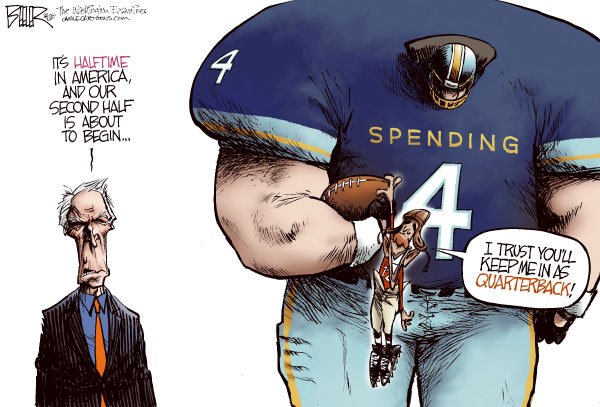
Halftime in America: things don’t look good for the home team

Forget the Super Bowl, Clint Eastwood announced it’s halftime in America, a game where far more is at stake than the matchup between the Giants and the Patriots. But then again, maybe America’s game is the real matchup between the Giants and the Patriots. The Giants being those behemoths our government deemed too big to fail and the Patriots being taxpayers who were forced to bail them out. And I hate to say it folks, but it looks like the Giants are winning this game, too.

The symbolism of Eastwood’s halftime commercial is ironically appropriate. The nearly 82 year old actor is a pale facsimile of his former self, not unlike Chrysler, which was on its way to the salvage yard until the government declared that it was the taxpayer’s responsibility to put them on life support. Hey, it’s halftime in America and we provide cradle-to-grave coverage for everything and everybody. As Yakov Smirnoff would say, “What a country!”

White House spokesman Dan Pfeiffer tweeted, “Saving the American Auto Industry: Something Eminem and Clint Eastwood can agree on.” While you’re trying to get that picture out of your mind let’s not forget about the real halftime star, Madonna. Why, at 53 she’s a mere youngster compared to Clint. Madonna and Clint — it’s morning in America!

Super Bowl halftime was a lot like halftime in America — a combination of no substance, minimal talent but great marketing. And when you thought the hormone hoedown couldn’t get any weirder, British singer M.I.A. gave us the finger! That’s right, a foreigner flipped us off on the hallowed ground of the Super Bowl playing field — and we paid her to do it. I’ll bet that was Mahmoud Ahmadinejad’s favorite play of the game.

Clint Eastwood failed to give us the real score at halftime in Motor City so I will. The Congressional Budget Office estimates that by the time the bailout is completely wrapped up taxpayers will have lost only $14 billion. The Treasury Department considers the auto bailout a success because the industry has recently shown signs of a recovery. General Motors stock is down 25% since January.

$1.3 billion will not be recovered from bankrupt Chrysler, but Tim Massad, Treasury assistant secretary for financial stability still called this a “major accomplishment.” A foreign company, Fiat, now owns a 53.5% stake in the company. This is the company that sponsored the halftime in America commercial and we paid for it.

The second half of the halftime in America commercial talked about winning and Clint told us, “Detroit’s showing us how it can be done.” This, sports fans, is what’s so sad. This is Washington’s idea of winning.

I’m not sure you’ll want to stay tuned for the second half. It doesn’t look good for the Patriots.

(Jim Whitt is a noted speaker, consultant, author, and unapologetic people provoker.  Visit his blog at Purpose Unlimited.)

California’s Deficit is Biggest in Nation

A recent Rasmussen Report found that sixty-eight percent of voters view Congress’ job performance as poor. Failure in the eyes of the public doesn’t belong only to federal representatives. Many state legislatures face equally dismal public approval ratings. In California, the Legislature’s approval rating is just twenty-two percent. At the end of 2011, Hawaii Governor Neil Abercrombie earned the dubious distinction of the worst job approval rating among governors at just thirty percent. Oppositely, a majority of Garden State voters approve of the job performance of New Jersey Governor Chris Christie. In a recent poll, Christie’s job approval rating is fifty-three percent, and has not dipped below fifty percent since August 2011.

California, Hawaii and New Jersey have diverse approval ratings, yet the three states have one commonality: debt. In a recent State Budget Solutions study, California, Hawaii and New Jersey are among states in the worst fiscal situation. The study examines how total state debt is affected by state size, including population, among other factors. However, the study does not include analysis regarding the Constitutional limitations that each state developed to limit their respective debts.

The approval ratings in these three states may drop further if each constituency knew that Constitutional violations are being overlooked. Why would a state go to the trouble of amending its Constitution to limit spending powers if the legislature cannot assure citizens that spending will, in actuality, be limited?

Looking deeper into California, the Golden State places first among the states with the largest total deficits with $117,747,412 in outstanding debt. According to the American Enterprise Institute (AEI) data, the economic outlook ranking of California is just 47th out of the 50 states, indicating dismal future economic performance. Interestingly, the California Constitution is one of the longest in the world. The length is attributed to a number of factors, among them, a lack of faith in elected officials. The California Constitution includes individual rights that are broader than in the federal Bill of Rights, suggesting that Californians placed a lot of emphasis on protecting individual liberties and ensuring the government does not have an undue influence on the people.

The California Constitution specifically addresses debt in Article 16, Section 1. Here, the Constitution states, in part:

The Legislature shall not, in any manner create any debt or debts […] which shall, singly or in the aggregate with any previous debts or liabilities, exceed the sum of three hundred thousand dollars ($300,000), except in case of war to repel invasion or suppress insurrection, unless the same shall be authorized by law for some single object or work to be distinctly specified therein which law shall provide ways and means […]. [Emphasis added].

Unless California is at war or suppressing an insurrection unbeknownst to Californians and Americans alike, the California legislature is violating their own Constitution. An additional breakdown of the subsections of the study, including the definitions of “accumulated state budget deficit,” “single object or work,” as well as bond allowances may offer some Constitutional cushion, but the intent of the provision is clear: limiting the legislature from accumulating excessive debt.

Historically, the California legislature has spent in excess of 100% of its revenue for nineteen of thirty-six years since 1976. Not only does this overspending violate the Constitution, it depleted the Budget Stabilization Account (Proposition 58). Since constitutional debt limitations do not apparently suffice, voters approved the Budget Stabilization Account (BSA) in March 2004 to require the State Controller to transfer a specific percentage of estimated General Fund revenues from the General Fund to the BSA. Theoretically, the proposition was meant to help balance the budget.

However, since FY2008-09, the Governor has issued an executive order each year tosuspend the transfer to the Budget Stabilization Account. Strategically, in the 2012-13 Governor’s Budget, the expenditures from the account are labeled “Proposition 98 Expenditures,” while the empty transfer line item is labeled “Budget Stabilization Account.” Despite overwhelming public support to limit the debt California is rapidly racking up, it seems that the appropriators are happy to suspend efforts attempting to accomplish that end and will even use labeling techniques to help cover up these efforts.

Even more alarming, Governor Jerry Brown proposed in January that the state plug $5.4 billion of deficit by borrowing from other internal state funds, shifting property tax revenues from redevelopment agencies to counties and taking money from voter-approved funds for services for mentally ill and for young children.

So, how can Californians reconcile excessive spending with the violation of the Constitution and a voter-approved proposition meant to curb spending? It is readily apparent that tricky budgeting and below-the-radar executive orders indicate that the provisions mean little to California lawmakers. Lawmakers in the Golden State should follow the provisions in the state Constitution, the highest law of the state, and both address California’s massive deficit and create more responsible budgets in the future.

(Bob Williams is the President of State Budget Solutions; Kristen De Pena is an Associate Writer for Sunshine Review and State Budget Solutions. Originally posted on Fox & Hounds.)

Gingrich’s #1 Supporter, Sheldon Adelson

Las Vegas has always been a strange admixture of probity and sin, a place of unlikely couplings.  The city was founded by Mafia muscle and Mormon money.  Corporations may have replaced crooked noses, but otherwise, nothing’s changed.  And of all places, Vegas, city of strange bedfellows, offers the key to why the Republican nominating process could drag on for months.

The only reason Newt Gingrich is still running for President, instead of offering his services to yet another government agency as a 7-figure “historian,” is because of the financial backing of a Vegas casino magnate, Sheldon Adelson.

Adelson and his wife have contributed at least $10 million to PACs supporting Gingrich in recent months, and that money kept Gingrich from fading into obscurity in both South Carolina and Florida.  You could make the case that Gingrich, an ethically challenged politician, and Adelson, a highly respected and successful businessman and philanthropist, make an odd couple.   And you would be right.

Adelson is a pragmatist who built his businesses the old-fashioned way:  with hard work, brilliance, and a competitive spirit.  Gingrich is…well, Gingrich.  A guy who spews out random thought masquerading as ideas with the regularity of a silver ball on one of Adelson’s roulette wheels.

If Adelson employed someone as undisciplined, unethical, and unreliable as Gingrich, the relationship wouldn’t last very long.  Yet he is showering the former Speaker with cash, to prolong a nominating season that could leave Romney weakened and the Republican Party divided while the Democrats wait, rested and ready, for the fall campaign.

How ironic that Adelson, no fan of labor unions, is donating serious cash to a candidate whose continuing presence actually benefits the Democrats and their labor union supporters.  Where’s Adelson’s pragmatism now?  Reports indicate that if Romney wins, Adelson will contribute big time to him as well.  But why wait?  Why let Gingrich bloody Romney for months, only to pick Romney up off the mat and hope that what’s left of him can somehow beat Obama?

But the real odd couple isn’t Gingrich and Adelson.  It’s actually Gingrich and the conservative wing of the Republican Party.  My conservative credentials are impeccable:  I campaigned door-to-door for President Richard Nixon’s reelection back in 1972, when I was 14.  But none of the Republican Presidents of the last forty years, from Nixon to Ford to Reagan to either Bush, could get nominated today.  And if they did, they would lack the support of the myopic conservative side of the party, which seems more interested in administering loyalty oaths to candidates than actually winning a general election.

Why does the right love Gingrich?  He doesn’t share their family values, unless starting two new families while you’re still technically part of a previous family doesn’t matter.  He doesn’t share their ethical values, unless the conservatives can somehow overlook a $300,000 fine for ethical violations.  And he certainly doesn’t share their commitment to honesty, claiming that he received $1.6 million for services as a “historian” when he could have told the truth:  he was just another lobbyist.

I’m not here to debate whether Ronald Reagan thought Newt Gingrich was the greatest Congressman he’d ever met or three ham sandwiches short of a picnic.  I just don’t understand why the right would swoon over a guy they wouldn’t want to sit next to in church.

Let’s face it:  Mitt Romney is a tough candidate to warm up to.  It’s like rooting for the Yankees if the Yankees had bought ten other major league teams, cherrypicked the best players, fired the rest, and then shuttered the stadiums and put all the ushers on employment.  New debate coach or not, the only time he opens his mouth is to change feet.  And I find myself personally offended by his hair.

But the guy can beat Obama.  Doesn’t that count for anything?

Conservatives today are a little bit drunk with power.  They haven’t met an oath they don’t like, whether it has to do with abortion, raising taxes, repealing healthcare, or getting out of Afghanistan.  The result is that they are forgetting the real goal.  It’s not about putting into office some mythical Republican Paul Bunyan who will swing his mighty axe on Day One, overturn Roe v. Wade, shut down the Fed, get us out of the United Nations, and make LeBron James go back and play for Cleveland.

It’s about rallying behind a candidate who can win.

Not about voting for, or writing large checks to, candidates who can’t.

Newt Gingrich has better hair than Mitt Romney.  He’s faster on his feet.  He doesn’t say dumb stuff.  But he’s a loser.

Enough with these odd couplings of candidate, donors, and a base that thinks every registered voter in America listens to Rush Limbaugh.   The sooner that conservative Republicans stop holding their noses and overlooking Newt’s flaws – of which the main one is his utter unelectability – and the sooner the Sheldon Adelsons of the world put away their checkbooks and stop trying to stop Romney, the sooner the Republicans can do the real work of defeating Obama.

And there’s nothing odd about that.

(New York Times best selling author Michael Levin runs BusinessGhost.com, America’s leading provider of ghostwritten business books.)

Food Stamp Junk Food Bans Miss The Real Problem

In the past year, legislation has been introduced in Washington and half a dozen states to further restrict the use of food stamp benefits (renamed SNAP–Supplemental Nutrition Assistance Program–benefits).  Florida is the latest (joining California, Texas, Illinois, Oregon and Vermont), where a bill to ban purchases of “non-staple, unhealthy foods” (whose author cited potato chips, cookies and sodas) with SNAP benefits just passed one committee vote.

Unfortunately, preventing substantial diversions of aid funds from donors’ intended purposes to others that recipients choose is virtually impossible.  Every government transfer program allows resources given for one purpose to have far different effects than intended.  Not just food stamps, but other in-kind transfer programs, cash aid, municipal bond issues, lottery funds for education, humanitarian foreign aid, and more.  In each case, earmarked expenditures replace dollars that would have been spent in the same areas, freeing them to be spent however recipients choose.

SNAP benefits are equivalent to a cash transfer for almost all recipients, because the vast majority would purchase more food than their benefit allotments. The benefits simply replace money recipients would have spent on food anyway, freeing that cash to use as they wish.  That remains true for food purchases that would remain eligible after the new restrictions.  For example, if a low-income family would have spent $300 on “healthy” food and $100 on “junk” food, $150 in SNAP benefits can be used to replace “healthy” purchases that would have been made with cash, and would place no restriction on purchases of “junk,” or anything else, for that matter.  That is, the resources go where the recipients want, not where the latest “reform” tries to dictate.  All that will be added are fights over what is restricted (e.g., diet soda has far fewer calories than orange juice), more complicated rules and higher administrative costs.

The same issue faces other in-kind programs as well, such as housing and winter heating subsidies.  To the extent subsidies replace money that would have spent on those items, earmarked funds are diverted to whatever uses recipients select.  This expands bureaucracies, but does not, in fact, control recipients’ use of funds.

Similar problems haunt bond measures to fund particular government spending programs, as for schools.  Diversions of such funds to uses different than those advertised have been so common that citizen oversight boards are now created (with limited effect) to convince voters of public agency trustworthiness to get bond issues passed.

Other examples include state lotteries promoted to supplement education funds. Politicians, taking into account those additional funds, pare other budgetary support for education. The dollars released are then spent however the state government decides, just as if the lottery proceeds went directly into its general fund.  As professors Patrick Pierce and Don Miller concluded in a study of education funding, “Regardless of the state, the educational spending rate declined once a state lottery went into operation.”

The same sort of diversions can hobble the effectiveness of humanitarian foreign aid.  The aid frees up resources otherwise required to buy such supplies, allowing them to be spent wherever the recipient government chooses.  As a result, much is lost to corruption or converted to other uses, including military spending, often used by recipient governments to terrorize those the aid was intended to help or to threaten neighboring countries.

With so many government assistance programs’ goals dramatically undermined by diverted resources, one wonders why relatively small diversions of SNAP benefits to “junk” food can create headlines, but much larger diversions elsewhere get little notice.  Perhaps only those diversions that become infamous enough to threaten public support are addressed, while many others are ignored, to maintain the illusion that government programs are more effective in achieving their goals than they are in fact.

(Gary Galles is a Professor of Economics at Pepperdine University.)

The Wealth of Our Nation

This week Hillsdale College held a symposium on Adam Smith. Four days of intellectual stimulation and a chance to reflect on the wisdom of what most would call the first economist.

Smith recognized that people coming together to trade among themselves would result in an increase in living standards for all. He noted that the role of government was limited (as was declared by America’s Founders). It’s fitting that Smith’s An Inquiry Into the Nature and Causes of the Wealth of Nationswas published the same year that the Declaration of Independence was signed.

Smith’s other published book, The Theory of Moral Sentiments, is less well known – but it was well read in his time and went through six editions. A powerful work, it lays out his observations of human behavior and an understanding of how and why certain customs lead to greater social harmony. For example, a society in which we can interact with one another peaceably to our own benefit requires a sense of propriety. Smith teaches that traditions are important – and a foundation of conservative thought from Edmund Burke to Russell Kirk.

But “Wealth of Nations” is his most famous work.

“Wealth of Nations” is one of those great books that everyone has heard of but few have read. It was a delight to spend time at Hillsdale with people who had not only read Smith – but had studied him. American would benefit if every legislator read Smith.

The book was an analysis of why parts of the world were mired in abject poverty while Britain enjoyed “opulence.”

“Yet it may be true, perhaps, that the accommodation of an European prince does not always so much exceed that of an industrious and frugal peasant, as the accommodation of the latter exceeds that of many an African king,” notes Smith.

This is an important point for two reasons. First, emerging market capitalism had made the lowest social order in Europe wealthier than the wealthiest of those in societies based on central planning. This is even truer today.

Look at the top 25 percent of countries in the Fraser Institute’s Economic Freedom of the World Index, and you’ll find that the per capita income of the bottom 10 percent is $8,735. Look at the lowest 25 percent and the per capita income of the bottom 10 percent is barely above $1,000.

Secondly, the gap between the richest and poorest in the United States and other market capitalist states is not as large class warriors would have us believe. I tell my students that the difference between their life style and that of Bill Gates is not that great. Like Gates, they live in a house with indoor plumbing and air conditioning (80 percent of all poor households in the US have air conditioning) though his may be bigger. Like Gates, they have a car (three-quarters of all Americas’ poor have their own car) though his may be nicer. Like Gates, they can fly to California though he may have a private jet. Like Gates, they probably eat what he eats, and so on. Basically, they live a similar life.

Now compare their life to someone living in a refugee camp in Somalia. That is a stark contrast. In this time of Occupy Wall Street rage Smith’s observation is worth repeating.

Adam Smith told us what we need in order to achieve this wealth for all, including the “industrious peasant.”

“Little else is requisite to carry a state to the highest degree of opulence from the lowest barbarism but peace, easy taxes, and a tolerable administration of justice: all the rest being brought about by the natural course of things,” he wrote.

Our federal government has grown far beyond this to the point where it regulates our daily life from how much water our toilet may flush to what kind of car we may drive. The massive health care and financial regulation bills of the Obama administration do not fit Adam Smith’s prescription for an opulent society. Perhaps in 2012 we will return to the philosophy that brought us the wealth of our nation.

(Dr. Gary L. Wolfram is the William E. Simon Professor in Economics and Public Policy at Hillsdale College. Originally posted on The Detroit News.)

Think Long Comes Up Short: Report calls for higher taxes in CA

California’s ongoing budgetary and political dysfunction has spawned a host of reformers backed by wealthy donors. The latest scheme, released with much fanfare in late November, is a report produced by the Think Long Committee for California and funded by billionaire Nicolas Berggruen. It’s called A Blueprint to Renew California, and it leaves much to be desired.

Most of Think Long’s proposals—the creation of a “citizens’ accountability committee,” additional spending on infrastructure and education, streamlining the environmental-permitting process—are window dressing for the main one: a $10 billion tax increase, imposed through a ballot initiative that would go before voters in 2012. And then, after it gets voters to sign off on the tax hike, the committee (like many in California’s majority party) wants to rein in the voter-initiative process. Berggruen and Think Long believe that the key to renewing California is to raise taxes on almost all Californians. Their plan would make the state’s tax code less progressive by trimming the corporate tax rate and imposing a new sales tax on services. The goal: to provide still more revenue to a state government that’s already bloated and wasteful.

Think Long released its utterly conventional recommendations with a burst of self-congratulation: “At a time when political leaders in both Sacramento and Washington seem hopelessly mired in gridlock, the committee has shown that difficult bipartisan compromise can be reached if politics is set aside and the public interest is put first.” These words might be more persuasive if Think Long weren’t composed of so many politicians who wielded power during the period when California’s budgetary problems became unmanageable. The committee’s members include former governor Gray Davis, bounced from office in the 2003 recall election; former assembly speakers Bob Hertzberg of Los Angeles and Willie Brown of San Francisco; and former state supreme court chief justice Ron George. Other advisors include former governor Arnold Schwarzenegger, current lieutenant governor Gavin Newsom, and Los Angeles mayor Antonio Villaraigosa. Most of these are poster children for what’s wrong with California; they are an unlikely group of saviors.

The report ignores the Golden State’s real problems: excessive government spending and dominance by public-sector unions and other special interests. The closest that Think Long comes to acknowledging them is three perfunctory paragraphs at the report’s end, which cite the pension crisis crushing municipal governments and offer this solution: “We recommend that the governor, legislature and local government officials make it the highest priority to work with public employee unions to find ways to address the long-term costs of pensions and the unfunded liabilities that have already been built up.” That’s as far as it goes.

Nothing in the report comes close to articulating major reforms that would help the state stretch its dollars. For instance, the nonpartisan Legislative Analyst’s Office recently reported that the cost of incarcerating inmates in California has more than doubled over the past decade, the result not only of court decisions regarding inmates’ health care but also of escalating compensation costs for correctional officers. A braver committee would have considered prison privatization or constraining the influence of the noxious California Correctional Peace Officers’ Association, which resists even modest reforms and holds outsize influence over both parties.

Even soft-pedaling, Think Long provoked the ire of the California Teachers Association. The CTA resents the committee’s proposal to junk Proposition 98—which directs 40 percent of the state’s budget to education from kindergarten through community college—even though the report goes on to propose an extra $5 billion for the schools from other sources.

Every would-be reformer knows that something is wrong with California’s budget and political process. But most have tended to be left of center and have offered ceremonial, symbolic reforms that don’t get to the heart of the state’s problems. Think Long is the latest example, and its “blueprint,” like the work of its many predecessors, is likely to be soon forgotten.

(Steven Greenhut is director of the Pacific Research Institute’s Journalism Center, editor in chief of CalWatchdog.com, and a columnist for the Orange County Register. This story was first posted on City Journal.)

CA Budget Crisis May Torpedo Tax Increase Initiative

State Controller John shocked California legislators when he sent a letter announcing that the State will run out of cash on March 8th without the legislature agreeing to allow the State Treasurer to delay $2.4 billion in payments to universities, counties and Medi-Cal, plus borrowing another $3.3 billion from Wall Street bankers.

The Controller’s announcement comes just two weeks after California Gov. Jerry Brown gave his State of the State speech to the combines Legislature, then immediately hit the road in a two- day campaign swing through Southern California to tout his November ballot initiative to raise taxes on all Californians. At a stop with 50 of Orange County’s top business leaders and CEOs, the Governor outlined how he was already making severe budget cuts, reorganizing state government, and implementing a 12-point pension reform plan. Brown said he offered these actions as credibility before asking business to support his November tax initiative. The Governor added that he welcomed California’s future population growth and assured his audience that the State’s future is bright. Brown reiterated his support for the nation’s first high- speed rail system and for expeditious completion of the environmental review on a proposed project to fix the state’s water delivery system that has devastated Central California farmers.

California lawmakers had been assured by the Brown Administration’s Department of Finance that the State had sufficient cash reserves through the end of the State’s June 30th fiscal year. But Controller Chaing warned that for the first six months of the fiscal year state tax revenues came in at $2.6 billion below budget and spending came in at $2.6 billion over budget. The Controller’s announcement came on the same day that the Assembly budget committee approved and sent to the floor legislation already approved by the State Senate that would supposedly fund the State until the end of the year by empowering the Treasurer to borrow $865 million from other segregated California Trust funds.

Controller Chaing warned that the State would be unable to make timely payments to vendors and other governmental agencies of at least $730 million beginning on March 8th and would be short billions of dollars more through at least April 13th. Furthermore, Chaing warned the State needed to restore at least a $2.5 billion reserve to handle the timing of large payments through the end of June. Although the Sacramento Bee quoted Democratic Assemblyman Bob Blumenfield of Woodland Hills that the $5.4 billion shortfall was small relative to the $10 billion state leaders were prepared to borrow last year, Republicans questioned the ability of the state pay back the accounts. The Bee reported that Michael Cohen, chief deputy director of Brown’s Department of Finance, said the state would pay back special funds whenever programs need the money to operate. Cohen also said the state is spending more money than expected because courts have blocked some cuts, while some savings may come later in the fiscal year than forecasters predicted.

This new budget crisis comes at a very difficult time for the Governor after he travelled the state selling his tax initiative as necessary to prevent draconian funding cuts to popular K-12 schools. Early polling had indicated support was growing for the initiative. But if voters learn the November initiative if passed would only fund this year’s budget losses and still result in draconian cuts to schools, support for the tax increase may collapse.

(Chriss Street is a financial writer and speaker, and is author of the book, “The Third Way.”  Visit his blog for more information.)