Teacher’s Union Victimizes Our Kids for Sake of Money and Power

In perhaps the most in-depth study on the subject to date, three Ivy League economists studied how much the quality of individual teachers matters to their students over the long term. The paper, by Raj Chetty and John N. Friedman of Harvard and Jonah E. Rockoff of Columbia, tracked 2.5 million students over 20 years, and using a value added approach, found that teachers who help students raise their standardized test scores have a lasting positive effect on those students’ lives beyond academics, including lower teenage-pregnancy rates, greater college matriculation and higher adult earnings. (The authors of the study define “value added” as the average test-score gain for a teacher’s students “…adjusted for differences across classrooms in student characteristics such as prior scores.”)

The only caveat from the authors is that using test scores in teachers’ evaluations could lead to “teaching to the test or cheating.” Nothing new here. Some people, when involved in any kind of competition, will try to gain unfair advantage or cheat outright. Typically, it’s a small part of the population and those who do should lose their jobs and face criminal charges.

The lesson is clear: test scores can give us a great deal of information about who the really good teachers are. But California Governor Jerry Brown, unfazed by the blockbuster study, actually called for less testing in his recent State of the State address.

No, Governor. In fact, we need more testing. In California, English and math are tested yearly starting in second grade. But history and science are tested only every few years. Tests should be given in the four core areas every year. As a former American history teacher, I could never figure out why there was no 6th or 7th grade history test. Why wait for grade 8 and throw in a few questions from the 6th and 7th grade curriculum? Never made any sense to me.

Senior Director of Education Studies at the Pacific Research Lance Izumi wrote in the Orange County Register last week,

“Brown’s education agenda contains a mishmash of proposals, some of which are steps backward and some that are mildly positive. On the clearly negative end, the governor, who has never been a fan of student testing, wants to reduce the number of tests and increase so-called ‘qualitative assessments.’ Trouble is, the reason tests are important is because they offer objective quantifiable data to measure student progress and the effect of teachers and schools on learning.”

While Jerry Brown’s call for less testing is wrongheaded, it isn’t surprising. Testing as a tool of assessing student progress has been around since Day 1, but using student test scores as a measure of teacher effectiveness has caused a backlash in some quarters. There is subset of teachers who laments that there is “more to teaching than just test scores.” And of course they are right, to a point, but they take their case to an extreme and dismiss testing completely. The ringleaders of the anti-testing zealots are the teachers unions, and their agenda has nothing to do with kids or their education. The California Teachers Association, by far the biggest political spender in the state, is about power and ensuring that the disastrous status quo is not disturbed.

Actually, teachers unions operate under the early 20th Century industrial mentality which stipulates that everyone can stick a widget on a car equally as well. Therefore, all widget stickers are equally good and all widget stickers should make the same amount of money. Substitute education for widget,teachers for widget stickers and students for cars, and you fully understand the teachers union model. Once this antiquated notion is truly grasped, the unions may find themselves in trouble, forced to acknowledge that some teachers are better than others, and that some are so bad that they shouldn’t be in the classroom at all. Once that is accepted as truth, better teachers might demand to be paid more than mediocre ones. And the good ones may not be so compliant if they’re the ones who get laid off instead of an inferior teacher who has been on the job longer. Thus, the whole concept of teachers as interchangeable industrial workers starts to unravel. And what could be worse for a group whose main lot in life is to keep acquiring buckets of money and enormous power being exposed as pushing a model that never should have been applied to the teaching profession in the first place?

The good news is that much of the rest of the country is catching on. Teacher quality has become a major topic of discussion with educators, the media and politicians of late. From Oklahoma to New York to Louisiana to New Jersey, states are getting serious about teacher evaluation, all using the results of standardized test scores as a significant part of the equation.

Good teachers matter a lot, and bad teachers can ruin a child’s future. Test scores are very helpful in identifying those teachers and value added methods are good ways to analyze test scores. But California, essentially governed by CTA, their bought-and-paid-for legislature and their man in the governor’s mansion will be the last state to do anything meaningful in this area. That means that one-tenth of the country’s children will continue to be victimized by a cartel that cares a lot about money and power and not a whit about them.

(Larry Sand, a former classroom teacher, is the president of the non-profit California Teachers Empowerment Network. This article was first posted on Union Watch.)

Democrats Fail to Govern California

Governor Jerry Brown and the Democrats in the state legislature are failing to responsibly govern California. State Controller John Chiang said earlier this week that California would need “additional cash management solutions” because state tax revenues are $2.6 billion less than what Governor Jerry Brown and the Democrats assumed in their slapdash budget last year.

This by no means is a surprise.

In November 2010, California voters passed Proposition 25, an amendment to the California Constitution which allows for a simple majority to pass the state’s budget. With that, and the re-election of Brown, the Democrats assumed complete control over California’s budget.  As they say, with great power comes great responsibility. So far, the Democrats have proven themselves incapable of handling the responsibility of a simple majority budget.

California’s impending insolvency is just more fallout from Governor Brown and the Democrats exercising their new powers. The Democrats currently control both the executive and legislative branches of government, but are having some serious trouble managing this on their own.  Instead of trying to engage Republican leaders for ideas, the Democrats simply insist on having only one point of conversation: taxes. Raising taxes on already struggling Californians seems to be the Democrats idea of cooperation.

What’s more interesting is that last week, the Democratic  Speaker of the House John Perez and Senate President Darrell Steinberg sued to block withholding of lawmakers’ paychecks, the people’s recourse for holding lawmakers accountable in return for granting the majority party their simply majority budget power. This week, the Democrats are demonstrating why that lawsuit is so important to them. Contrary to what they would have you believe, the Democrats are only concerned about their pay, and clearly not with the state’s ability to provide services to those who truly need them.

If they were truly concerned, they wouldn’t have put together the “smoke and mirrors” budget that they did last summer – the budget was filled with many political solutions, but nothing to restore confidence in the economy.

So thus far the priorities of the Democrats have been:

  1. Taxes Increases
  2. High Speed Rail
  3. Green Jobs

None of these are priorities for Californians, yet the Democrats continue to insist on them. Californians are beginning to expect this from the Democratic leadership – instead of using their power to bring real reform to California, they’ve decided to pursue their own agenda. I imagine that this November will be a real wake-up call for the Democrats, when they realize that Californians have moved on from supporting the Democrats and their “more-taxes-solves” everything approach to governing California.

(Tom Del Beccaro is the Chairman of the California Republican Party. This story was first posted on Fox & Hounds.)

California Redevelopment Agencies Begin Defaulting

Public officials are scrambling in the wake of the Supreme Court’s decision in California Redevelopment Agency vs. Matosantos to react to their loss of tax-increment financed redevelopment, which served as their piggy-bank under the Community Redevelopment Law for the past 65 years. The California State Legislature and their crony capitalist allies will desperately try to resurrect new tax and economic incentives to reclaim their ability to interfere in the California real estate markets. But barring any last minute emergency legislation, many redevelopment agencies will go into financial distress and be forced to hammer-sale huge amounts of depressed California real estate to avoid default.

Redevelopment agencies have incurred debt to finance “improvements” to private properties in their districts. The primary source financing has been $31 billion of tax-allocation bonds. These bonds were issued to finance property improvements and are to be repaid from hoped for increases from property tax collection if the improvements increase the assessed valuation of the properties. Local cities and counties often provide the start-up capital before bonds are issued.

Given the speculative nature of real estate development, prospectus for redevelopment bonds were loaded with risk factors; including decline in the value of real estate, failure of the project to generate increased tax increment, and changes in California state law. Given also that cities and counties generally dominate and control the redevelopment districts, local politicians would appear to have substantial liability regarding the activities of the districts. Unfortunately, all three risk factors identified in the prospectus have now occurred.

According to Seth Merewitz, Municipal & Redevelopment Law partner at Best Best & Krieger:

“If redevelopment is not reinstated in some fashion by the legislature, then the successor agencies will be charged with meeting enforceable obligations entered into by the redevelopment agency as well as performing many other wind down functions. Moreover, the successor agencies will begin the process of selling off all of the commercial, industrial, residential and even vacant land assets currently held by redevelopment agencies across California. This inventory of property for sale throughout the state will present vast opportunities for investors to

pick up real estate assets and trigger future economic development or add more real estate inventory to a flooded and depressed market.”

Many redevelopment districts now fantasize they can enter into Public-Private Partnerships to maintain their unfinished projects. The concept is that the skills and assets of public and private sector can be shared to deliver facilities for the use of the general public. Unfortunately, crony developers usually acquired properties in redevelopment districts with small down payments and relied on the district to sell unsecured tax-free bonds at interest rates of 4-5% to finance 100% of their property improvements. If the projects succeed, developers made huge profits and the bondholders got paid in full. But if projects failed, developers simply turned the properties over to their secured lender, thus leaving the unsecured bondholders and the district at huge risk.

Once upon a time, banks were willing to take the huge risks in financing development “deals”, but those days are over! The few banks still willing to finance commercial developments demand the property owner have 55% equity , pay 12% interest rates, plus 3-5% points in fees.

State Controller’s office stated the Supreme Court’s decision will generate $1 billion in additional taxes in the next budget year and increasing amounts in subsequent years. Redevelopment agencies have on average leveraged $1 in tax increment revenue into $18 of indebtedness. Redevelopment agencies owe $31 billion in bond debt and another $9 billion directly to the cities and counties that sponsored the districts. Consequently, with the loss of $1 billion in property tax revenue, the state-wide leverage of redevelopment agencies just doubled.

Panic of default is already beginning to build for many redevelopment agencies. Their local city and county sponsors are probably trying to incentivize developers to rescue “orphaned projects” with expedited permit processing, pre-entitled land, and major increases in density. But with bond payments due every six months, hammer-sale property liquidations may soon begin.

(Chriss Street is a financial writer and speaker, and is author of the book, “The Third Way.”  Visit his blog for more information.)

Democrat Super Control of State Senate Means More Taxes Likely

Many of the news stories that reported on the California Supreme Court’s decision to keep the proposed state senate districts as drawn by the Citizens Redistricting Commission in place for 2012 — even though a pending referendum against them likely will qualify for the ballot — focused on the Democrats ability to secure two-thirds of the senate so that they can pass tax increases. This decision and the tax issue will surely alter the rhetoric of state senate campaigns.

A candidate’s view on taxation will be the central issue in swing senate districts. Even though the chatter is that Democratic leaders are looking for a way to raise taxes, don’t expect Democratic candidates to put on their campaign placards: Vote for Jane Smith, She’ll Raise Your Taxes.

Despite mixed results in recent polls, voters are not jumping for joy over the chance to pay more taxes. Debate over the candidates’ position of taxes will highlight many senate campaigns.

This is not to say the Democrats suddenly will decide against raising taxes if they have the two-thirds majority. They have given every indication they have been chomping at the bit to do so. However, it might be easier for Democratic legislators to hail tax increases when they know their Republican colleagues will be there to stop those taxes than to actually face their constituents after they vote for tax increases that will take effect.

A newly Democratic controlled senate will vote for taxes from time to time. Especially, if taxes are perceived to fall on someone else – that famous man behind the tree in the ditty, “don’t tax me, don’t tax thee tax the man behind the tree.” In other words, the rich and the business community better watch out.

The Democratic legislators will also feel pressure from the public employee unions who are for tax increases. Remember the public unions that marched to Sacramento a couple of years ago demanding $40 billion in new taxes? Pressure from the public unions for taxes will be put on Democratic candidates with threats of withholding electoral support if they don’t comply.

But those candidates will have to consider the feelings of the general public on taxes, for it is the voters, not the union leaders, who have the politicians’ fate in their hands.

If Democrats secure the two-thirds vote in the state senate and do vote for tax increases or fee increases in the coming years, taxpayers and the business community should consider this a warning shot across their bow if the Assembly ever goes two-thirds Democratic as well. Reconsider a proposal I suggested last year.

Give the people the final check on tax issues by changing the constitution to allow for referendums on tax measures.

(Joel Fox is the Editor of Fox & Hounds and President of the Small Business Action Committee. This story was first posted on Fox & Hounds.)

Dems Vote to Slash School Funding

Anyone involved in state politics would concede that it would be a cold day in hell when Democratic legislators vote to cut school funding, especially to schools in their own districts. But that it exactly what happened on Tuesday.

This week, the Assembly Budget Committee passed SB 81, a fast-tracked bill that supporters say would restore the trigger cuts in the Gov. Jerry Brown’s budget to the Home to School Transportation program. By doing this, legislators reversed a $248 million school bus and transportation cut, and transformed it into a reduction that instead targets cuts in each of the state’s K-12 school districts, more “equitably and evenly.” Or so they say.

The 27-member committee passed SB 81 with a vote of 20-5, with two abstentions; 15 Democrats and five Republicans voted in favor of the cuts. Five other Republicans voted no.

The day before, the Assembly passed AB 1172, by Assemblyman Tony Mendoza, D-Artesia, to make it more difficult for charter schools to be approved by school districts, based on a nebulous definition of “negative fiscal impact” to the district.

It has been a tough two days for California charter schools.

Budget Woes

Last summer, the Legislature passed a majority-vote budget that relied on “trigger” cuts, if by December 2011, revenues were not at the levels that were expected when the budget was enacted.

SB 81 “restores a reduction of $248 million to the HTST program for Fiscal Year (FY) 2011-12 and replaces this with a reduction of $248 million to school district, county office of education and charter school funding,” the bill’s analysis states.

But if the bill was equitable, fair and even, why single out charter schools for the funding reduction?

California’s public charter schools do not receive any of the state’s home-to-school transportation funds. Instead of just taking money back that had been previously allocated to traditional public schools for transportation, this would be just a sizeable budget take-away for the charter schools.

Underfunding Charter Schools

The Legislative Analyst’s Office just released a new report, “Comparing Funding For Charter Schools and Their School District Peers,” and not a moment too soon. The report is two years overdue, according to charter school advocates.

The report found that charter schools have been substantially underfunded compared to traditional public schools. “Completely closing this funding gap in 2012-13 for the roughly 440,000 charter students projected statewide would cost $133 million,” the LAO reported.

Add this new cost onto the disproportionate cuts charter schools have faced since 2008, and it appears that there are many lawmakers who don’t want charters around.

Charter schools are funded at a base year rate, with 2008 as the base. But many charter schools were either not in existence, or very new in that year. Jed Wallace, CEO for the California Charter Schools Association, said this can cost charters as much as $1,000 per student in state funding.

“On top of that reality, charter schools are blocked from borrowing the same tax revenue notes as traditional public schools,” Wallace explained. “They borrow at a 1-2 percent rate. We have to go to capital markets and pay 15-20 percent interest.”

Supporters and Opponents

Assemblyman Brian Nestande, R-Palm Desert, asked that a representative from Gov. Jerry Brown’s office comment on the bill, which reverses one of the trigger cuts in Brown’s budget. “The governor is okay with the current version of the bill,” reported Michael Cohen with the Department of Finance.

“I am frustrated with a lot of other members,” Nestande said to the committee. “This is not a new issue. Some districts are getting disproportionately hit. It should have been addressed previously and was not.”

Nestande said after the hearing that while the state has to fix this problem with the budget we have, charter schools are deliberately short-changed.

The governor proposed creation of a new block grant funding program for K-12 schools, from which schools could choose to have bus service if they need it. Nestande said that the governor’s proposal would allow school districts manage their own affairs, including transportation needs. Some school districts have serious transportation issues, and others do not.

“It’s a catastrophic problem in my district and in many other rural parts of California,” said Assemblyman Wesley Chesbro, D-Arcata. “Garberville students have no other options for going to school. And there are no public transportation systems. For some parents, it would be three-hours to and from school,” Chesbro added.

“There are 770 square miles, and one high school,” said Dr. Paul Stanton, Superintendant of the Humbolt Unified School District. “And there are no sidewalks.” Several officials from the Humbolt School District traveled six hours in school buses to attend the hearing, along with many Humbolt area school children.

Supporters of SB 81

SB 81 had many union supporters at the hearing, including the California Teachers Association, the Los Angeles Unified School District, State Superintendant of Schools Tom Torlakson, the California School Boards Association, the California School Transportation Officials and the California Labor Federation.

While the transportation cut would hit some rural districts disproportionately hard, Torlakson has not actively addressed this issue.

“Enough was enough,” Torlakson said in response to Brown’s announcement of the elimination of home-to-school transportation. “It’s a sad day for California.”

‘Taking hundreds of millions of dollars from our schools — on top of the $18 billion in cuts they have already suffered — will only make life harder for students in California’s chronically underfunded schools,” said Torlakson in December, when it became clear that the state budget trigger cuts would go into effect.

Torlakson had a representative at the hearing on Tuesday, but she merely stated his support for the bill.

Undermining Charter Schools

Public charter schools have never been fully funded by the state, and do not receive all of the block grant funds that the state’s traditional public schools receive. The LAO report confirms this.

With passage of SB 81, instead of cutting bus service, an across-the-board cut of $42 per student would take place for all public school students.

But charter schools are ineligible for bus money and are inequitably funded by the state. Charter schools would also be cut $42 per student, adding to the $301 per-pupil shortfall charter schools already have.

“The wheels of the bus are falling off the majority vote budget we just passed. We had other options of where to spend the money in the budget,” said Diane Harkey, R-Dana Point. ”The districts I represent, I called virtually all of the superintendents from the larger districts, and not one of them comes out a winner. This will go on and on. And the only reason is, we’re out of money.”

Assemblyman Bill Berryhill, R-Ceres, said his district will also be hit hard. He said, “We have enough money to do anything we want, just not everything. It’s a matter of priority.”

(Katy Grimes is CalWatchdog’s news reporter. Grimes is a longtime political analyst, writer and journalist. This article was first posted on CalWatchdog.)

Brown wants CA businesses to pay tribute to his Tax Initiative

Brown isn’t so much insurance commissioner as he is in the business of selling insurance. To understand this, realize that a major oil company, casino Indian tribes and health care providers have all contributed to Jerry Brown’s campaign to raise taxes on Californians, taxes that will hit average folks especially hard.

Why would Occidental Petroleum, Native American gambling interests and the California Hospital Association, among others, support making a bad situation – California already ranks at or near the top in almost every tax category – even worse? Certainly these savvy businesses are aware of the damage done to our state economy by high taxes and crushing regulations, which has just been confirmed in a report by the Washington, D.C.-based Tax Foundation that shows California ranking 47th out of 50 as a place to do business.

To support his budget that will spend seven percent more this year than last, the governor plans to increase income taxes on those making more than $250,000 along with a half-cent hike in the sales tax. A review of Brown’s initiative by the non-partisan Legislative Analyst shows that the bulk of the new taxes will come from the highly regressive sales tax. State Senator Rod Wright summed up the problem graphically, “If somebody makes $10,000 a year or somebody makes $300,000 a year, the sales tax on toilet paper is the same.”

The motive of those businesses siding with Brown becomes more apparent when their relationship with state government is examined more closely. The tribes have shown a tendency to make nice with those in power. Slot machines have proven to be cash cows and agreements with the state determine the number of slot machines the casinos are able to offer to gamblers. When new agreements are discussed, it wouldn’t hurt to be able to call in a chit with the governor.

It is even more clear as to why health care interests, including Blue Shield of California, would want to be on the governor’s list of friends. State government has significant regulatory oversight of both hospitals and health insurance companies. For some service providers, the state is a major client and it is the state that controls how much hospitals are reimbursed for care provided to the uninsured on an emergency basis. Although to citizen taxpayers, their actions may look shortsighted, perhaps for hospital and insurance company executives, helping the governor achieve his goals seems like a good insurance policy.

The advantage to a major oil company from helping the governor raise taxes may seem less obvious. However, several efforts are pending, including one by former President Pro Tem of the Senate and current chairman of the California Democratic Party, John Burton, that would saddle oil firms with an oil extraction tax. If you are a company looking to head off higher taxes on your business, contributing to the pet project of the man who wields the veto pen probably looks like a good investment. A few hundred thousand dollars today could head off millions of dollars in taxes later.

For average Californians who are unfamiliar with the nasty business of politics, know this: Governor Brown is feverishly working the phones to line up even more businesses to literally pay tribute, in cash, to his tax increase effort. But it also appears that most businesses have had enough and are standing up to the Governor’s political shakedown apparatus.

As John Kabateck, President of the National Federation of Independent Business and I stated in a recent open letter to state business leaders, “It is difficult to understand why, given California’s heavy tax burden any private sector entity doing business in California would support even higher taxes.”

We called upon the business community to do the right thing for all Californians who are anxiously awaiting relief – any relief – from the terrible tax-and-spend policies in Sacramento. We hope that business leaders and their organizations will step up to the plate for the good of all hardworking Californians, and help hold the line on taxes.

(Jon Coupal is president of the Howard Jarvis Taxpayers Association -– California’s largest grass-roots taxpayer organization dedicated to the protection of Proposition 13 and the advancement of taxpayers’ rights. This story was first posted on HJTA.)

State of the Socialist Union: Talk like Lincoln, Act like Marx

When I was youngster I asked my grandpa if he was a Republican or a Democrat. “I’m a socialist,” he answered. Since this was a term unfamiliar to me I reported my conversation with Grandpa to my parents. They laughed and assured me Grandpa was pulling my leg. As the owner of a small business during the first half of the 20th century he loathed the New Deal policies of Franklin Roosevelt.

In his state of the union address President Obama said, “I’m a Democrat. But I believe what Republican Abraham Lincoln believed: That Government should do for people only what they cannot do better by themselves, and no more.”

I think the President was pulling our leg. The government does so much for people that they can’t do for themselves anymore. Half of U.S. households pay no federal income tax and at least one member of half of U.S. households receives some kind of government benefit. That pretty much sums up the state of the union. Talk like Abraham Lincoln and act like Karl Marx.

In psychological terms this is known as cognitive dissonance. That’s the feeling of discomfort that results from holding two conflicting beliefs. Something has to change to eliminate the dissonance. We either change our behavior to match what we say we believe or change our beliefs to match our behavior. Or we rationalize our behavior, which is pretty much what the President did throughout his address.

The President said, “It’s time to apply the same rules from top to bottom: No bailouts, no handouts, and no copouts. An America built to last insists on responsibility from everybody.” Earlier in his speech he lauded the achievements of General Motors and Chrysler, two failed companies which we bailed out. This is an example of cognitive dissonance.

Nowhere is cognitive dissonance more evident in our country than this — we say we value liberty but in reality we seek security. “Any man who trades liberty for security doesn’t deserve either,” said Benjamin Franklin. And yet that is the trade we are making as a nation. We’re trading capitalism for socialism. We’ve been working at it seriously for about 100 years.

The 16th Amendment was ratified on February 3, 1913: “The Congress shall have power to lay and collect taxes on incomes, from whatever source derived, without apportionment among the several States, and without regard to any census or enumeration.” This effectively provided a path for income redistribution at the federal level. I’m pretty sure Grandpa must have said, “What the hell are we thinking?”

The price tag for socialism is steep. If you are a taxpayer your share of the national debt is $135,372. The national debt per citizen is $48,860 so you are subsidizing non-taxpayers to the tune of $86,512. Your share is getting bigger every day. The national debt is over $15 trillion and is currently growing at an annual rate of $1.3 trillion. It should easily double in the next 10 years because socialism is winning the battle over capitalism.

From a marketing standpoint the problem with capitalism is it shows no favor. It’s absurd for politicians to talk about crony capitalism. When anyone profits due to preferential treatment from the government it is crony socialism. Bailing out Chrysler and General Motors was crony socialism.

President Obama talked about the need to develop U.S. energy and create jobs. Yet he shot down the Keystone Pipeline which would accomplish both. Railroads such as Burlington Northern, a unit of Warren Buffett’s Omaha, Nebraska-based Berkshire Hathaway Inc., are likely to be the beneficiaries. It costs about $3.00/barrel more to ship oil by rail than to pump it via pipeline. Looks like another case of cognitive dissonance and crony socialism.

From a marketing standpoint the great thing about socialism is that it is not as blatant as communism. It succeeds not by revolution but by incremental encroachment. When the President invoked the Buffett Rule in his speech — everyone making $1 million a year should pay no less than 30 percent in taxes — that’s an easy sell. Now, if he said everyone making over a $100,000 should pay no less than 50 percent in taxes we’d have a revolution on our hands. But based on our current level of spending — which will increase rather than decrease — how many years do you think it will be before we hear that “rule” in a state of the union address?

It’s time we stopped using labels like Democrat, Republican, liberal, progressive, conservative, social conservative or fiscal conservative. Here’s the question we need to ask of anyone who aspires to office, “Are you a capitalist or a socialist?”

Oh, don’t expect a straight answer. They’ll probably quote Lincoln, then act like Marx.

(Jim Whitt is a noted speaker, consultant, author, and unapologetic people provoker.  Visit his blog at Purpose Unlimited.)

Why the Cost of Healthcare Continues to Rise in CA

One of the largest drains on every states budget is healthcare cost.  California has historically been in the top of state healthcare expenditures due largely to its past of providing one of the most generous sets of program benefits in the country.  Both Governor Brown and Secretary Dooley deserve a tremendous amount of credit for acknowledging the mounting problem of healthcare costs and taking steps to begin the process of addressing it.

Healthcare costs in the U.S. are estimated to top $3 trillion this year.  That is a significant increase from the estimated $2.4 trillion in 2009.  The Affordable Care Act (ACA), aka Obamacare, is supposed to be lowering the costs and improving efficiencies for healthcare.  While it can be argued, and it has vociferously, that it is early in the process and the projected savings will begin in the next four to five years, there are some significant indicators from the administration in Washington DC that more and more of the promised savings will not happen.  This will spell further disaster for states like California that already shoulder a disproportionate share of the healthcare burden of our population.

Before we can discuss AB154 and AB171, let’s review some broader recent decisions and data that have a direct impact on California’s projected healthcare costs.

Part of the plan to afford the care under the Affordable Care Act was to appropriate revenue from the purchase of healthcare and penalties for non-purchase of policies.  The governing method to assess the fees and assure collection was the IRS.  Within months of its passage the government had to admit that the idea of the IRS administering this program’s revenue would not work and that segment of the legislation was repealed.  This now begs the question how will this revenue be assured?

As we are all painfully aware, there is some disagreement over whether or not the Affordable Care Act’s mandate to purchase insurance is constitutional.  Scholars, pundits, and constitutional lawyers on both sides are already at polar opposites over the issue with each side quoting chapter and verse as to why, or why not, it will be upheld or declared unconstitutional. The reason for the gulf in the interpretation of the underlying law is its base on a prime case called Wickard v. Filburn from 1942 that started the justification for the federal government’s expansion into what had prior been clearly state jurisdiction.  Any non-lawyer’s reading of the case simply defies common sense—this will be a very sticky wicket indeed. If the Supreme Court declares the mandate unconstitutional then much of the insurance reform inherent in the bill falls apart. Another large segment of projected saving will revert to increased expenses ultimately burdening the state both directly and indirectly.

The U.S. Secretary of Health and Human Services, Kathleen Sebelius, has recently ruled that the CLASS Act—a segment of the bill that was designed to expand options for people who become functionally disabled and required long-term services and support—is not affordable by the definition under the act and therefore it has been suspended.  Where will these costs fall if the federal government stimulates the expectation but fails to provide the funding?

A major part of the projected savings was though the requirements of Accountable Care Organizations (ACO’s).  In the bill, they were projected to provide a savings of approximately $333 million per year, or just about $1 billion over three years. The CBO recently announced the results of a 20 year study focused on disease management and value based payment methods that fundamentally negate most, if not all, of the assumption on which these projected savings were based. In fact the study indicates they will potentially increase costs.

Another main point of the Affordable Care Act was to eliminate treatment disparity.  Who wants to argue for disparity? No one!  But even CA Secretary of Health and Human Services, Dianna Dooley, has said publically that “…we all need to get used to the idea that disparities will exist.”  I commend her for this statement because it is unequivocally true.  There is a basic law of diminishing returns that says that you will spend 80% of your money trying to arrest 20% of the problems.

Another key segment area of the ACA savings plan is Insurance Rebates. The act maintains that it has teeth to control the insurance industry profits because of its ability to mandate rebates for fees in excess of the medical loss ratio that the U.S. Secretary of HHS sets.  In the first place, the rebate amount is a mere trifle compared to the $3 trillion national expense.  More importantly, rebates have been mandated by the federal and state governments of Pharma for years.  Rebates do not lower costs at all.  Rebates in this bad play are methods to redirect money from the general consumers of the products, prescription drugs in this case, to other areas that the federal government, or the state, wants to spend them.  They do nothing but increase the cost in an arbitrary and specious way and obscure the real cost of care in America.  If monies flow in payments to the drug companies, and then flow back to the states, and the states, like California, can redirect these monies back to the programs or the general fund to fund more patients, it amounts to nothing more and a consumption tax.  A look at the California budget shows that about ½ of the drug spend for some programs comes through mandated rebates.  Sure this is a good thing for the participants in the programs, if like California the moneys flow back to services—not all states do this, some pay for other infrastructures—but it is not good for understanding the real impact of these programs economically as the myriad of convoluted funds flow become impossible to track or account effectively.  Frankly, the $3 trillion in health costs for the U.S. is not likely even close to $3 trillion because it is an unintelligible mix of both invoice pricing and actual reimbursement payments.  And for those who do not know, a healthcare provider typically is getting reimbursed from eleven cents on the dollar to twenty-two cents on the dollar for services they bill—and they seldom can predict the amount.

Yet another key segment of savings under ACA was the premise that hospital readmissions will reduce.  The plan is to select a series of specific disease states and for the government to begin to select measures that will allow for adjustment, read penalties, to hospitals that have higher than the selected measures for readmission.  Houston, we have a problem.  One of the biggest drivers of healthcare cost is age related illnesses.  Since 1964, when we created Medicare and Medicaid, the lifespan has increased from about 70 years old to almost 83 years old today.  The effect of this increased lifespan has been to significantly increase the cost of care in one’s life and shift the cost curve of lifetime health expenses to our last few years of existence. A recent Kaiser study now indicates that almost 85% of our lifetime expense for healthcare will be made in the last 5 years of life—and the trend is still increasing.  We are aging, our culture of how we manage our elderly relatives has shifted from family responsibility to outsourced solutions (nursing homes), and we now are more focused on quality of life than just life as the basis for our expectation of care.

Let’s stay on the topic of re-admissions for another moment because this is a big one.  One of the assumptions that drive the belief that we can reap savings by setting measures and penalties is that and assumption is that the reason for the readmission is that hospitals get more money for readmissions. As a result, they are not doing much, or enough, to improve the outcomes in the first place.  But this is a false assumption for many reasons.  To illustrate the issue, let’s discuss Hospital Acquired Infections.  The premise is that Hospitals are sloppy or slipping when it comes to hygiene and if they simply do a better job following antiseptic protocols to reduce infection, then these unnecessary costs will go down.  The people drawing this conclusion do so from the basis that healthcare is more of a cause and effect system, a static system, where we have fixed cures for most of what affects us.  This is one of the main cores of why we keep thinking we can make progress if we just keep doing X process more and better… But the problem is that the practice of healthcare, after all, is largely a war with other species (bacteria, viruses, and other complex pathogens), a war with our environment, (accidents, violence, and pollution) and a war with ourselves (diet, exercise, work habits, and sleep). From time to time, we can see gains for ourselves in these battles, but our mortality assures us that we will all eventually lose the war. Basic biology and the laws of nature have stacked the deck against us. Innovations in technology, science, and medication have helped many of us delay the day of our ultimate surrender, but these advances have also fostered the false belief that no price is too high to pay for an extra day or week of life. Related to infections, we are losing this war as our chemical and biological weapons have continued to become less and less effective. The protagonists, other species, have evolved resistance to our weapons and the remaining available chemistries’ at our disposal have become more toxic to us who take them. Hospital readmissions will likely continue to increase.

Lastly, ACA relies heavily on projected savings from the mandate of conversion to Electronic Health Records (EHR’s).  While EHRs are a good thing and will very likely improve patient outcomes, any projected savings, should they even materialize, will be negligible.  How can I predict this so definitively?  If you look at where the healthcare dollar is spent only about 12 cents is spent in administrative costs today as it is.  The percentage that may be gained in efficiency from conversion to electronic records will likely be 10% to 20% of that number which would yield about 1.2 cents, to 2.4 cents, for every healthcare dollar.  The current plan for EHRs does nothing to change the current HIPPA regulations and as such the sharing or coordination of care though the transportability of these records between providers and sponsors is very expensive and practically prohibitive.  The application of technology has always been made with the promise of increased productivity and lower costs but an honest assessment of the past 40 years shows that overall lower cost and significant gains in productivity are the exception not the rule.

The largest cost drivers, where EHRs could have a major influence, are in the areas of duplicated services, defensive medicine, fraud, and abuse.  By many estimates, on both sides of the political spectrum, only about 33 cents of the governmental healthcare dollar is realized in services—about 60 cents is lost in these areas.  There is little debate on this total number across the aisles.  There is large debate as to whether the costs are larger in the fraud and abuse area or in the duplicated services/defensive medicine areas.  This debate is moot as EHRs could have the potential to drastically reduce these aggregate costs if, and only if, they are coupled with mandated coordination of care and benefits across all available sources.  By the way, I don’t mean single payer.   Single payer is a great sound bite but the term likely does not really describe what people are seeking.  Do we really want all care to come from a governmental source—eliminating choice, volunteer treatment, faith based programs, non-profits, philanthropic sources, corporate sources, etc.?  When I have had this discussion with various legislators, both state and federal, the answer invariably has become; well no, of course not!  What most really seem to want, and what is necessary to make this all work, is a central point of administration with the ability to connect the providers around the patient as the center point in a kind of virtual care team.  This is relatively inexpensive, does not initially even require full HER implementation to achieve significant savings, and provides a great role for state government to play.

With this as a backdrop, we come to the last big issue facing why healthcare is continuously increasing in cost and the issues with AB154 and AB171 drastically put at risk California’s healthcare future.  AB154 is legislation recently approved by the Assembly that will require private insurers to cover diagnosis and treatment of mental illnesses (it appears all mental illnesses on the books).  AB171 requires coverage of developmental diseases such as autism.  The Assembly also approved legislation to cover oral chemotherapy and mammography regardless of age.  While I applaud the sentiment, these kinds of actions that constantly increase the overall coverage of anything, and everything, which can ever affect anyone as they perpetuate their long risky walk through life to older and older age, in conjunction with the items previously discussed, are setting California up for a perfect storm.  As the ACA projections continue to fall apart and as the federal cost for healthcare programs like Medicare and Medicaid continue to increase, states like California will be left in the crosshairs of larger expectations for treatment and less, perhaps no, federal money to pay for it. Already the President refers to Medicaid as a state program.  I guess he forgets that both Medicare and Medicaid are just parts of the federal Social Security Act of 1964.  Of course, the states consider this a federal program and due to the increasing drain on state budgets some are trying to figure out how they can again opt out of this federal program.

Our largest issues come down to the following things.  We no longer truly insure health care to preserve basic life.  More and more we are requiring insurance to cover “quality of life.”  We have extended though technological gains the amount of time we can spend on the planet to the point that we are now on average way beyond the period where our bodily systems effectively fight the healthcare war.  As we have gained the additional ten more years of life from the past forty years of technical and medical accomplishments, we have moved into a new reality that to preserve our quality of life during this extended period we are consuming consuming more and more of our resources.  Unfortunately, much of what programs like Medicare and Medicaid are now paying for are not the actual costs of care.  They are paying for the things we purchased during the former years to improve our quality of life way beyond the realm of healthcare.  These programs are really funding the earlier purchases of larger screen flat panel televisions, vacations, 2nd homes, new cars.  They fund the things that, prior to 1964, we typically did not purchase because we knew we needed the money for our elderly rainy day funds.  We were worried that we would need to pay for the catastrophic accidents and illnesses that fate dictated we would face as we aged. Today, we are all free to make these lifestyle purchases because the threat of elder catastrophe is now covered by entitlement.

This is not an argument to go back to the way it was, neither an argument to eliminate these programs, nor an argument that we should die earlier.  I know of no one that wants to see people die younger, suffer more, or live in destitution.  The point of this article is to bring to the front the dilemma.  It is here we need to develop a better dialogue and, as Ben Franklin said, “find compromise, through tolerance.”  It is here we also need to start to focus our hard decisions on where personal responsibility ends and our safety net begin.  Until we do this, California faces the coming perfect storm and like all other state will likely face it alone without federal help.  The decisions we make on items like AB154 & AB171 while laudable are significantly increasing expectations and hence our risk of future economic collapse.  Remember it was Albert Einstein who said, “Insanity is doing the same thing over and over again and expecting different results.”  Wait, is this why AB154 is being passed?

I commend the Governor and the Secretary for their effort to begin to address this issue.  While there are many who want to lay blame for everything at their feet, I find in both inappropriate and counterproductive.  Both have had long records of public service.  Both began, perhaps, more on the side of idealism but they have each arrived at pragmatism based on hard one experience and dedication to effective solutions.  I can’t think of any I would rather have trying to help California move these issues forward.  That said it is time we all begin to recognize the depth and diversity of the problems, reset our expectations and all become responsible for the solutions!

(Tom Loker served as the Chief Operating Officer of Ramsell Holding Corporation. Prior to joining Ramsell, Mr. Loker was the founder and senior partner of Wild Tiger Holding Company and Thomas Loker Consulting. Visit his website at www.loker.com and his blog at tloker.wordpress.com.)

Water Wars Flood LA Central Basin

Remember “Chinatown,” the murky 1974 movie about the water wars in the Los Angeles Basin in the 1930s, starring Jack Nicholson and Faye Dunaway?

A January 18 California appeals court water rights case is reminiscent of the multilayered plots and subplots in the flick.

The “Chinatown” movie plot involves fictional character Hollis Mulwray who is  murdered due to his opposition to the proposed construction of a new dam.  The fictional Mulwray is based on the real historical person of William Mulholland, the infamous head of the Los Angeles Department of Water and Power, who allegedly stole water from Mono Lake in Northern California in the early 20th Century.

But the current court case is not like the movie “Chinatown” in one important aspect. There is no sex involved in the putting in and taking out of water from the Los Angeles Central Basin Water District water basin that is the focus of this court case. But there is alleged bureaucratic bigamy and robbery.

Quoted in the Long Beach Press Telegram newspaper, Long Beach City Water Department Director Kevin Wattier succinctly summed up the main issue in the case, “Right now it’s like a bank account where you can put money in but can’t take it out.”

The legal citation for the current case is Water Replenishment District of Southern California versus the City of Cerritos, Case No. B226743, Second District Court of Appeals, filed Jan. 18, 2012.

The Plaintiffs

The original complainants (plaintiffs) were five cities and a regional water replenishment district: Long Beach, Lakewood, Los Angeles, Huntington Park and Vernon; and the Water Replenishment District of Southern California.

A water replenishment district is a special agency of government that recharges underground water supplies from natural rainwater runoff captured from a local watershed.  In this case the water recharge basins are adjacent to the upper San Gabriel River and the 605 Freeway in Los Angeles County.  And the watershed involved is the San Gabriel Mountain and River watershed.

All the cities involved in the case are located downstream of the water recharge basins.  Long Beach is located near the mouth of the San Gabriel River to the Pacific Ocean. A map of the cities along the San Gabriel River can be found here.

The Defendants

The defendants (respondents) are three cities and one sub-regional water agency: the cities of Cerritos, Downey and Signal Hill, together with the Central Basin Municipal Water District.  The Central Water Basin is obviously located near the center of the land surface of the Los Angeles urban basin.

While there is no sex involved in this case, there is bureaucratic bigamy and alleged robbery: all of the parties to the case share the same underground water basin.  In fact, the Water Replenishment District was created to refill the Central and West Coast underground water storage basins.  There has been a history of court cases in the Central Basin alleging “overdrafting.”  That is water terminology for “highway robbery.”

The History of the Central Basin Water Wars

The Central Basin has a 277-square-mile underground footprint.  If the basin were square shaped, it would comprise an area of about 16.5 miles by 16.5 miles. The Central Basin serves city water departments, unincorporated areas, private water companies, school districts, electric utilities and landowners.  The Central Basin Water District sells treated water to cities and others within its regional service area. Like the movie “Chinatown,” water is a many-layered story.  There are no murders but there are plenty of complex water wars.

Going back to 1965, a court ordered that 500 parties having water rights in the Central Basin were subject to limits as to how much water they could take to prevent overdrafts.

In 2001, several interested parties sought unused storage space in the Central Basin.  A court appointed the California Department of Water Resources to serve as “watermaster,” or water traffic cop.  But at that time, the court rejected the legal notion that the right to extract water creates a concurrent right to store water.

By 2009, another group of water pumpers bubbled up. They filed a court action to use 330,000 acre-feet of “dewatered space” in the Central Basin for future water storage.  This would be enough water for about 660,000 households per year. This action sought even more layers of complexity: three “watermasters” were to be appointed.

The trial court issued an order on July 7, 2010. The order said it only had authorization to apportion water rights and not rights to unused capacity space in the Central Basin.  Additionally, the court believed it could not appoint “watermasters” over unused space in the basin that held no water today. The Water Replenishment District of Southern California is appealed the ruling.

The Current Court Ruling

On Jan. 18, 2012 the State Appellate Court ruled that the trial court: 1) had authority to allocate future storage in the Central Basin; 2) had jurisdiction over water transfers between the Central and nearby West Coast Basins; and 3) was not prohibited from appointing a “watermaster” over unused space in the Central Basin. The court additionally ruled that the Central Basin Water District might also be able to serve as “watermaster.”

The defendants — the cities of Cerritos, Downey and Signal Hill — contended: 1) their costs would be increased if others were given the right to lease unused capacity in the Basin; 2) over-drafting of the Basin could result if new “wet water” was not put in first; and 3) there was a threat the appointed watermaster could try to merge the Central and West Coast Basins. The Central Basin did not want a proverbial “shotgun marriage” to result over the issue of renting a room to the unwanted bastard child of unused basin capacity.

Presumably, the above issues can be heard and adjudicated now that the jurisdictional issues have been clarified.

Enormous Implications

The timing of this case has enormous implications for what is happening statewide.  The Delta Stewardship Council appointed by the State Legislature is about to put into place widely encompassing laws that could usurp powers from local water districts.  Local water agencies would no longer be able to do anything that adversely impacted the Sacramento Delta.  The Delta is where Southern California gets most of its imported water supplies.  Conceivably, local water departments might not be able to issue any new water permits or “will serve” letters to real estate developers if that meant using more imported Delta water.

David O. Powell, the former chief engineer of the San Diego Office of the State Department of Water Resources and the Alameda Water District, said he believed the proposed Delta Plan would result in cutting water allocations to Southern California in half.

This is despite Southern California using about the same amount of water it used 25 years ago, even with 35 percent more population. Through conservation, Southern California has already given up about 1 million acre-feet of water per year to the Delta ecosystem. That is enough water for about 2 million households or 4.5 million people. Yet the Delta Stewardship Council wants to reduce water use by and additional 20 percent by the year 2020.

State and regional water agencies have shown an inability to bring more water to Southern California without huge, costly infrastructure projects, such as: the proposed Peripheral Canal that would route water around the Delta and/or the proposed $11.1 billion water bond.  Both of these projects would pinch the already deficit-plagued state budget.  There are matching fund requirements in the proposed state water bond.  Thus, the real cost of the proposed water bond may be about $18 billion.  The cost of the Peripheral Canal is estimated to cost $13 billion, or $23.5 billion with bond interest costs.

Consequently, local water districts and cities are going to have to find a way to capitalize on the unused storage capacity in the eight underground water basins in Southern California.  They may be compelled to contract for some of their own water supplies instead of depending on more imported water from regional water wholesalers.  This could mean water transfers from recycled water, from the new Cadiz water basin in the Southern California desert, voluntary purchases of water from farmers, desalinated ocean water or the development of new water resources. This will require a much more open water conveyance and storage system with reasonable transfer costs than the present semi-socialized system with many trade barriers.

So the outcome of the Water Replenishment District versus the city of Cerritos case may have huge consequences for Southern California’s cities and economy.

Economic Homicide? 

To add another subplot to the story, Assembly Bill 375 – the anti-urban sprawl bill passed in 2008 — would divert future population growth to the coastal urban areas.  But this may result in “no growth” if the water spigot from imported water from the Delta is simultaneously shut off.  This could kill off an economic recovery.

So maybe the above-mentioned court case is like the movie “Chinatown” and will involve murder — economic homicide — anyway.

Or it may have a wedding and happy ending: economic reproduction if local water agencies and city water departments are allowed to contract for future water and deposit it in fertile underground local water basins.

A sequel to “Chinatown” came out in 1990, called “Two Jakes.” It wasn’t as good, even though it starred Jack Nicholson and another great actor, Harvey Keitel.

It’s time for a better sequel. Call it, “Central Water Basin Blues.” Jack Nicholson could star once more, this time with Arnold Schwarzenegger, now an actor again after his stint as governor. As in the original “Chinatown,” and as with the real California, reality and fiction would blend on the celluloid.

(Wayne Lusvardi is a Political Commentator and writes for CalWatchdog, where this article was first posted.)

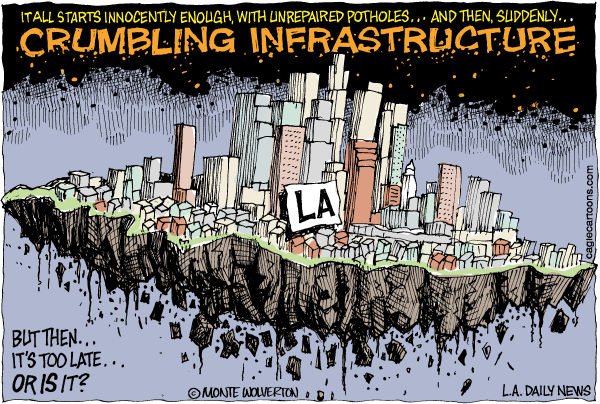
Crumbling Infrastructure? Rebuilding Roads the Right Way in California

Californians are not known for stoicism. Citizens of a state that exemplifies the excesses of the therapeutic culture are known for emoting—usually loudly, often publicly, and frequently well beyond their listener’s point of exhaustion. When it comes to the state’s congested freeway system, however, Golden State residents have developed a high threshold for pain. Sure, the phenomenon of “road rage”—bursts of violence unleashed by clogged thoroughfares—originated in Los Angeles. But it’s the exception that proves the rule. For every motorist driven to mania, thousands more quietly accommodate themselves to the fact they won’t get where they’re going anytime soon. Think of it as the soft tyranny of low expectations.

It takes a true disaster to inflame the passions of California drivers grown accustomed to inconvenience. Over the holidays, they experienced precisely that: on the afternoon of Wednesday, December 14, a tanker trunk filled with 8,800 gallons of gasoline exploded on Highway 60 in Montebello, a community in eastern Los Angeles County’s San Gabriel Valley. The resulting flames were so intense that they caused the concrete in a section of freeway overpass to explode, forcing the California Department of Transportation to close that part of the freeway for the better part of a week in order to demolish the bridge. With Highway 60 acting as a prime conduit for commerce flowing from the ports of Los Angeles and Long Beach—the nation’s busiest as measured by number of containers—to the massive distribution centers of the Inland Empire to the east, the ramifications for trade were brutal.

In responding to the incident, Governor Jerry Brown took a page from the playbook of one of his predecessors, Pete Wilson, the state’s Republican governor from 1991 to 1999. In the aftermath of 1994’s devastating Northridge Earthquake (a 6.7 on the Richter Scale), which destroyed sections of another vital Southern California artery, Interstate 10, Wilson waived the traditional regulations (including exhaustive environmental studies) that most California construction projects must satisfy before going forward. Wilson’s emergency approach—combined with performance incentives that indexed bonuses for contractors to how quickly the freeway was rebuilt—led to I-10’s reopening in 66 days. The initial projection estimated 26 months. Now Governor Brown has used his official declaration of a state of emergency to waive several statutes and regulations that would impede the rebuilding process.

The instinct favoring swift action is sound, particularly given the economic consequences for Montebello and the surrounding communities. But it invites a question: why does it take an emergency to get roads built quickly and efficiently in California? A 2008 Milken Institute study estimated that, without serious changes to California’s approach to infrastructure, the statewide costs of congestion would skyrocket to $42 billion a year by 2030. As it stands, Bay Area commuters lose an average of 50 hours per year to road congestion. It’s worse still in Los Angeles, where drivers average 64 hours per year idling in traffic.

As is often the case in California, however, near-universal accord in diagnosing a problem doesn’t translate to effective action. The obvious solution—expanding the state’s freeway capacity—is expensive, and most green and NIMBY groups oppose it. Environmentalists fret that expanding access would only strengthen the state’s car culture, putting more vehicles on the road and increasing carbon emissions—though vehicles idling in traffic tend to generate substantially higher greenhouse-gas emissions than those in free-flowing commutes.

Lately, a curious partner has joined the environmental lobby against proposals to upgrade California’s freeways: construction trade unions. In November, Bob Balgenorth, president of the State Building and Construction Trades Council of California (an AFL-CIO affiliate), wrote in an op-ed in the Bakersfield Californian: “Continuing to build more and more freeways . . . would be much more expensive, more environmentally damaging, and less efficient for moving millions more Californians up and down our state.” If you think it’s odd that the head of a building union would oppose more building, you’re right: Balgenorth and his colleagues, it turns out, are seeking a favorable contract from the California High Speed Rail Authority, which administers the voter-approved plan for a statewide bullet train. Rail is the environmentalists’ proposed panacea for California’s traffic woes. Balgenorth was appointed to the California High Speed Rail Authority’s board of directors last year.

Projections for the rail project have always been naive. Advocates for the project’s 2008 ballot initiative claimed that it could replace up to 92 million car trips annually, the sort of wild prediction one usually finds in a five-year plan released by a politburo. Since voters approved the project, however, its difficulties have only compounded. More than three years later, not a single inch of track has been laid. Cost projections have ballooned from $40 billion to nearly $100 billion. And California voters now oppose the program by a margin of 59 percent to 31 percent, according to a Field Poll.

For now, then, it looks as if the automobile will remain the centerpiece of California transportation—and it’s past time for the state’s elected officials to recognize this reality. They need to get serious about expanding freeway supply and setting up market mechanisms, such as congestion pricing, to manage demand. Otherwise, they risk a continued drag on the state’s productivity—and sooner or later, public resentment, too. Even California drivers have a limit to their patience.

(Troy Senik is a senior fellow at the Center for Individual Freedom and an editor at Ricochet.com. This story was first posted in City Journal.)