Oakland’s Mayor Jean Quan is in deep trouble of her own making

Jean Quan, the ideologically leftist Democratic mayor of Oakland, California, has presided over her city in a manner both inept and irresolute. She let herself be badgered and manipulated by the neo-Trotskyists and would-be anarchists who march under the Occupy Oakland banner, vacillating between appeasing the demonstrators and arresting them. Quan’s wildly shifting posture has angered almost everyone and satisfied virtually no one. Now, the community-activist-turned-mayor faces at least two campaigns to recall her from office.

The recall, of course, is a firmly established institution in the Golden State. But while recall petitions may be commonplace, successful recall elections are rare. California’s recall of Governor Gray Davis in 2003 was national news not just because Arnold Schwarzenegger assumed Davis’s place, but also because it was the first time since the Progressive Era reform went into effect in 1913 that the state’s voters actually kicked out a sitting governor.

Public animus against Quan doesn’t bode well for her political survival. Gene Hazzard, a photographer for the Oakland Post, a black community newspaper, launched the first recall campaign on December 7. Hazzard’s effort focuses on Quan’s failure to improve public safety and attract new business investment to the city. His supporters are aggressively canvassing neighborhoods with petitions. Hazzard’s recall drive has support from the Committee to Recall Jean Quan and Restore Oakland, which originally intended to launch its own campaign. “Right now, there is one petition out there,” commented Charlie Pine, a retired economic analyst and “Recall and Restore” spokesperson.

A second recall campaign is seeking certification, however. Its chief backer is entrepreneur Greg Harland, who lost decisively to Quan in the 2010 mayoral election. (He finished eighth in a field of ten candidates, earning just 0.9 percent of the vote.) Oakland uses a “ranked-choice” voting system, in which voters select their first, second, and third choices for office. The idea is to minimize runoffs, but the system has other strange effects—such as propelling laggards like Quan into office. Quan won only 24.7 percent of the first-choice ballots, but because of the quirks of ranked-choice voting, she beat former state senator Don Perata, who had 34.39 percent of first-choice votes. Quan won because a much larger percentage of voters for liberal activist and city council member-at-large Rebecca Kaplan picked Quan second over Perata.

Though only in their infancy, the recall campaigns have already drawn opposition. Representatives of the Alameda County Labor Council last month condemned the petition drive. Labor Council executive secretary-treasurer Josie Camacho said: “This lady has been in office less than a year; we need to give her some slack.” But the recall campaign against Quan doesn’t have much to do with her lack of on-the-job experience or the long-standing, ongoing social pathologies that bedevil Oakland. It will almost exclusively be a referendum on the mayor’s abysmal response to the Occupy Oakland tumult.

Quan has been worse than useless in dealing with Occupy Oakland, arguably the most radical and disruptive among the dozens of demonstrations and tent cities that have sprung up around the U.S. since September. Sure, Occupy Wall Street shut down the Brooklyn Bridge for a few hours one day and caused endless traffic snarls around Lower Manhattan. But in addition to trashing swaths of downtown in October and November, Occupy Oakland blockaded the fifth-largest port in the United States not once, but twice. Quan’s personal and political confusion was never more evident than in her posturing on the port disruption.

During the first port shutdown, advertised as a “general strike” on November 2, Quan promised to protect Oakland’s business community. But businesses—even those with signs expressing solidarity with the “99 percent”—suffered widespread vandalism and theft. (Incidentally, Quan’s husband, Floyd Huen, and her daughter, Lailan Huen, bothparticipated in the demonstration that shut down the port.) A smaller group carried out the second port shutdown on December 12 and 13. Oakland police said that the November blockade drew 7,000 protesters, while Occupy supporters claimed 100,000 people turned out. Though it was part of a much larger effort to stop port operations along the West Coast—from Anchorage to San Diego—the December disruption, by contrast, drew no more than 3,000 participants, according to a mediaestimate. Aside from the costly cancellation of a night shift at two marine terminals in Oakland, the second port “strike” succeeded only in closing down cargo operations briefly in Portland, Oregon, and at the small port of Longview, Washington, where the local International Longshore and Warehouse Union (ILWU) is mired in a jurisdictional fight with another union. Police skirmished with protestors in Seattle, Long Beach, and San Diego, but otherwise it was business as usual.

After Occupy’s second port incursion, however, Quan seemed to flail in all directions. She condemned the interlopers as “a small group of people” determined to “hold hostage this port, this city, this economy.” True as far as it goes, but Quan then told the San Francisco Chronicle’s editorial board late last month that the city could not guarantee against future disruptions. The mayor said that she would deploy 500 police to stop another Occupy intrusion—but then said she’d charge the Port Authority $1.5 million for the service. Port representatives said they were unaware of such a proposal and opposed paying for city police. “Keeping the port open and operational is how we’re going to sustain jobs for the region,” said Isaac Kos-Read, a port spokesman.

Quan betrayed her incompetence and weakness further when she admitted to the Chronicle’s editors that city officials were overwhelmed by the second blockade. She said that they had expected only 300 Occupy participants to appear and were surprised when—in her estimate—1,200 showed up. Quan also claimed that the ILWU supported Occupy Oakland’s attempt to disrupt port operations—and that it would halt work and call a mediator if even a single protestor on a bicycle appeared at the port gate. This was a complete fabrication. Robert McEllrath, ILWU’s international president, warned in a December 6 letter to union locals: “None of this [port disruption] is sanctioned by the membership of the ILWU or informed by the local and international leadership. . . . Simply put, there has been no communication with the leadership and no vote within the ILWU ranks on . . . Occupy actions.”

Further undermining Quan’s shaky claims of authority, the Chroniclereported that Oakland police said they were ordered not to prevent the December Occupy obstruction, which cost the port facility between $4 million and $8 million. And the newspaper added that “major retailers, including Target, Walgreens, J.C. Penney and Crate & Barrel, are threatening to pull out of the Oakland port and move business to the Port of Los Angeles.” Asked if she was concerned that major businesses would desert Oakland in the face of Occupy’s campaign of chaos, Quan replied nonchalantly: “Are businesses threatening to leave? Maybe.”

Regardless how the competing recall efforts sort themselves out, proponents must submit 19,811 valid signatures—that’s 10 percent of Oakland’s registered voters—by May 14. Jean Quan’s fecklessness, in a period of economic distress, appears to have made her removal from the mayor’s office more likely than not. This time she won’t be able to depend on ranked-choice voting to skew the outcome. If the recall makes the ballot, it will be strictly “Yes” or “No” for Jean Quan—no waffling allowed.

(Stephen Schwartz is a widely published journalist and author who worked from 1989 to 1999 as a staff writer at the San Francisco Chronicle. This article was first published in City Journal.)

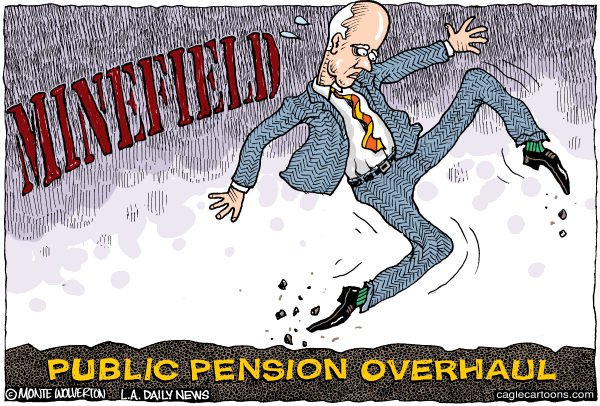
CalPERS role in preventing Vallejo pension cuts

Were Vallejo officials pushed away from trying to cut pensions during bankruptcy by fear of a long and costly legal battle with deep-pocketed CalPERS, promised by attorneys representing the giant pension fund?

The bankruptcy of Vallejo, an old port city of 118,000 on San Francisco Bay, was widely watched as a possible way for struggling local governments to cut soaring pension costs.

But when Vallejo emerged from a 31/2-year bankruptcy last November, pensions were untouched. The city actually increased annual payments to CalPERS, reducing pension debt sooner.

Public employee unions, alarmed by Vallejo’s rare move in May 2008, sponsored several versions of legislation making it more difficult for local governments in California to declare bankruptcy under federal law.

Now before declaring bankruptcy, a bill signed by Gov. Brown last fall, AB 506, requires local governments to go through a neutral evaluation process or to declare a fiscal emergency due to public health and safety jeopardy and bills that can’t be paid.

CalPERS responded to the Vallejo bankruptcy by hiring the Sacramento law firm of Steven Felderstein, which was paid $451,000 through last November. The CalPERS board received regular closed-door briefings on the bankruptcy.

In December 2008, CalPERS filed a motion in federal bankruptcy court arguing that if Vallejo labor contracts were overturned, separate city contracts with CalPERS for pensions and retiree health care would remain in force.

Vallejo cut retiree health benefits, some bond payments and made other savings during bankruptcy. Big reductions in police and firefighter staffs and cuts in street and building maintenance could have been made without bankruptcy.

New labor contracts increased worker payments toward their pensions and gave new hires lower pensions, a step taken by many local governments. On a split vote during bankruptcy, the Vallejo city council gave police a 7 percent pay raise in July 2010.

U.S. Bankruptcy Judge Michael McManus in Sacramento overturned a Vallejo contract with an electrical workers union in August 2009, a first-of-its-kind ruling some experts said.

But by last year a Bank of America report quoted by CNBC, which said Vallejo had paid roughly $10 million in legal fees during a lengthy bankruptcy with little to show for it, reflected the view that the city had become a cautionary tale.

National media attention shifted to Rhode Island last August when Central Falls, a city of 18,000, went into bankruptcy. A number of public retirement systems in the labor-friendly state are seriously underfunded.

The Rhode Island state treasurer, Gina Raimondo, was the force behind legislation in November that switched current workers in the state retirement system into a cost-cutting “hybrid” plan combining a smaller pension with a 401(k)-style investment plan.

The legislation also raised the retirement age for current workers and suspended cost-of-living adjustments for the pensions of current retirees. In California, many believe the state courts have ruled that pensions promised current workers can’t be cut.

Retired police and firefighters in Central Falls agreed last month to a pension cut, a step a New York Times story said is “thought to be unprecedented in municipal bankruptcy and one that could prompt similar attempts by other distressed governments.”

The Times story on Dec. 19 by Mary Williams Walsh said the last city to go through Chapter 9 bankruptcy, Vallejo, planned to cut the pensions of current workers and retirees, but decided not to when CalPERS “threatened” a costly legal battle.

“Vallejo instead cut pay, health care and other benefits, as well as city services and payments to its bondholders, and left the pensions intact,” said the Times story. “Even though the bondholders faced a loss, all parties eventually agreed they had been treated equitably, and the state passed a law making it easier for Vallejo to continue borrowing.

“The episode strengthened the perception that public retirement plans were unalterable, even in bankruptcy.”

Asked for a comment on the Times story, a CalPERS spokeswoman, Amy Norris, e-mailed this reply:

“The CalPERS lawyer that worked on the City of Vallejo bankruptcy case confirmed with our outside counsel on the case, and the City of Vallejo’s bankruptcy lawyer that CalPERS did not make any threat to the City.

“We did inform the City that any attempt to reduce pension benefits in the bankruptcy case would go to the core of CalPERS mission and that CalPERS would respond accordingly. However, City of Vallejo never seriously contemplated cutting benefits and it quickly affirmed its contract with CalPERS. The NYT article was inaccurate or an exaggeration of the facts.”

Vallejo Councilwoman Stephanie Gomes, a pension reform advocate, e-mailed this reply when asked for a comment on the Times story:

“In bankruptcy, the City considered a number of options regarding reductions in existing employee compensation, current retiree health care and current retiree pension benefits. According to our lawyers, CalPERS’ outside bankruptcy lawyers told them that they would challenge any attempt by the City to reduce current retiree pensions.

“So while the City considered pursuing reductions of current pensions of existing retirees, we had to make our decision in light of the legal issues (primarily California constitutional and statutory protections), equity/fairness issues, and cost issues (CalPERS would likely have devoted significant resources to challenge the ability of the City to modify current retiree pension benefits).

“The 1,000-pound gorilla in the room when making our decisions was always CalPERS — they had a lot more time and money to fight us in court than we had available in the middle of bankruptcy.

“So we chose to avoid expensive litigation and to pursue critical budget reductions within the existing rules and regulations — we reduced compensation/health care benefits for most of our existing employees, reduced current retiree health care benefits, increased pension contributions from existing employees and created second tier pensions for new employees (not all groups got a second tier pension in bankruptcy — I hope we equalize this in this year’s contract negotiations). None of these were easy changes.

“Personally, I believe we need serious changes in how CalPERS is governed (i.e. adding an equal number of people who aren’t vested in a CalPERS pension to the Board to represent taxpayers, more strict rules on lobbying and gifts, and much more transparency and accountability); and their de facto control over municipal and county budgets via rules and regulations that constrain our budgeting options.”

Reporter Ed Mendel covered the Capitol in Sacramento for nearly three decades, most recently for the San Diego Union-Tribune. This story was first published on Calpensions.)

More Pension Truths and Why You Should be Very Angry

In last week’s post, I focused on “air time,” a little known scheme in California and 20 other states that allows teachers and other public employees to pad their pensions at taxpayers’ expense. Also, not very well known is just how many of Joe and Jill Taxpayer’s tax dollars are going into the pockets of retired teachers.

In California, teachers contribute 8 percent of their pay to their retirement system. Where do the rest of the contributions come from? The current rates include 8.25 percent from the teacher’s employer and 2 percent from the state. But wait a minute. Who is the teacher’s employer? It’s the school district. In Los Angeles, for example, most school district money comes from the state, some from the federal government and the rest is local revenue. Hence, the employer’s contribution is all really the taxpayer’s burden, as the state, city and feds generate no money on their own. So it would be much more honest to say that 10.25 percent comes from the taxpayer.

Let’s look at the taxpayer’s responsibility another way. Sandy, a teacher I know, worked for 24 years in CA and retired at age 61. The amount of money she contributed into the system at retirement (including interest accrued along the way) was about $150,000. Sandy started collecting a pension of about $40,000 year (plus a yearly 2 percent COLA increase) for life. Whatever interest this money accrues over the next few years, Sandy’s contribution will have evaporated in about four years. So, at age 65 she will start living off other people’s money – whatever the “employer” (i.e. taxpayers) kicked in, whatever the “government” (i.e. taxpayers) kicked in and whatever is left, the taxpayers will have to fork over.

Should Sandy live to be 80, 15 years of her pension will be coming from the taxpayer – about $600,000 worth. (Note: there are about 755,000 current and retired teachers in the state as well as another 1.6 million in the California Public Employee Retirement System who can and are taking advantage of this system.)

Can anyone justify this? Hardly. The question then becomes what to do without impoverishing retired teachers and other public employees, while at the same time stopping the rip-off of taxpayers.

First, those who are retired need to show good will and agree to take a cut in their pensions. Additionally, those districts offering virtually free health care for life – many teachers are required to contribute only miniscule co-pays — need to curtail their generosity.

An example of what can be done just took place in Central Falls, Rhode Island. About to go under due to its suffocating union contracts, the city convinced firemen and cops to agree to accept a cutback in their pensions. Accomplished in a Democrat controlled state, maybe there is some hope for the rest of the country. Rhode Island State Treasurer Gina Raimondo recently gave a talk at the Manhattan Institute where she explained that they pulled off such a feat with “political nerve and good judgment.”

“The plan enacted in November cuts $3 billion of the state’s $7 billion unfunded liability by raising the retirement age, suspending cost-of-living increases until the pension system is 80% funded, and even moving workers into a hybrid plan that has a smaller guaranteed annuity along with a 401(k)-style defined-contribution plan.

“‘We decided we owe each other a bright future,’ said Ms. Raimondo, who said she and fellow Democrats (as well as Independent Governor Lincoln Chafee) came to the conclusion they could no longer afford the lavish promises made to state workers without destroying economic opportunity for everyone.

“‘More government revenue wasn’t an option because Rhode Island already suffers from the nation’s 5th highest state and local tax burden—a full 10.7% of per capita income, according to the Tax Foundation. Everyone in the pension system had to give something, from new employees to retirees.’ But a key to reform, Ms. Raimondo said, was to avoid blaming these beneficiaries for the mistakes of the past. ‘No finger pointing’ was her mantra, along with a corollary: ‘Math, not politics.’

“The first step was an education campaign to explain why a tiny state could not afford an unfunded liability that was more than $7 billion and headed north. This also helped to blunt union opposition. Once there was a consensus that the problem was real, citizens were ready to consider solutions.

“Ms. Raimondo said those solutions had to be discussed openly. Rhode Island’s reform process was so transparent that even when a draft bill to implement the changes leaked to the press before its formal introduction, it was essentially a nonstory because the reforms had already been discussed publicly.”

Those of us in California need look at what has happened in Rhode Island – recognition of a big problem, honest dialogue about it, transparency, shared sacrifice and a move to privatization – and start the ball rolling in that direction. Teachers and other public employee pensioners need to come forth and be a part of the process. They need to recognize that pension fund managers are clueless Pollyannas and that their unions have conned them by insisting that the current system is sustainable. This cannot happen too soon. If we don’t do something in the near future, the state could conceivably go into default and we could see the current exodus of business owners and taxpayers become a full-fledged stampede if California’s fiscal malaise gets any worse. I wonder how many Californians can fit into sensible little Rhode Island?

(Larry Sand, a former classroom teacher, is the president of the non-profit California Teachers Empowerment Network – a non-partisan, non-political group dedicated to providing teachers with reliable and balanced information about professional affiliations and positions on educational issues. This post first appeared on Union Watch.)

Like the State, Gov’s Tax Plan could be Short Revenue

The Legislative Analyst says that Governor Jerry Brown’s tax increase proposal is not going to bring in as much money as advertised. The LAO says the personal income tax increase in the initiative can’t be trusted to produce – the income tax is too volatile. Wonder what the LAO is going to say about the Munger initiative or the California Federation of Teachers/Courage Campaign proposal, both of which completely rely on income tax increases?

The governor’s Department of Finance says the governor’s measure will raise $6.9 billion a year. LAO suggests the figure is closer to $4.8 billion. The disparity of over two billion dollars reflects a difference of opinion on how much the income tax portion of the governor’s package will raise. The plan also includes a half-cent sales tax increase.

The LAO explains: “Most of the income reported by California’s upper-income filers is related in some way to their capital investments, rather than wages and salary-type income. In 2008, for example, only about 37 percent of the income reported by PIT (Personal Income Tax) filers reporting over $500,000 of income consisted of wages and salaries. The rest consisted of capital gains (generated from sales of assets, such as stocks and homes), income from these filers’ interests in partnerships and “S” corporations, dividends, interest, rent, and other capital income.

The situation makes income tax collection “highly volatile” the LAO emphasizes. The LAO notes that the top 1% of tax filers pays 40% of state income taxes.

Another reason income tax revenues may not meet expectations is because of the dynamic nature of taxes. Some bureaucrat can do a static calculation figuring that if taxes were raised a percentage point or two or five, a simple multiplication will tell how much more money will be collected.

It is not that simple.

There are consequences to raising taxes. People have been known to alter financial activities in response to tax changes.

Taxpayers could make moves to protect their income through any number of legal maneuvers. Some high-end taxpayers might even move out of California.

Or economic conditions just might depress the collection of taxes. This would not be the first time that a tax increase produced less money than expected because the tax increases slowed economic activity.

Of course, there is another side to the volatility message. Revenue could increase better than expected. The state appears to slowly be coming out of the economic doldrums and rumors of blockbuster IPO sales of Silicon Valley companies such as Facebook could change the revenue picture, although perhaps not this year.

The LAO concerns should also reflect the office’s predictions on what the Munger and CFT/Courage Campaign initiatives purport to bring in if they pass. Munger increases income taxes on all but the lower end taxpayers with a particular emphasis on dinging the top earning taxpayers. CFT raises income taxes on millionaires.

(Joel Fox is Editor of Fox & Hounds and President of the Small Business Action Committee. This article first appeard on Fox & Hounds.)

CA Needs Better Budgeting, Not New Taxes

California government has grown too large, fueled by its endless appetite for increasing amounts of taxpayer dollars each year.  Once again, Governor Jerry Brown threatened Californians with nearly $5 billion in spending cuts, largely deducting from education at all levels, including K-12, community colleges, CSU, and UC budgets.  With the knowledge that people support and value learning, Brown targets education and essentially holds it hostage, reminiscent of a terrorist act designed to collect ransom in the form of higher taxes by holding a gun to the heads of hardworking taxpayers.  Such tactics amount to cowardice, as they aim at the maintenance of status quo under the overwhelming pressure of burgeoning unions that financially supported and elected him, and are standing in the wings to gain.  This is not leadership!

Gov. Brown and the Democratic legislators have threatened to make huge and visibly painful cuts in schools, safety, and other vital public services in order to force Californians to support higher taxes for the continuation of those services.  They punish Californians through Draconian cuts that will lead to dire consequences, even though we are already suffering as a result of past bad fiscal policies, in addition to a state unemployment rate of about 12% and one of the highest home foreclosure rates in the nation.  As if this wasn’t enough, California families are still reeling from rapidly rising gas and food prices.

What we need from our elected leaders in Sacramento is leadership.  Perhaps it’s asking for too much?  Leadership requires a change in paradigm, for an approach that addresses real budget problems through fundamental reforms.  We require improvements in the way tax money is collected, allocated, and spent.  Our leaders need to embrace the philosophy of small and streamlined government.

Our representatives ought to provide leadership in making tough decisions through analytical and thoughtful prioritization of functions and expenditures in every department of the state government, such that Californians will have access to the most essential and efficiently delivered programs and services, that will ensure future economic growth and prosperity, and do so with utmost commitment and self-discipline to live within our means.  We need real prioritization with compassion, without gimmickry, and recognition that prioritizing is an art.  This can be done and must be done, or citizens should unite and vote out inept leaders who don’t understand this concept, and thus, stand in the way of the common good.  Enough is enough!

When the governor and the Democratic legislators ask for tax increases, they assume that all state programs and services are equal in weight and importance, and therefore, lack priority.  This is neither proper planning, nor strategic in nature.  Certainly, such thinking reflects a tremendous lack in leadership, and a lack of respect for the intelligence of the taxpayers.  Anyone can balance the state budget, if given more and more taxpayer dollars.  The solution is not more money seized from hardworking constituents, nor severe cuts towards much needed services, but prioritization and analysis that will allow our leaders to fund essential programs, and cut back on spending where it is not necessary.

Taxpayers should not support any tax increases of any kind until our elected officials provide us compelling data on their most efficient use of all financial resources and their results.  Until we hold the feet of our elected officials to fire and hold them accountable, be assured that any tax increases will continue to be wasted.  So far, Governor Brown has provided us no such convincing data, arguments or results.  We should not and will not be fooled.

While taxpayers prioritize their living expenses on a daily basis, our state programs and services seem to enjoy eternal life and endless spending.  There is s something terribly wrong with this picture!

(Dr. Raghu P. Mathur is the former president of Irvine Valley College, chancellor of the South Orange County Community College District, and president, Board of Trustees of the Saddleback Valley Unified School District in Orange County, CA.  Currently he serves as the Chair, School of Education at Argosy University in Orange, CA.)

Hayashi spokesman Sam Singer, “The Fixer”, can’t fix her botched story

The strange news that a benign brain tumor is the real reason that Assemblywoman Mary Hayashi shoplifted at Neiman Marcus isn’t odd enough – today’s Sacramento Bee ran a front page, above-the-fold story again about Hayashi’s incident, but it was a kinder, gentler version.

“I accept responsibility and I offer apologies, not excuses,” the Bee reported that Hayashi said in a written statement. The title of their story, Mary Hayashi Apologizes For Unintentional Shoplifting, told the story.

The first reports after the shoplifting incident reported that Hayashi’s spokesman blamed the theft on her cell phone use at the time, which caused her to forget to pay. Now he says it might be a brain tumor.

Prosecutors said that Hayashi, who represents the 18th California Assembly District east of San Francisco, was caught on a security camera walking out of the store on Union Square with a shopping bag full of items she didn’t pay for.

Hayashi’s hired spokesman said she had been inside of Neiman Marcus in Union Square, and walked out of the store while using two cell phones. But she took three articles of clothing with her, dropped into a shopping bag that she brought with her into the store.

This is where details get a little fuzzy. I know that I’ve never unintentionally or intentionally put any articles of clothing into another shopping bag before walking out of a store, much less three pieces of clothing. And I have been known to talk on the phone while I shop.

“Hayashi was stopped by Neiman Marcus’ security detail shortly after leaving the store around 12:15 p.m. Tuesday with a shopping bag that included three items worth $2,450 that she hadn’t paid for when she checked out at the register, the district attorney’s office said,” the San Francisco Chronicle reported on Oct. 29. Hayashi allegedly stole leather pants, a black skirt and a white blouse worth $2,450.

Investigators say store security was tracking Hayashi after a saleswoman told security guards that she suspected the Assemblywoman of stealing a dress the week before.

The Bee reprinted Hayashi’s prepared statement:

“There were a number of personal factors that led to the situation where I made this absent-minded error,” she said. “My medical condition may have complicated the situation, however, I want to be clear that I take full personal responsibility for my actions.”

Hayashi said she is “taking steps to deal with my health” while continuing to serve as a legislator.

“After a lifetime of public service, this has been a painful experience — but one of my own making,” she said.

Who Is Sam Singer?

Hayashi’s hired spokesman, Sam Singer’s website states that he is “nationally known for handling some of most significant public affairs and crisis communications issues of the day.”

Ouch.

“Sam Singer has been dubbed ‘The Fixer’ by the San Jose Mercury News, a ‘Top Gun for Hire’ by the San Francisco Chronicle, and one of the most powerful people in San Francisco by 7X7 Magazine for his ability to turn the news around when things look dire for his clients,” his website said.

Several of the newspapers in Hayashi’s district have reported a surprising lack of sympathy from her constituents. ”My gut feeling, as a constituent, is that it’s a BS excuse in order to get out of her crime,” said Brian Morrison, who is president of the Castro Valley Chamber of Commerce but stressed that he is speaking only as an individual, the Bee reported in another story later in the day.

In Hayashi’s Brain Tumor Defense Gathers No Sympathy, reporter Steven Tavares from East Bay News, attended Hayashi’s court hearing Friday, and wrote:

“If this woman who has quite assuredly ruined her political career with a deeply regrettable error one harmless day last October is now wrestling with her own mortality, don’t you think her husband would accompany her to face her fate in court? Instead, she was as alone as a public figure could possibly be. In addition, if Hayashi, whose reputation is in need of a significant overhaul, wanted to begin the healing by revealing the weight of brain tumor hovering over her life, she would have squared up to the cameras and told the world about the diagnosis herself. She didn’t. In fact, she squirreled away to pay her paltry $180 fine and later dodged the press.”

District Attorney George Gascon said his office would accept the judge’s decision, ABC news reported. ”She is a first-time offender. She has no criminal record. So while what she did is inexcusable and she needs to be held accountable for her actions, I think it’s appropriate to examine and explore all the different possibilities,” Gascon said.

I am not sure how Sam Singer is going to spin the District Attorney’s statement.

Remember that right after her arrest, the San Francisco Chronicle reported that Singer called Hayashi’s arrest “a mistake,” and that “she had walked out of the store with the items unintentionally and intended to go back.”

But Singer also said Hayashi is “distraught by this misunderstanding … and she believes this will be cleared up in the near future.” He added, “She apologizes for any misunderstanding.”

(Katy Grimes is CalWatchdog’s news reporter. Grimes is a longtime political analyst, writer and journalist. This article was first posted on CalWatchdog.)

Taxpayers Held Hostage by Sham Budget

Like the villain in a cheesy hostage movie, Jerry Brown took to the stage last week to deliver his annual budget. His ransom demand to Californians was simple: Vote for more in taxes or I’ll cut $5 billion from education. Upon hearing the threat, citizens across the state yawned and then went about their business knowing that the gun pointed at their wallet wasn’t even loaded.

Brown’s proposed tax hike wasn’t really a surprise as just a few weeks ago he laid out the plan to increase income and sales taxes on Californians by $35 billion over five years. If this sounds familiar, it should. These are the very same taxes voters rejected less than three years ago by a two-to-one margin. Indeed, voters have rejected the last seven tax hikes dating back to 2006. But ignoring the admonition that those who ignore history are doomed to repeat it, the Governor not only assumes that voters will approve taxes, but he is so confident of this that he built the revenue into his budget. Brown envisions a seven percent hike in spending for 2012-13, the largest annual increase in six years.

Brown might want to rethink his role as a Tony Soprano wannabe. Quite frankly, the part doesn’t fit a former Jesuit. But more importantly, California shows nascent signs of economic recovery on its own (despite our policy leaders doing all in their power to strangle the state’s economy in its crib). Revenues have increased more than three percent and the unemployment rate has declined to 11.3 percent, the lowest level in nearly three years.

So why choke off this fledgling economic recovery with taxes? Simply, California politicians lack the intestinal fortitude to live within their means. Sure, the Governor talks a good game. He even referenced paying down the ‘wall of debt’ again in his speech last week. But he followed that up with asking for a $12 billion water bond, continued support for California’s High Speed Fail, er Rail, program and a cap-and-trade scheme that will drive Californians’ energy costs through the roof.

Whether the recovery is weak, robust or nonexistent, it is very unlikely voters will be persuaded to pay the ransom. Not because they don’t want good education, but because they’ve heard all these threats countless times before. What they know — whether they can cite the specifics or not — is that vast sums of their taxpayer dollars are being wasted.

In any campaign for higher taxes — either the governor’s plan, those from dilettante billionaires or from the almighty public employee labor bosses — voters will be reminded by taxpayer groups like HJTA that they are not undertaxed — but that our government leaders simply are not good stewards of their tax dollars. Like seven times before, tax hikes on the ballot will meet the fate they so richly deserve.

Jon Coupal is president of the Howard Jarvis Taxpayers Association -– California’s largest grass-roots taxpayer organization dedicated to the protection of Proposition 13 and the advancement of taxpayers’ rights. This story was originally posted on HJTA.org.)

Michelle Bachmann repeats female casualties of Presidential race

This past week, Michelle Bachmann suspended her campaign for the Republican nomination for President of the United States.  On August 13th of last year, Bachmann became the first woman to win the Iowa Straw Poll.  A short 143 days later, she came in last in the Iowa Caucuses.

Much will be written about Bachmann’s campaign – her 23 foster children, her standing as the founder of the Tea Party Caucus in the U.S. House, her Midwest accent (strikingly similar to Sarah Palin’s Alaska accent), her energy on the stump and her lack of funds to continue.

Like Hilary Clinton, Bachmann spent a great deal of time focusing on her achievements.  She didn’t avoid talking about her gender and was able to show that she was just as capable of competing as the men on the stage.

Bachmann was called “fun, feisty, and fabulous” by some who knew her in the media.  But others (Chris Matthews and Jimmy Fallon come to mind) criticized Bachmann’s intelligence and occasional factual misstatements more than they did the men in the race on either side.

Bachmann was the Republican Presidential sweepstakes most vocal opponent of Obamacare.  Her suspension of her campaign probably helps Mitt Romney who appears nothing less than invincible in this week between Iowa and New Hampshire.

TALES OF THE WOMEN WHO HAVE RUN FOR PRESIDENT

Thirty-four women received their party’s nomination since 1874 when Victoria Woodhull ran for President with Frederick Douglas as the nominee of the Equal Rights Party.

Surely, you think I’m joking, but I’m not.  Thirty four women representing parties as diverse as the American Woman’s Party, the Communist Party, the People’s Party, the Right to Life Party, and the Green Party World Worker’s Party have served as their party’s U.S. Presidential Nominees.

My all-time favorite is the late Gracie Allen, beloved comedian and wife of George Burns who ran as the nominee of the Surprise Party whose mascot was the kangaroo.  Gracie and George did a whistle stop train tour and as always, she was endearing in her remarks about every day life stating at one stop that “Everybody knows a woman is better than a man when it comes to introducing bills into the house.”

In major parties, a woman has never become her party’s nominee.  However, in 1964, Margaret Chase Smith lost the nomination to Republican Barry Goldwater.  Shirley Chisholm, Patsy Mink, and Bella Abzug ran in 1972, losing to George McGovern.  Chisholm received 152 votes at the Democrat National Convention.

In 1988, Colorado Congresswoman Pat Schroeder (a Democrat) lost to Mike Dukakis and in 1992; Patricia Schroeder (a Republican) received 152 votes to place 12th in the New Hampshire Primary.

The Republicans’ most accomplished and qualified woman, Elizabeth Dole received 231 write-in votes in the 2000 New Hampshire Primary and placed third in the Iowa Straw Poll after dropping out of the race for President.  If Dole had begun her campaign earlier and had the funding, she would have been a contender as she placed second in every poll to George W. Bush during the time she was a candidate for President.  Subsequently, she was elected to the United States Senate from North Carolina.

U.S. Secretary of State Hilary Clinton achieved more than any other women, reaching second place in 2008 Democratic Primaries, securing 1,726.5 Delegate votes and winning more primaries than any other women in history. Clinton won 21 states with more than 18 million votes.  The race between Clinton and Obama was among the closest in history with her winning 48.03% of the popular vote to his 47.43%.

While Michelle Bachmann made it farther than previous Republican women who have run for President, Clinton’s campaign for her party’s nomination appealed across the country and across the board for the longest period of time.

Clinton’s campaign and Dole’s had more commentary about sexism than the others but Bachmann was also was a victim of gender bias.

Whether you are a Republican, Democrat, or Independent or are affiliated with a minor party, the study of the campaigns and the media coverage of women who have stood for the Office of President of the United States is fascinating and in some ways startling.

Part II of this series will examine the media’s treatment of Bachmann, Clinton, Dole and other women candidates seeking to achieve the highest office.

Stay tuned….

(Judy Lloyd is a senior manager and strategist specializing in government affairs, community outreach, development and public relations.)

Is Mitt Romney John McCain version 2.0?

The endorsement of Mitt Romney’s presidential bid by John McCain, the 2008 Republican nominee, was the latest indication that Romney is the GOP establishment’s heir apparent.

As Romney, who picked up McCain’s endorsement last week, appears to be gliding to a comfortable victory in New Hampshire’s primary Tuesday, the next major campaign stop, and the GOP establishment begins to rally behind him, he has still yet to capture the trust, energy and esteem of many rank-and-file Republicans, let alone the Tea Party activists.

The prevailing wisdom among GOP establishmentarians and Romney backers may be: “Take it or leave it, it’s going to be Romney versus Barack Obama.” But if Romney is unable to energize his party’s base, he will suffer the same fate as McCain, a clear defeat.

McCain’s 2000 and 2008 bids for the Republican presidential nomination in many ways mirror the candidacy of Romney. In 2000 McCain was labeled the moderate or liberal candidate against George W. Bush. Some went so far to label him a RINO – Republican in Name Only.

In 2008, McCain had experience competing in early primary states and better understood the various constituencies. As such, he pivoted, campaigning as a conservative-ish choice for Republicans. But he still received backlash, especially by the most conservative primary voters who resisted the Arizona senator because they believed he was soft on issues of great importance to conservatives such as campaign finance reform. He suffered a dismal fourth-place finish in conservative Iowa but rebounded in New Hampshire and elsewhere.

McCain’s 2008 campaign pivot was not what won him the nomination though, He essentially prevailed through attrition, an attitude prevailed that McCain was the best of a lackluster lineup – the safe pick with the best chance of beating the Democrats. McCain perhaps also benefitted from a GOP loyalty factor, that is, the belief that he paid his dues and was next in line (a perception that benefitted the successful candidacies Richard Nixon, Ronald Reagan and George H.W. Bush).

Romney is still viewed as a RINO by many Republicans and is not popular among Tea Party activists. In fact, South Carolina Gov. Nikki Haley prompted blowback from Tea Partiers in her state because she endorsed Romney. Many Republican voters see Romney’s record on a plethora of issues as fluid, lacking conviction. And, of course, he has been most roundly criticized for his health care agenda when he was governor of Massachusetts from 2003-07.

This election cycle Romney is benefiting from experience and pre-existing relationships in key primary states such as Iowa (he finished second there in 2008) and in New Hampshire (he also finished second there behind McCain in 2008). Since then he has been a perennial candidate.

Romney’s position in the primary process this election cycle is not too dissimilar from McCain’s in 2008, but Romney is better off considering his photo-finish victory in Iowa. Romney has the potential to all but lock up the nomination by Super Tuesday, March 6, if not as early as the Florida primary Jan. 31.

Before then, South Carolina on Jan. 21 will be Romney’s major test and perhaps the last opportunity for anti-Romney Republicans to rally behind an alternative candidate. A Rasmussen poll released Friday showed Romney leading in South Carolina with 27 percent of likely GOP primary voters; former Pennsylvania senator Rick Santorum followed, with 24 percent.

Nationally, Romney is polling at 29 percent to Santorum’s 21 percent, according to the latest Rasmussen survey.

Another challenge outside South Carolina is that Romney must demonstrate he can “get a majority somewhere,” as former House Speaker Newt Gingrich said. He has yet to do so. Gingrich believes conservatives will “gradually coalesce” around a candidate to defeat Romney. “[O]ne of us,” he told ABC’s “Good Morning America,” “will eventually emerge as the conservative alternative and will beat Romney.”

Santorum may be the anti-Romney conservatives are hoping for.

A nominee who does not excite the Republican base will not fare well against Barack Obama and his polished, aggressive and manicured campaign style. What may unite Republicans more than anything else is their desire to oust President Obama from the White House, and that may be enough to propel Romney or another Republican to a general election victory. But banking on that strategy is risky business.

(Brian Calle is an Opinion Columnist and Blogger for the Orange County Register. His blog is called Uncommon Ground.)

Gallegly retirement opens up new possibilities in GOP-leaning Congressional seat

California’s 2012 redistricting already is shaking up state and even federal politics. The candidates’ dogfight for the new 26th congressional district could determine whether Democrats or Republicans control the U.S. House of Representatives after the November election — or at least the degree of Republican control.

Rep. Elton Gallegly, R-Simi Valley, announced on Saturday that he’ll retire from Congress. He currently represents the old 24th Congressional District, which was drawn after the 2000 U.S. Census.

Gallegly would have had to run an uphill challenge against Rep. Buck McKeon in the new 25th District, based on the 2010 U.S. Census. McKeon has been in Congress since 1993 and is chairman of the powerful Armed Services Committee.

Gallegly’s other option was a tough general election fight in the 26th Congressional district. The new Ventura County-based district, which includes Oxnard, Thousand Oaks, Moorpark and Camarillo, gives Democrats a slight voter-registration advantage.

However, the district has conservative tendencies and voted in favor of Proposition 8, California’s anti-gay marriage initiative. According to Redistricting Partners’ analysis of the district, it went handily to Obama in 2008 and slightly favored Whitman in 2010.

Gallegly’s retirement creates the opportunity for several county politicians to make their moves on the long-coveted seat. The Democratic side already features five announced candidates: Ventura County Supervisor Steve Bennett, Moorpark Councilman David Pollock, community activist Zeke Ruelas, businessman David Cruz Thayne and Oxnard Harbor District board member Jess Herrera.

On the Republican side, state Senator Tony Strickland, R-Santa Barbara, could be challenged by County Supervisor Linda Parks, a slow-growth environmental activist.

What to Watch for in CD 26

10. State Senator Tony Strickland Will Clear the Republican Field

Strickland will have the support of the Republican establishment, both in the county and on Capitol Hill. Ventura County’s field of top-tier Republican candidates has winnowed in the past five years. Bob Brooks, a popular Republican county sheriff and close Gallegly friend, passed on the chance to take over the seat in 2006, when Gallegly first flirted with retirement.Tom McClintock, another longtime county Republican stalwart, couldn’t wait for Gallegly’s retirement and moved to a Northern California congressional seat in 2008.

Other than Strickland, there’s only one Republican elected official in Ventura County with grassroots support, name ID and a strong fundraising prowess: County Supervisor Peter Foy. He told me Saturday night that he’s supporting Strickland. It’s perhaps Strickland’s most important local endorsement because it clears Strickland’s right flank.

Ventura County Supervisor Linda Parks, a registered Republican, won’t gain any traction with any of the county’s Republican establishment if she decides to enter the race. Ventura County Republican Chairman Mike Osborn, a close Strickland ally, led the county party’s independent expenditure campaign against Parks in 2010. Republican women proved to be the key voter demographic in that race. Expect the same in this match-up between Tony Strickland and Parks. If Parks is able to make the runoff, Republican women will be the most crucial voting bloc.

On Capitol Hill in Washington, D.C., expect House Majority Whip Kevin McCarthy, R-Bakersfield, to quickly lock down key endorsements and financial support for Strickland. The Strickland-McCarthy friendship dates back to McCarthy’s tenure as Assembly Republican leader.

Strickland served as an important member of McCarthy’s inner circle in Sacramento, and he’ll want to add Strickland as a loyal member of his team in Washington. (Fun fact: The pair overcame a one-time “young Republican” feud. McCarthy came up through the Bill Thomas machine; Strickland the more conservative crowd. The split was so bad it led to the creation of two separate young Republican organizations.)

9. Left-Wing Fight: Latino Democrat vs. Environmentalist Liberal

The CD 26 race could turn into a nasty fight between a Latino Democrat and a progressive environmentalist. Ruelas and Herrera will fight to be the consensus Latino candidate, while Bennett and Parks jockey to be the environmentalist candidate. (Yes, even though Parks is a registered Republican.) One quarter of the voting age population is Latino. Unless another Latino candidate enters the race, Herrera, a five-term commissioner on the Oxnard Harbor District, likely has the advantage over Ruelas.

The environmentalist battle might be avoided altogether. Bennett and Parks share the same base of anti-growth supporters. Both have served for decades as leaders in the SOAR movement (Save Open-Space and Agricultural Resource). SOAR opposes property rights in favor of protecting obscure wildlife.

In late December, the Ventura County Star reported that Bennett was having second thoughts about the race. If Bennett drops out, he’ll likely support Parks, despite her Republican registration. Bennett has endorsed Parks in the past and even contributed money to her supervisorial campaigns. Expect environmentalists to unite early in an “anyone but Strickland” coalition.

8. Regional Split: West County (Oxnard) vs. East County (Thousand Oaks)

Ventura County’s natural geographic divide is the Conejo Grade.  East County includes Thousand Oaks, Newbury Park and Moorpark. It’s wealthier, more Republican and increasingly moderate.

West County, which includes Port Hueneme, Oxnard and Ventura, is the major source of Democratic votes, due to its working class and primarily Latino population.

The first signs of a geographic split will be internally, between the environmentalists Bennett and Parks. Bennett represents West County; Parks East County. Parks should have the edge because she’ll have support from a broad base of community leaders in the East, while some of Bennett’s Democratic support will go to the Latino consensus candidate. Prior to her election to the county board, Parks served as a member of the Thousand Oaks City Council. Assuming the environmentalist crowd consolidates behind Parks, there’ll still be a geographic split with the Latino candidate from Oxnard.

Strickland has represented all of these areas in either the state Assembly or Senate, with most of his support coming from Camarillo, Moorpark and Thousand Oaks.

7. The Heretofore Unknown Wealthy Republican Who Wants to be Called “Congressman”

Strickland’s biggest competitor for traditional Republican votes could come from the heretofore unknown wealthy Republican who wants to be called “congressman.”

In 2006 and 2008, wealthy attorney and businessman Michael Tenenbaum ran to replace Gallegly. He seized on Gallegly’s “will-he-or-won’t-he” moment to fill that role.

Another wealthy Republican could follow the Tenenbaum model. Gallegly has held the seat for 24 years, so you can expect a few wealthy businessmen to think twice before passing on their chance at a congressional seat.

6. Big Labor Will Decide Who Makes the Runoff

Big Labor will play heavily in this race, but it’s unclear whom they’ll support. Both Parks and Bennett have strong, pro-union records on the Board of Supervisors. Herrera and Ruelas are former and current longshoremen.

Labor could stay out of the primary and keep its powder dry for a general election fight against Strickland. Or, it could decide to get behind the potentially stronger candidate, Parks.  There’s even the possibility that a few unions might consider supporting Strickland.

Whomever Big Labor gets behind will be the candidate to make the runoff.

5. Strickland’s  Pre-Primary GOP Endorsement Undermined by … Tony Strickland

Parks’s Republican registration, despite being in name only, complicates Strickland’s chances for a pre-primary endorsement from the California Republican Party. A party endorsement could provide crucial financial support. During last year’s internal party endorsement debate, party kingpins Jon Fleischman and Mike Schroeder proposed an easy pre-primary endorsement process that would favor conservative candidates. Their plan was defeated in favor of a complicated local convention system.

Under the current party rules, two-thirds of the county central committee members in Los Angeles and Ventura Counties must approve a pre-primary endorsement. Then, two-thirds of the California Republican Party Board of Directors must authorize the endorsement.

It’s a complicated but feasible hurdle for Strickland to overcome. Of course, Strickland has no one to blame but himself. He provided critical support for the more complicated plan. It was the brainchild of none other than McCarthy. The question will be if fringe, anti-Strickland Republicans can marshal enough votes to block an endorsement at the local level.

4. Outside Groups Will Play Heavily in the Race

Environmental groups, labor unions, Indian tribes and business interests will all play in this congressional race. Strickland, a former president of the California chapter of the influential Club for Growth, can expect major support from anti-tax, pro-growth advocates.

Parks is a quintessential RINO — Republican in Name Only. She’ll ignite the ire of anti-tax, anti-union activists throughout the country. Think Dede Scozzafava, the New York Republican politician just appointed to a post by liberal Democratic Gov. Andrew Cuomo; but Parks sports a record of quashing property rights to save squirrels. The Sierra Club and state public employee unions will play in the race in favor of the consensus liberal candidate.

3. The Most Expensive Congressional Race in California History

If you’re a Republican donor in California, chances are you’ve already received a fundraising pitch from Strickland. It’s been 24 hours since Gallegly announced his retirement. That’s enough time for Strickland to contact several hundred donors.

One of the best fundraisers in the state, I’d look for Strickland to post a massive fundraising number at the end of the first reporting period. (Yes, I just raised expectations.) The combination of Strickland’s fundraising and outside groups will make the 26th congressional district one of the most expensive races in California history.

2. Linda Parks Will Re-Register as a Democrat

A potential game changer in this race is when Parks re-registers as a Democrat. In a debate, I’d ask Parks to name the last Republican presidential candidate she has supported. (Not that anyone can blame her for abandoning the anti-freedom Sen. John McCain.)

If Parks re-registered as a Democrat, she’d have the formal support of her Democratic friends and allies. Check Parks’s past endorsement record and you’ll find a “Who’s Who” of Democratic activists. It’d be so much easier for her to campaign as a Democrat instead of as a moderate Republican.

If Parks fails to make the runoff, look for her to endorse the Latino Democrat, regardless of her party registration.

1. The Race Will Remain Undecided for Days, Possibly Weeks

Get the lawyers ready for a heated ballot review process in November. It is easier to list the races that “Landslide Tony” has won easily than identify the races he’s barely squeaked out. Most of his victories have been decided weeks after Election Day.

The only race Strickland has won by a comfortable margin was his final re-election to the State Assembly in 2002. In 1998 and 2000, Strickland beat schoolteacher Roz McGrath by a hair. The 2008 state Senate race against former Assemblywoman Hannah Beth Jackson took weeks of ballot checking before a winner was declared.

And then there’ll be the rematch for District 26 in 2014.

Bonus Prediction: Epic Ground War Between Strickland and Parks

The best ground campaign activists in California Republican politics will reunite to run the ground campaign in this race. Strickland has trained a network of activists and should be expected to reinstitute his flop-house walk program. That’s where poor college students are convinced to spend day and night walking for the cause. Look for the best political operatives in conservative politics to forgo their lucrative state salaries and temporarily take LWOP — leave without pay — to support Strickland’s bid.

The Strickland machine will face its toughest test yet in Parks’s environmental operation. Every activist who has chained himself to a tree to save the spotted owl will mobilize to support Parks. She is a serious and credible candidate with high name ID. If she doesn’t re-register as a Democrat, this may be the first and only race to feature a Republican versus Republican general election match-up.

(Full disclosure: The author previously worked for Tony Strickland, a candidate for District 26. This article was first posted on Cal Watchdog.)