School Choice, Charter Schools Missing Out on Vouchers

January 22 through 28 marks the second annual National School Choice Week. While much of the rest of the country can celebrate some successes since last year, California’s education reformers often spend their days fighting rearguard actions just to preserve hard-won but modest gains. Nationally, the 2010 elections galvanized school reformers and led to such a quick succession of victories that the Wall Street Journal dubbed 2011 “the Year of School Choice,” while City Journal similarly called it “The Year of the Voucher.” By contrast, in California, the 2010 elections signaled new legislative assaults on charter schools, on open public school enrollment, and on parent empowerment.

It’s an amazing turnabout. As the Journal’s editors noted, no fewer than 13 states enacted school-choice legislation in just the first half of last year—creating new voucher programs in Indiana and expanding existing ones in Wisconsin, Florida, and Ohio; eliminating charter school caps in North Carolina and Tennessee; and authorizing new tuition tax credits in Louisiana and Florida. Manhattan Institute senior fellow Marcus Winters noted last autumn how in the previous decade, the expansion of school-voucher programs had “slowed considerably” because of defeats at the ballot box and in state courts. Now, however, “the push toward vouchers is coming from a new breed of reform-minded politicians from both parties. Once a taboo subject, vouchers are now talked about openly on the campaign trail, and politicians are hiring reformers to run high-profile school systems.” Democrats who see school choice as a civil-rights issue have adopted what was once exclusively a Republican concern.

Where was California in all of this? With a high school dropout rate hovering around 30 percent and a majority of college-bound graduates requiring remediation in English and math, the Golden State would appear to be a prime candidate for serious reform. But with a calcified state legislature, an impenetrable state education code, a sclerotic bureaucracy, a powerful state teachers’ union, and a governor who owes his 2010 election to union support, preservation of the status quo is almost a given.

California does have a fairly extensive system of public school choice, but meddlers in the legislature continually imperil it. California boasts more than 900 charter schools—public schools allowed to operate outside the bounds of typical school district regulations and union contracts—and that’s more than any other state. While most studies have shown charters to be better than traditional public schools, some say there is no difference between them. At worst, charters do the same job as traditional public schools for less money. Only about 15 percent of California’s charter schools are unionized, which is why the California Teachers Association—the top political spender in the state—has made a priority of eviscerating the existing laws rather than expending time and resources trying to organize hundreds of independent schools. Governor Jerry Brown, in an encouraging display of political fortitude, stood up to the CTA last autumn when he forced legislative leaders to withdraw a series of anti-charter bills and vetoed several other bills that would have undermined charters’ independence.

Homeschooling similarly survived an onslaught from the state education establishment. About 200,000 homeschoolers reside in California today, though in 2008 it appeared that the number would be reduced to zero. The Second District Court of Appeals ruled that all instructors of children must have a state teaching credential, thus disenfranchising practically every homeschooling parent. A higher appeals court reversed the ruling five months later, claiming that homeschools are, in effect, private schools where no teaching credential is needed. While homeschooling represents the ultimate in parental control, relatively few families can afford to have one parent stay at home and become a full-time teacher.

A novel approach to school choice in California is the Parent Empowerment Act, better known as the parent trigger. The law, passed in 2010 by a single vote in both legislative chambers, lets parents of students in failing schools file petitions to force changes in school governance. The beauty of the law, written by former Democratic state senator Gloria Romero, is that it bypasses the traditional bureaucratic and union entanglements. If at least half of parents at a qualifying school sign a petition, the local district must undertake one of several prescribed options, including shutting it down or converting it into a charter school. Needless to say, the law—a bête noire for the entrenched education special interests—was attacked and nearly derailed. But buses full of determined parents lobbied heavily last year before the state board of education in Sacramento, and the parent trigger survived. Parents have “pulled the trigger” only twice so far—most recently two weeks ago—so it’s difficult to assess its impact. Even if more parents exercise the petition option, the law limits the number of schools eligible to be triggered at 75 (even though 1,300 schools qualify as failing).

What California needs most and doesn’t have are vouchers, which most advocates now call “opportunity scholarships.” Under a voucher system, a portion of public money designated to educate a child would follow the student to a school of the parent’s choosing. It could be a traditional public school, a charter school, or a private school. Seventeen such programs exist across the country, and after two decades, we have a good idea of vouchers’ effectiveness. Greg Forster, a senior fellow with the Foundation for Educational Choice in Indiana, reviewed ten empirical studies of voucher programs. According to Forster, “nine find that vouchers improve student outcomes, six that all students benefit and three that some benefit and some are not affected. One study finds no visible impact. None of these studies finds a negative impact.”

Voucher opponents insist that such programs “siphon money away from public schools.” What they’re saying, in effect, is that private schools will perform better at the expense of public schools. True, public schools would lose some money under a universal voucher system, but there’s no evidence that this would make them any less effective. In a separate review, Forster discovered that “[19] empirical studies have examined how vouchers affect outcomes in public schools. Of these studies, 18 find that vouchers improved public schools and one finds no visible impact. No empirical studies find that vouchers harm public schools.” Even in the world of public education, competition works.

California has twice tried and failed to enact voucher legislation through the initiative process. Voters decisively rejected voucher measures in 1993, and again in 2000. The reasons for these lopsided losses are many. But with more states and the District of Columbia embracing opportunity scholarships, and greater public appreciation that the educational status quo is unacceptable, perhaps Californians would be more receptive to a voucher law now, even a limited one. Of course, should such an initiative make it to the ballot, the teachers’ unions would spend every penny and every ounce of human capital to keep vouchers from becoming a reality.

California would also benefit from a tax-credit scholarship program, which would allow individuals and corporations to receive a state tax credit for making donations to nonprofit organizations, which in turn would use the money to fund private school tuitions. Currently, 16 states offer some form of tax-credit scholarship program. But as with vouchers, tax credits could be a tough sell in a state where legislators are averse to any form of “privatization.”

If California is to afford its citizens a top-flight public education, as it once did, voters and policymakers must come to grips with the fact that education should be first and foremost about children. For far too long, the emphasis in public education in the state has been on the perks given to adults. As long as special interests remain in charge, California’s children won’t get the education that they deserve.

(Larry Sand, a retired teacher, is president of the California Teachers Empowerment Network. This article was first posted on City Journal.)

Romney is a Moderate: America Needs a Strong Conservative Leader

The 2012 Presidential Election is essentially the most important race this generation has ever seen, and allowing a moderate like Gov. Mitt Romney to win the nomination would be a huge mistake.  Rallying behind the “default” nominee is a massive blunder, and the GOP establishment must know better.

America is more than capable of maintaining its exceptionalism in an increasingly globalized world, as long as it continues to stand for liberty, freedom, and the free enterprise system.  Since its founding, people from around the world have migrated to this land of opportunity to realize their dreams under the welcoming and guiding spirit of our Statue of Liberty.

More than ever, our country is in desperate need of a solid conservative Republican president to address critical issues facing our nation today, such as boosting the economy through well-planned growth and reducing chronic unemployment, increasing innovation, efficiency and productivity in manufacturing and other sectors of the market, reducing the national debt and taxes, repealing Obamacare, advancing alternative energy sources, decreasing government and regulations, and reforming immigration policy and practices.  Moreover, we need someone that can deliver strong leadership, not merely manage the White House.  But we are moving in the direction of nominating a well-known moderate Republican who served as Governor of Massachusetts.

Times have changed and we live in a world of new paradigms.  It is believed that when the paradigms change, all nations go back to zero and need to start over to reestablish themselves.  Our technological revolution has ushered a new paradigm, and our country is perilously rudderless and deficient in getting its citizens ready for the challenges of the global economy of the 21st Century with a solid vision, strategic goals and comprehensive action plan. Tea Party members, along with small and large business leaders, and conservative leaders of the national GOP need to come together quickly, think clearly, act boldly and swiftly, and rally behind a well-trusted conservative Republican candidate for president, or they will have failed this country and everything it stands for.  That candidate is Former Speaker Newt Gingrich who just won big in the South Carolina primary.  Under the present circumstances, I believe that the best Presidential Republican ticket will be one with Gingrich on the top of the ticket and Senator Santorum with the Vice President slot. For the sake of the unity of the party and for the good of the country, Santorum needs to be advised strongly by the party leaders to cease his campaign, endorse Gingrich and invite all conservative Republicans to rally behind Gingrich.  There is no question that time is of the essence.  We must act decisively, and act now.

The weakest argument that political pundits have advanced in supporting Gov. Romney is that he is most electable.  This is exactly what the Republican leaders said about the electability and subsequent election of Arnold Schwarzenegger as Governor of California.  We know too well the consequences of believing such an argument, having experienced the outcome of his failed governorship.  What’s worse, the California GOP now sits on the sidelines in Sacramento, having no influence in the state whatsoever.

I strongly believe that this is exactly where the national GOP may well be headed in Washington, D.C. with Gov. Romney.  Of course we want to win the presidential election in 2012 by beating Obama; however, it’s not worth winning the election with a candidate who is moderate and unable to bring about the kind of change the country needs.  As Republicans, we should be concerned with nominating the most qualified candidate to provide the necessary transformational leadership, by seriously addressing the needs of the country.    That person, like former President Ronald Reagan, is Newt Gingrich today.

Dr. Raghu P. Mathur is the former president of Irvine Valley College, chancellor of the South Orange County Community College District, and president, Board of Trustees of the Saddleback Valley Unified School District in Orange County, CA. 

If CalPERS earnings falter, taxpayers forced to bail-out public employee pension fund

A new advisory panel, following a move by CalPERS last year, recommends that public pensions take a small step that touches on a big issue: What happens if pension fund earnings fall below the forecast?

Investment earnings are expected to provide two-thirds or more of the money needed to pay pensions in future decades. Critics say earnings forecasts, 7.75 percent a year for CalPERS and CalSTRS, are too optimistic and conceal massive taxpayer debt.

To make more pension information public, the first report of an actuarial panel recommends, among other things, that retirement systems add a “sensitivity analysis,” which is likely to show what happens if earnings miss their target in the next few years.

It’s not a long-term forecast like a Stanford graduate student study two years ago. Using a lower risk-free bond rate advocated by some economists, 4.1 percent, the study showed how state pension debt ballooned from the reported $55 billion to $500 billion.

Pension debt has become a political issue cited by reform advocates, who say public pensions must be overhauled to prevent the growing cost from eating up money needed for basic government services.

A short-term “sensitivity analysis” is intended to be practical, a way to help state and local governments know how much their annual pension costs may vary in the next few budget cycles if investment earnings or other factors miss their target.

For the first time, the annual California Public Employees Retirement System actuarial report last fall on state and non-teaching school pensions included a sensitivity analysis.

The report showed how employer contributions could vary if, all other factors remaining unchanged, earnings during three fiscal year are above or below the target by a little or a lot.

For example, if earnings hit the target of 7.75 percent the employer contribution in fiscal 2015-16 for most state workers would be 19.5 percent of pay. (The employee contribution, 8 percent of pay, is bargained with labor and presumably unchanged.)

But if total investment earnings this fiscal year and the next two fiscal years show a loss, minus 3.64 percent, the employer contribution in 2015-16 would increase by about half to 28.9 percent of pay.

Falling short of the 7.75 percent target with earnings of 2.93 percent would increase the 2015-16 contribution to 22.6 percent of pay. Exceeding the target with earnings of 19.02 percent would produce little change, dropping the rate to 18 percent.

The sensitivity analysis may not be the long-term debt calculation sought by reformers. But it does clearly show the risk of how a double-dip recession, and another plunge in the stock market, could drive up government costs.

The California Actuarial Advisory Panel, with eight members appointed by public officeholders and agencies, was created by legislation recommended by the California Public Employee Post-Employment Benefits Commission four years ago.

“There is no single clearinghouse for funding policies and practices from around the state and country which can be used to evaluate the actuarial assumptions, crediting rates, or proposed actions of a particular retirement system,” the commission said.

Actuaries have a key role in setting the annual payment that state and local governments must make to pension funds. During a push to cut pension costs, former Gov. Pete Wilson obtained legislation giving lawmakers control of the CalPERS actuary.

A labor-backed initiative, Proposition 162 in 1992, returned control of the actuary to the CalPERS board, while also giving all public pension boards control of their administration and pension funds to prevent Wilson-like “raids” on “surpluses.”

The importance of actuary control was seen in a major state pension increase, SB 400 in 1999. The trendsetting benefits now called “too rich” and “unsustainable” by some are being rolled back for new hires and blamed for soaring pension costs.

CalPERS, the SB 400 sponsor, told legislators the increased pensions would be paid for by a surplus, investment earnings and inflating pension fund assets, leaving state pension costs unchanged for a decade, said a legislative bill analysis.

A 17-page CalPERS brochure touting SB 400 that was distributed to legislators said in capital letters: “NO INCREASE OVER CURRENT EMPLOYER CONTRIBUTIONS IS NEEDED FOR THESE BENEFIT IMPROVEMENTS.”

The bill negotiated by public employee unions and the administrationsailed through the Legislature in September 1999 during the last two days of the session, passing the Assembly 70-to-7 and the Senate 39-to-0 without questions or debate.

A report issued by the nonpartisan Legislative Analyst’s Office in December 1999 estimated the SB 400 pension increase would cost the state $420 million the first year. But CalPERS agreed to two actuarial changes lowering the net cost to $205 million.

CalPERS had used its actuarial power as leverage, agreeing to the cost-cutting changes only if pensions were increased. The worth of assets was increased from 90 to 95 percent of market value, and the amortization of excess assets was shortened.

“Coupled with the benefit increases, PERS agreed to change the two actuarial valuation methods discussed above, but only if the increases were adopted,” said the analyst’s report. “(PERS could have made these changes independent of the improved benefits.)”

Legislators also were not told of an accurate forecast made by CalPERS actuaries in 1999. If investment earnings hit the target, then 8.25 percent, the state payment a decade later in fiscal 2010-11 would be $679 million, similar to the 1988 payment.

But if earnings averaged 4.4 percent, the actuaries predicted that the state payment in fiscal 2010-11 would be $3.9 billion — almost precisely the amount expected before unions agreed to employee contribution increases lowering the current payment to $3.5 billion.

If legislators had been shown something like the sensitivity analysis recommended by the actuarial panel, would there have been some discussion of SB 400 in the Senate, possibly even opposition?

The public pension “disclosure” recommendations issued by the panel last month are the first step. The panel is working on a “model for actuarial polices and methods” that may be released for comment early next year.

A bill enacted last year, AB 1247, requires CalPERS to issue an annual report showing state pension contribution rates and liabilities if investment earnings miss the target, currently 7.75 percent, and are 2 percent above or 2 percent below.

Within 30 days of receiving the CalPERS report, the chairman of the actuarial panel (currently Alan Milligan, the CalPERS chief actuary) or someone named by the chairman is supposed to give a legislative hearing an analysis of the report.

But the panel would like to work with lawmakers on two concerns about the new law: targeting the work of another public agency actuary, which is outside the scope of the panel charter, and the ability of the panel to handle the additional workload.

(Reporter Ed Mendel covered the Capitol in Sacramento for nearly three decades, most recently for the San Diego Union-Tribune. This story was first posted on CalPensions.)

AB1413 “Gut and Amend” Abuse Would Gut Voter Voice

A bill about to be passed by the Legislature – AB 1413 – would rob us of our right to vote for write-in candidates, a right we’ve enjoyed and exercised since California statehood in 1850.

With such a major change, one would assume it’s imminent passage is the culmination of a long public process, where the proposed change has been publicly vetted, with broad participation by civic and good government groups in debates, public forums, op/eds and talk shows.

But AB1413 hasn’t gone through such a process. Instead it’s come through the back door in a “gut and amend” bill, gutted a few days before the end of the August 2011 legislative session and now back for a quick ‘emergency’ 2/3 vote so it can go into effect immediately.

AB1413 is being pushed hard by the County Clerks, because it addresses ballot-printing requirements they believe could create an unnecessary burden and significantly increase election costs. Great, let’s address this. But there is no reason to mix such a technical fix with such a profound voting rights issue.

Where is this coming from?

There are currently both state and federal lawsuits challenging Senate Bill 6 (SB6); a federal appeals court will soon hear the federal lawsuit (Chamness v. Bowen). SB6 was the implementing statute for Proposition 14, which created the jungle primary/top two general election process for California and is slated to be tried for the first time this year.

The authors of Proposition 14 specifically avoided putting the write-in question on the ballot before the people, by hiding it in SB6. What SB6 says is that even though voters’ ballots include a space to cast write-ins, such votes won’t be counted! This violates our state constitution, which guarantees the right for everyone to have his or her vote counted. This is one of the main points of both lawsuits.

But instead of eliminating the portion of SB6 that deprives us of our ability to cast write-in votes and thus protecting our right to have our votes counted, AB1413 would get rid of the ability to cast write-ins entirely — and do so without meaningful public debate.

This dark way of doing politics is exactly how we got Proposition 14 in the first place. Proposition 14 was placed on the ballot (and SB6 approved by the legislature at the same time) between 3:40 am and 6:55 am, in February 2009 – fifteen months before Proposition 14 appeared on the ballot. This was in response to political extortion by then State Senator Abel Maldonado, who named that as his price to give the legislature the final ‘yes’ vote it needed to reach 2/3 to approve that year’s eight months’ overdue state budget.

Whether one cares or not about write-in voting, good government demands that the people have a say before Sacramento makes such a radical change to our election laws. At a minimum this proposed change should’ve been introduced in a regular bill to allow for months of public hearings. More appropriately, if the legislature truly believes that Californians should lose their right to write-in voting, it should put that question before us via the initiative process and let the people decide.

But for the immediate present, with the County Clerks pushing hard for passage before the end of the month, the Assembly should amend AB1413 to ensure that voters can continue to vote for write-in candidates, and send it back amended to the Senate, which passed it in its present form last week.

Who would oppose this? One of the three listed supporters of AB1413 is the mis-named ‘Californians to Defend the Open Primary’, a San Rafael-based non-profit ‘educational’ organization funded by the same large California corporations and individual billionaire that funded Proposition 14.

Without disclosing their reasons, these “Defenders” of democracy have pushed hard for Californian’s write-in option to be taken away.  Why?

Perhaps jungle primary supporters oppose write-in voting because they want to limit– not encourage – competition. One only has to look as recently as the November 2010 US Senate election in Alaska, where Lisa Murkowski was elected via write-ins after voters decided that neither the Democratic nor Republican nominees were acceptable. Such a popular outcome would’ve been forbidden under SB6. Here in California, voters elected two members to the US House and one to the US Senate via write-ins between 1930 and 1983.

By contrast, the absence of write-in votes gives the misleading appearance of public embrace for such limited options, because there is no way for voters to register their differences or dissent.

But even without the Top Two, AB1413 is still a bad idea. Californians have successfully used the write-in option for 161 years. In some cases, it’s been a democratic safety valve for voters who don’t agree with the choices before them. In others, it allows the system itself to adapt to changing issues and circumstances by allowing new candidates into our extraordinarily long election process. What if a major new issue arises during the fall that has no champion, or if a candidate falls gravely ill or is convicted of a crime days before the November election?

By ensuring our right to choose a candidate of our choice, write-in votes protect our fundamental right to vote. There has been no evidence that the presence of the write-in option is hurting our democracy. By contrast, it gives voice to voters that don’t feel they have one.

Whether to do away with write-in voting is an important choice that must be made by the voter, not the Legislature.  Let’s hope Sacramento makes the right call and preserves this fundamental right of democracy.

(Michael Feinstein is Co-chair of the Green Party of the United States and a former Mayor and City Councilman in Santa Monica, Calif. This article was first posted on Fox & Hounds.)

LAUSD and Teacher’s Union Sued by Parents: Accountability at Last

For nearly 40 years, the Los Angeles Unified School District has broken the law—and nobody seemed to notice. Now a group of parents and students are taking the district to court. On November 1, a half-dozen anonymous families working with EdVoice, a reform advocacy group in Sacramento, filed a lawsuit in Los Angeles Superior Court against the LAUSD, district superintendent John Deasy, and United Teachers Los Angeles. The lawsuit in essence accuses the district and the union of a gross dereliction of duty. According to the parents’ complaint, the district and the union have violated the children’s “fundamental right to basic educational equality and opportunity” by failing to comply with a section of the California Education Code known as the Stull Act. Under the 1971 law, a school district must include student achievement as part of a teacher’s evaluation. Los Angeles Unified has never done so: the teachers union wouldn’t allow it.

In 1999, the state legislature amended the law, named after the late Republican state senator John Stull, to require that “the governing board of each school district shall evaluate and assess certificated employee performance as it reasonably relates to: the progress of pupils toward the standards established pursuant to subdivision (a) and, if applicable, the state adopted academic content standards as measured by state adopted criterion referenced assessments.” In plainer words, a teacher’s evaluation must be based at least in part on how well her students perform on state tests.

This is hardly a radical notion, as 23 states and the District of Columbia now use student performance on standardized tests as part of teacher evaluations. But in California, what pass for “teacher evaluations” are little more than dog and pony shows. Typically, they consist of a rare (and brief) visit from a principal who usually has helped plan the lesson to be observed. The principal notifies the teacher well in advance of when the observation will take place. And the teacher, of course, prepares her kids to be at their absolute best when the principal visits. Invariably, everything goes swimmingly, and the teacher gets a perfect rating. So consistently good are the results of these phony “evaluations” that 99 percent of all teachers receive satisfactory ratings.

The parents filed their lawsuit at a delicate moment in contract negotiations between the district and UTLA. Lawyers gathered for a hearing on November 21, where a judge set the trial date for next June. Just before the hearing, the judge removed Deasy and the teachers’ union from the suit as defendants but ruled that they will remain “real parties” and still be part of the case. Eight days later, on November 29, district and union leaders reached a tentative agreement on a new collective-bargaining agreement in which the teacher-evaluation provision was conspicuously absent. Negotiations are ongoing, and it’s anyone’s guess whether the parents’ lawsuit will have any effect on the outcome. But the lawsuit will almost certainly have an impact statewide. According to EdVoice CEO Bill Lucia, only a handful of the state’s more than 1,000 school districts are in full compliance with the Stull Act.

Why has this sad charade been allowed to go on for so long? In part, because teachers’ unions believe that linking student performance to a teacher’s evaluation would be a grave injustice. They have fiercely opposed all efforts to do so. This is an understandable position for the union, which exists to protect the jobs of adults, not serve the interests of children. But the people on the other side of the bargaining table have no such excuse. The failure of the Los Angeles Unified School District to follow the law might be ascribed to incompetence, corruption, or simple ignorance. But explanation is not exoneration.

With a court now poised to intervene after four decades of neglect, LAUSD and the union may face some accountability at last. Trouble is, the state education code doesn’t stipulate how much weight to give student performance in evaluations. No doubt the union will negotiate to minimize the student-performance component to near zero, with little or no consequence for bottom-performing teachers. (“Bad teacher” does not appear in the union lexicon, and the “due process” required for firing a poor performer has made such an outcome about as common as an appearance of Halley’s Comet.) A plaintiff victory and enforcement of the Stull Act would have a major impact in a state where one-third of all students drop out before completing high school and where a great majority of those who do graduate and go on to college need remediation. Will school boards finally take action to reverse a 40-year shame—or will they once again cave to union demands and turn their backs on California’s children?

(Larry Sand, a retired teacher, is president of the California Teachers Empowerment Network. This article was first posted on City Journal.)

Voters distrust Romney but dislike Newt even more

Mitt Romney’s campaign for the Republican presidential nomination suffered its first real setback, a resounding loss to Newt Gingrich in Saturday’s South Carolina primary.

The former House speaker’s first victory is the latest manifestation of the trepidation GOP voters and Tea Party activists have for the former Massachusetts governor. Still, Republican voters in South Carolina were not flocking to Mr. Gingrich; they were running from Mr. Romney, who carried a double-digit lead a week ago and wound up losing by more than 12 points.

Much as the Romney campaign may try to spin the loss as a one-off, Mr. Gingrich has the wind at his back for now. But both candidates have much work to do if they intend to inspire and capture the enthusiasm of a volatile and scorned GOP voting base. Voters appear not to be thrilled about either of the choices.

Attacks by Mr. Gingrich worked, especially as Mr. Romney stumbled in debates when questions were raised about releasing his tax returns. (Mr. Romney said Sunday that he would release his 2010 return this week.) The Gingrich campaign has found a compelling weapon, painting Mr. Romney as an unethical capitalist, a moderate, who’s too elite and out of touch with ordinary Americans. Republicans in Florida, whose voters will be counted Jan. 31, can expect to see and hear more of the same.

Although effective, Mr. Gingrich’s attacks also raised questions about his own credibility as he took aim at not only Mr. Romney but also at capitalism, discrediting his own supposed free-market principles. Antics like these may help explain why Mr. Gingrich is so disliked by so many Americans.

In a recent Fox News poll, Mr. Gingrich was viewed favorably by 27 percent of respondents while 56 percent had an unfavorable view of him. In a recent CBS News/New York Times survey, Mr. Gingrich was viewed favorably by 17 percent of voters and unfavorably by 49 percent. In a Public Policy Polling survey, 26 percent saw him favorably and 60 percent unfavorably.

Mr. Gingrich in all three polls had higher negative ratings than Mr. Romney and President Barack Obama.

This level of negative perception may prove Mr. Gingrich’s undoing, although his win in South Carolina may improve the numbers. As Conn Carroll, senior editorial writer for the Washington Examiner, put it, “America does not love Romney, but, boy, do they hate Newt.”

Although former Pennsylvania Senator Rick Santorum and Rep. Ron Paul have given no indication of quitting, the GOP nomination contest now appears to be a two-man race, with many primary voters distrusting one option and disliking the other. Both Romney and Gingrich face the challenge of gaining credibility in the eyes of conservatives and, looking beyond the nomination battle, the general electorate. On to Florida.

(Brian Calle is an Opinion Columnist and Blogger for the Orange County Register. His blog is called Uncommon Ground.)

Brown Wants to Increase CA Business Taxes to Offset Unemployment Insurance Debt

While much attention is focused on Governor Jerry Brown’s initiative tax proposal to fund education and public safety, a tax increase on business is included in the governor’s newly proposed budget. Brown wants to tax business on a per employee basis to make initial down payments in the debt created by the state’s Unemployment Insurance Fund.

Last week, Fox and Hounds ran Greg Lucas’s complete analysis in Capitol Weekly concerning the $10-billion hole in the unemployment insurance fund. As Lucas pointed out, “absent change in the status quo, five years from now – when the administration says the fund will still be insolvent – employers will be paying some $1.8 billion more than they do now, about $135 more per employee.”

With California businesses already facing an unfriendly business climate and the threats of new taxes pushed by different interests, a tax increase proposal that may go under the radar is another knock against business.

The debt in unemployment insurance is part product of job loss during the great recession and part due to doubling in weekly benefits mandated by the legislature over a four year period starting in 2001. The fund was already in financial trouble by the time the state hit the $450 weekly benefit in 2004, well before the recession.

The governor has proposed raising business taxes to help pay the interest on the money borrowed from the federal government to pay unemployment claims and repay funds borrowed from the state’s disability fund.

California is not the only state in this fix. Twenty-seven other states have a debt to the federal government to fill the hole in their unemployment funds. States have responded by raising state payroll taxes, making benefits to workers less generous or a combination of the two.

Some states including Idaho, Texas and Illinois issued bonds to pay back the money they owed the federal government. The state of Illinois issued a $2 billion bond figuring the interest rate it got on the bond would be better than the 4% it had to pay the federal government saving both the state and businesses money.

Still a bond is paying off debt with a new instrument of debt. Officials in the California treasurer’s office said they have no plans to consider a bond to satisfy the federal loans.

So the focus is on the governor’s budget tax proposal. The tax surcharge would start at $39 per employee in 2013 and increase to an average $61 in 2014. But the state tax will not be the only burden if the refund of the federal loan money is not made in time.

Employers receive a credit from the federal government for federal taxes paid under the Federal Unemployment Tax Act. If the state does not repay its debt in time, the credit is reduced meaning the employer federal taxes also go up an additional $21 per employee.

As I have argued on this site before, the answer to California’s budgetary problems is not to weigh business down more but to free business up to create jobs. It is common sense that the more jobs that are created by California businesses, the fewer citizens are in need of unemployment insurance and the more revenue the state will collect from these employed taxpayers.

Requiring a new tax on business on top of other business restraints without seeking major reform is just bad for business and that makes it bad business for the state.

(Joel Fox is the Editor of Fox & Hounds and President of the Small Business Action Committee. This story was first posted on Fox & Hounds.)

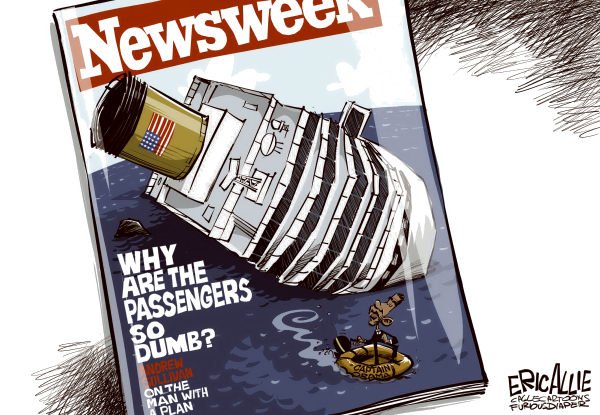
California is sinking like the Costa Concordia

The recent capsizing of the Carnival Cruise Lines ship Costa Concordia off the coast of Italy is symbolic of both Italy’s and California’s inability to continue to fund welfare states.  A lack of “social capital,” not income or taxes, is tearing at the social superstructure of California from within.

The Costa Concordia departed from “Civitavecchia,” an ancient second-century port of the Roman Empire near Rome.  In Italian, “civita” means civilized or civic society.  “Vecchia” refers to old age, as in, “you’ll support me in my old age” (sara il bastone della mia vecchiaia).

The initial reports of the shipwreck indicate that the captain may have abandoned ship in violation of maritime laws.  If the media reports are correct, it was not the ship’s officers but the Filipino cooks, maids and rank and file crew who saved passengers during the chaos to abandon the ship.  Plausibly, they had enough social capital from a Catholic-Asian-influenced social culture to save 4,000 passengers.

The capsizing of the Costa Concordia is symbolic of what is slowly happening to the government cruise ship “Costa California.”

Cruise Ship ‘Costa California’ Coming Apart

The metaphorical cruise ship “Costa California” is listing to port. It can’t find a way to plug a structural $20 billion annual state budget deficit.  But contrary to Gov. Jerry Brown, who proposes to raise taxes, Costa California isn’t leaking taxes from its ballast tanks.  Rather, it is leaking social capital.  There aren’t enough young, intact families to take out mortgages to support the pensions of public or private retirees.  Thus, the economy is coming apart.  But it is really the social fabric that is fraying.  It doesn’t matter how much money you have if you are trying to escape going down with a sinking ship.

According to the Occupy Wall Street movement, California is divided along social class lines with the rich comprising 1 percent and the not-rich comprising the other 99 percent. But libertarian sociologist Charles Murray says the reason for California’s social class divide is not primarily due to an income gap but due to a gap in social capital.

By American social capital, Murray means those institutions that bring about industriousness, neighborliness and lack of class envy; and which promote marriage and family formations along with a culture of entrepreneurialism.

Murray’s soon-to-be-published book, “Coming Apart: The State of White America 1960 to 2010,” says it is the lack of marriage and religious institutions that is resulting in greater social division, fewer liberties and a declining economy.  A synopsis by Murray of the book can be found online in an article titled, “Belmont and Fishtown: On Diverging Classes in the United States.” The article is a comparison of two fictional neighborhoods in upscale Boston and working-class Philadelphia, respectively.  An audio of Murray stating the evidence for the thesis of his book can also be found here.

Although similar divisions exist among other races and groups, Murray concentrated on whites because other groups are more influenced by racial discrimination and recent immigration. By isolating whites in his study, Murray more easily can focus his analysis on class divisions.

The focus of Murray’s book is not the middle class.  Instead, he compares the top 20 percent and the bottom 30 percent on the social class ladder.  What he finds is a growing social class divide.   The Tea Party’s focus is on the preservation of the middle class. And the Occupy Movement’s focus is on the growing social divide.  Both are misdirected social movements when it comes to rescuing California.

Social Divisions

To Murray, the origins for the divide are social and not due to the “greed” of Wall Street.  In 1960, about 88 percent of the “upper class” and 83 percent of the “lower class” in the U.S. were married.  Today, 83 percent of the upper class still are married, but only 48 percent of the lower class.  The result is that there aren’t enough intact families to take out mortgages and start new businesses to support the pensions of the elderly.  Thus, the inter-generational financial structure of the economy is coming apart.  But it is really the social superstructure that has self-destructed with the “nudging” of government.

What Murray is concerned about nationally has also taken place in California. California saw a leveling off of intact nuclear families from 2000 to 2007. The number of two-parent families with children grew from 4,117,036 in 2000 to only 4,218,469 in 2007.  This reflects a minus half percent (-0.5%) decline relative to total population growth. Two parent families with children constituted 35.8 percent of all state households in 2000 and 34.7 percent in 2007. This reflects a 1.1 percentage-point decline. Meanwhile, state population grew 8.1 percent over the same seven-year period.

What apparently has grown in California are the number of single-parent families due to divorce and out-of-wedlock births, not childless households. Unmarried partner households (same-sex) only represented 0.9 percent of all households in 2007.

Virtue Gap

What is causing this is the lack of socially institutionalized “virtues” that foster family formations, the work ethic and social responsibility.   This can only be derived from religion that is separate from the state.  It can’t be manufactured by government funded non-profit clones, academia, some faddish therapy or churches captured by politicized extremes.

In California, “occupying” Wall Street will not fix the state.  Nor will increased public school expenditures per student.  Fully funding state and local government budgets so that pension obligations can be met is not the long-term answer, either.  Figuratively speaking, that would just take on more water to the Costa California cruise ship.

Repealing Proposition 13 would not close the social class divide.  It would just widen the divide, as the widow and small business person couldn’t withstand the tax shock.

Neither would restoring redevelopment or imposing Obamacare make a difference.  Such discussions are like trying to pick a chair in a game of musical chairs on a sinking ship.  But the band plays on.

Restoring the Sacramento Delta and curtailing urban sprawl would be of no consequence either.  Global warming may or may not become a problem in our lifetimes or ever.

But the cooling off of marriage has, within one generation, wreaked structural devastation on the economy and compelled California to look to rampant immigration to offer a partial solution.  But immigration hasn’t brought enough intact two-parent families with entrepreneurial values to plug the gap.

For that matter, reducing the size of government alone would also not produce the social capital needed to keep the family and the economy from eventually declining.  However, Murray nonetheless says that reducing the size of government is a necessary pre-condition for social and economic regeneration.

Civil Society, Not Social Authoritarianism

Murray is not considered a “social conservative” but a libertarian.  Social conservatism is associated with a form of authoritarianism that wants government to have a greater role in the supporting of morally correct choices.

This is the kind of subtle social authoritarianism that Obama has adopted with the “nudging” policies of technocratic guru Cass Sunstein.  Only these policies are secular, so they are considered politically correct. Sunstein is opposed to free markets and believes that elite policy experts know what is best for the public.  But “nudging” policies can’t replace the family, free religious institutions, neighborhoods and other voluntary associations.  Because they reflect government coercion, they add to social alienation.

That is not what Murray is driving at.  Murray is interested in purely voluntary associations cultivating social capital for the public good.

Murray attends a Quaker church, not one that’s Evangelical, fundamentalist or liberal Christian.

Murray says non-religious people are as moral as those who are religious.  But the irreligious don’t leave behind primary social institutions that continue their social values.  Free religious institutions are, if I may say so, California’s original “Think Long Committees.” 

Such free institutions cannot be cloned by the state or by wealthy philanthropic organizations created by social elites.  There is no DNA from which to copy truly voluntary religious associations into the secular world.

In the language of the new genetics, the family and religion are “epigenomes” that self-program DNA by diet or behavior.  The epigenetic code can be inherited by succeeding generations. For example, it was found that binge eating in years of abundant agricultural harvests in Sweden cut 32 years off the life spans of the next two generations of farmers due to a single year of gluttony. By analogy, California government has experienced two decades of budgetary gluttony and thus has several years of self-inherited problems to solve.

Social institutions are like epigenomes that reprogram DNA code in the human cell.  Their effects are long-lasting.

De Tocqueville Libertarianism

Murray might be called a “de Tocqueville” libertarian because he believes that primary social institutions, such as the family and religion, are the creators of social capital that generates political liberties.  Alexis de Tocqueville was a famous French writer who visited America in the early 19th Century.  His famous book, “Democracy in America,” found that the American brand of democracy and business enterprise, and the work ethic, came from participation in voluntary associations not controlled or subsidized by the state.

The ideal of most libertarians is the naked individual with “inalienable” rights facing huge bureaucracies.  This is the image portrayed in Ayn Rand novels. Consider the fictional architect Howard Roark battling the bureaucracy in the novel, “The Fountainhead.”  But Roark is an “unarmed prophet” with no social capital.

Libertarianism can lead to an alienated individual who is part of the “lonely crowd” and who “bowls alone.”  Murray’s libertarianism sees the need for primary social institutions to serve as a buffer from the huge Wall Street corporations on the one hand, and the Federal Reserve and predatory eminent domain for redevelopment by the elites on the other hand.  “Wall Street,” “Big Corporations,” and “Too Big to Fail Banks” reflect icons of social alienation to the political Left.  “Fannie and Freddie Mac,” “the Federal Reserve,” “Redevelopment” and “Eminent Domain” reflect alienation on the Right.

People who are religious tend to become Little League organizers.  They fight for installing traffic signals at dangerous intersections.  They want a better world for their children and the children of others.  They are politically involved in more than a self-interested way.  They create lasting social capital that can be transferred to bigger issues.

The Maligning of ‘Prop. 8 as Hate’

In California, Proposition 8 to ban gay marriage is seen by liberal cognitive elites as just another form of social authoritarianism.  Libertarians just want “government out of the family.”

But Jennifer Roback Morse of the Hoover Institution has made a libertarian case for the exclusiveness of the “traditional” nuclear family.  This does not necessarily mean that gays should be prohibited from “civil unions” or other legal protections.

How to Re-float the Cruise Ship ‘Costa California’

According to social scientist Charles Murray, California can refloat the cruise ship “Costa California” if it can right-size government to allow voluntary associations to fulfill their irreplaceable role without resorting to social authoritarianism.

This even extends into an alternative to Obamacare.  Health has a social basis, as even liberal policy makers know.  Using “civil society” to form self-care and mutual aid groups focusing on health care is a viable alternative or complement to either socialized, privatized or “single payer” health care.

Murray points out that his findings are contrary to the stereotype that the working class is more religious and thus has more social capital than the upper class.  To the contrary, it is the lower classes that are sinking as the welfare state has replaced free religious and social institutions.  Moreover, upper class elites do not socialize with the lower classes anymore and have limited the pathways for social mobility in a high-tech society.

Murray writes: “Encompassing these specific ways in which declines in the Founding virtues diminish civic culture are the class divisions that have emerged in the raising of the next generation. In Belmont, the intact two-parent family is still the norm—about 90 percent of all Belmont children are still living with both biological parents when the mother turns forty. In Fishtown, that figure has fallen below 30 percent. The socialization of children in Belmont and Fishtown has become radically different, and everything we have learned about the problems associated with single parenthood forces us to expect that the consequences for the transmission of industriousness, marriage, honesty, and religiosity to the next generation will be profound.”

Translated to California’s current situation: the CalPERS pension fund may depend as much or more on the revival of civil society than on endless higher taxes. And your civita vecchia  — your civilian retirement — may depend on it too.

(Wayne Lusvardi is a Political Commentator and writes for CalWatchdog, where this article was first posted.)

Obama Rejects Job Creating Pipeline: A Divided America

America has two basic economies, and the division increasingly defines its politics. One, concentrated on the coasts and in college towns, focuses on the business of images, digits and transactions. The other, located largely in the southeast, Texas and the Heartland, makes its living in more traditional industries, from agriculture and manufacturing to fossil fuel development.

Traditionally these two economies coexisted without interfering with  the progress of the other. Wealthier gentry-dominated regions generally eschewed getting their hands dirty so that they could maintain the amenities that draw the so-called creative class and affluent trustifarians. The more traditionally based regions focused, largely uninhibited, on their core businesses, and often used the income to diversify their economies into higher-value added fields.

The Obama administration has altered this tolerant regime, generating intensifying conflict between the NIMBY America and its more blue-collar counterpart. The administration’s move to block the Keystone XL oil pipeline from Canada to the Gulf of Mexico represents a classic expression of this conflict. To appease largely urban environmentalists, the Obama team has squandered the potential for thousands of blue-collar jobs in the Heartland and the Gulf of Mexico.

In this way, Obama differs from Bill Clinton, who after all recognized the need for basic industries as governor of   poor and rural Arkansas. But the academic and urbanista-dominated Obama administration has little appreciation for those who do the nation’s economic dirty work.

NIMBY America’s quasi-religious devotion to the cause of global warming is the current main reason for their hostility to the basic economy. But it is all a part of a concerted, decades-long jihad to limit the dreaded “human footprint,” particularly of those living outside the carefully protected littoral urban areas.

Oddly, in their self-righteous narcissism, the urbanistas seem to forget that driving production from more regulated areas like California or New York to far less controlled areas like Texas or China, may in the end actually increase net greenhouse gas emissions. The hip, cool urbanistas won’t stop consuming iPads, but simply prefer that the pollution making them is generated far from home, and preferably outside the country.

The perspective in the Heartland areas and Texas, of course, is quite different. They regard basic industries as central to their current prosperity. Oil and gas, along with agriculture and manufacturing, have made these areas the fastest growing in terms of jobs and income over the past decade.

Of course, the apologists for the NIMBY regions can claim that they, too, create economic value. And to be sure, Silicon Valley — now in a midst of one of its periodic boom periods — Wall Street and Hollywood constitute some of the country’s prime economic assets. Similarly, highly regulated cities such as New York, San Francisco, Seattle,   Boston and Chicago offer a quality of life, at least for the well-heeled, that draws talent and capital from the rest of the world.

But the NIMBY model suffers severe limitations. For one thing, these high cost areas generally lag in creating middle-skilled jobs; New York and San Francisco, for example, have suffered the largest percentage declines in manufacturing employment of the nation’s 51 largest metropolitan areas. Indeed with the exception of Seattle, the NIMBY regions have all underperformed the national average in job creation for well over a decade.

These areas are becoming increasingly toxic to the middle class, especially families who are now fleeing to places like Texas, Tennessee, North Carolina and even Oklahoma. NIMBY land use regulations — designed to limit single-family houses — usually end up creating housing costs that range up to six times annual income; in more basic regions, the ratio is around three or lower.

Ironically, America’s most ardently “progressive” areas turn out to be the most socially regressive, with the largest gaps between rich and poor. Even the current tech bubble has not been of much help to heavily Latino working-class areas like San Jose, where unemployment ranges around 10%, nor across the Bay in devastated Oakland, where the jobless rate surpasses 15%.

To succeed, America needs both of its economies to accommodate the aspirations not only of its current population but the roughly 100 million more Americans who will be here by 2050. If the regions that want to maintain NIMBY values want to do so, that should be their prerogative. But stomping on the potential of other, less fashionable   areas seems neither morally nor socially justifiable.

(Joel Kotkin is the Editor of NewGeography.com and Presidential Fellow in Urban Futures at Chapman University. This article was first posted on Fox & Hounds.)

Socialized Health Care in California is almost here

Like a bad horror movie in which the monster dies only to come back from the grave, socialized medicine has once again reared its ugly head in California. Not content to wait for Obamacare to kick in, state Sen. Mark Leno, D-San Francisco, has introduced SB 810. It’s a reincarnation of SB 840, a government-run health-care bill authored by Sheila Kuehl that was vetoed in 2008 by then-Gov. Arnold Schwarzenegger.

“According to the Legislative Analyst’s Office, the bill is estimated to cost $210 billion in its first full year of implementation and cause annual shortfalls of $42 billion,” said Schwarzenegger in his veto message. “To place this in proper perspective, our state budget deficit this year started at $24.3 billion.”

The fiscal hemorrhaging from SB 810, which is likely to be looked on more favorably by Gov. Jerry Brown, could be worse, perhaps $250 billion annually, according to the bill’s analysis. Startup costs could be in the hundreds of thousands to millions of dollars. Additional costs would result from the transition to a health care system run by state bureaucrats, including the implementation of a claims payment system, electronic medical records, labor market disruptions, reduced tax revenue and job loss from insurance companies.

Where’s the money going to come from? “Since no revenue source is currently identified, it would be pressure on the state General Fund,” the analysis states. That’s the same General Fund that has been running multi-billion dollar deficits for much of the past decade and which is on track for another $9.2 billion shortfall in the next fiscal year.

“There would be ongoing General Fund pressure in the millions to billions of dollars, because this bill would provide that the General Fund would be responsible for providing loans to the Healthcare Fund in the event of a shortfall or the delayed passage of the state’s annual Budget Act,” the SB 810 analysis states. “This bill would also permit the [health] Commissioner to use reserves and to borrow funds in such a situation and to take cost control measures.”

It would likely result in tax increases. The funding mechanism for Kuehl’s bill would have imposed a 12 percent tax on employers and employees along with another 11.5 percent in unspecified taxes.

Bureaucracy

If you thought the health care system was already bureaucratic, convoluted and confusing, wait until Sacramento takes over. A California Healthcare Agency would be formed along with the Healthcare Policy Board, the Office of Patient Advocacy, the Office of Health Planning, the Office of Health Care Quality, the Healthcare Fund, the Public Advisory Committee, the Payments Board, and the Partnerships for Health.

Few would argue that the current system is not in need of improvement.

Leno pointed out at the Jan. 17 Senate Appropriations Committee meeting that health care premiums have risen five times faster than the inflation rate since 2002. As a result, more employers are cutting back or dropping employee coverage. Employees are picking up more of the costs of premiums along with higher deductibles and co-pays. In the past year, 12 million Californians went without health insurance.

In 1960, the United States spent 5 percent of its gross domestic product on health care. That increased to 11 percent by 2000. Not it’s 17.6 percent of GDP, according to Leno. Without significant reform, the projections are that by 2015 we will be spending 20 percent of GDP on health care. Next: 25 percent by 2025 and 50 percent by 2060.

Leno said the World Health Organization ranks the United States 37th among nations in health care, despite Americans paying twice per capita than higher-rated countries with government-run health care. “So there is money in the system,” he said. “It’s just being wasted on both administrative and clinical waste. That’s what we’re purchasing: bureaucracy and waste instead of health care provision.”

He said costs can be cut through bulk purchasing of medicine and medical equipment. And he dismisses the concern about the impact on the General Fund budget, saying, “This is not a new $200 billion cost to the state of California. It’s the current $200 billion we are spending inefficiently on health care put into a new health plan that will be much more efficient, create greater results, keep Californians healthier and saving us billions of dollars.”

Leftist Support

California’s leftist organizations turned out in such large numbers that it took 17 minutes for all of them to come to the microphone and state their names and affiliations. In comparison, the opposition to the government takeover of a $200 billion industry was paltry.

Mark Burgat, representing the California Chamber of Commerce, said the Chamber disagrees that government systems are more efficient than private businesses, and that a single-payer system would be less costly than the current private system. But he provided no facts to back that up. He also warned about deficits in the tens of billions of dollars annually.

But he said the chamber supports Obamacare: “We believe the federal program is a program that is workable and we are working towards that end. We think that the state and the businesses in the state should focus on that. Trying to implement a California-only one-payer system is simply counter-productive.”

Also supporting Obamacare while opposing Lenocare is Nick Louizos, representing the California Association of Health Plans, who said, “Our industry is appropriately focused on implementing this [Obamacare] law and making it work. We believe the debate around SB 810 is counter-productive to those efforts. And, whether or not the funding is addressed in this bill or some future legislation, the cost of single-payer, as mentioned previously, is massive.”

Small Businesses Snuffed Out

The strongest argument against SB 810 was made by Ken DeVore, representing the National Federation of Independent Business.

“Right now small businesses in California are just struggling to survive,” he said. “Many of them can’t afford health care insurance for themselves, let alone for their employees. This could be the last thing that would drive them out of business, out of state. A study [on Kuehl’s bill] said that it would cost nearly a quarter million jobs in California if it was implemented with the imposition of all of these new costs on businesses. With 2.2 million unemployed in California right now, we just can’t afford something like this at this point in time with an economy that is still faltering.”

Several committee members spoke in favor of the bill; none spoke against it. But due to the need to further analyze the cost impacts on the General Fund, Chairwoman Christine Kehoe, D-San Diego, ushered it into the suspense file with an agreement to vote on the bill today (Thursday, Jan. 19).

Like its predecessor, SB 810 is likely to pass the Legislature and reach the governor’s desk. Leno is optimistic that Brown will sign it, noting that the governor pushed a government-run health plan when he ran for president in 1992. “In the brief conversations I had with him when he was a candidate [for governor in 2010], he does want to sit down, look at the numbers and understand it more clearly that it is, of course, affordable for California,” said Leno.

(Dave Roberts is a political commentator and writes for CalWatchdog, where this story was first posted.)