Trump Ad Echoes Campaign for CA Prop. 187

Donald Trump political adDonald Trump’s first TV ad of the 2016 campaign isn’t airing in California, but the images are very familiar to Californians.

The ad begins with a warning about radical Islamic terrorism, with photos of the two San Bernardino shooters over a background of flashing emergency lights and a sheet-covered body. Next, the announcer promises that Trump will “stop illegal immigration,” and the video cuts to grainy black-and-white footage of immigrants racing on foot to cross the border.

That clip is actually from Morocco, but if you lived in California in 1994, you probably remember the original version of this ad, with its grainy black-and-white footage of immigrants racing on foot to cross the border, running between the cars on Interstate 5.

“They keep coming,” the announcer said somberly in that campaign ad for Gov. Pete Wilson’s re-election. “Two million illegal immigrants in California. The federal government won’t stop them at the border, yet requires us to pay billions to take care of them.”

Also on the ballot that year was Proposition 187, which would have cut off public benefits, including education and health care, to everyone in California who was residing in the country illegally.

Pete Wilson won that election with 55 percent of the vote, and Prop. 187 passed with 59 percent.

Later, Prop. 187 was thrown out by a federal court and Wilson was widely blamed by political experts for turning a generation of Latino voters away from the Republican Party. But that’s not proof that voters feel differently today than they did in 1994.

Will Trump’s message resonate with a majority of voters in California or repel them? Let’s crunch the numbers from the 1994 vote for Prop. 187 and see if we can find the answer.

We’ll start by asking, “Who voted for Prop. 187?” According to an average of exit polls, 40 percent of Democrats, 76 percent of Republicans and 61 percent of voters registered as independent or other.

At that time, statewide voter registration in California was 49 percent Democrat, 37 percent Republican, and 14 percent independent or other party. Today, the numbers are 43 percent Democrat, 28 percent Republican and 29 percent independent or other.

How would a vote on Prop. 187 come out today if the 1994 exit poll percentages were applied to California’s current voter registration by party?

It would pass, 56 percent to 44 percent, assuming equal turnout across the board. It’s a guessing game to predict which party’s voters would be more energized to turn out, and whether that would change the outcome. It probably wouldn’t.

Like the voter registration statistics, the demographics of California have changed.

The 1994 exit polls estimated the ethnic/racial composition of the electorate as 78 percent non-Hispanic white, 9 percent Latino, 7 percent black and 6 percent Asian.

Who voted for Prop. 187? Sixty-four percent of non-Hispanic whites, 52 percent of both blacks and Asians, and 27 percent of Latinos.

The Public Policy Institute of California projects that in 2016, 60 percent of the state’s likely voters will be white, 18 percent Latino, 6 percent black, 12 percent Asian, and 4 percent multi-racial or other.

If each group voted as it did in 1994, Prop 187 would pass by a margin of 53 percent to 43 percent. Adding the 4 percent of voters in the more recent multi-racial category to either side won’t change the result.

There’s one more question. Have attitudes and views in this state changed so dramatically since 1994 that exit polls from that election are now irrelevant and meaningless? Maybe. But a different conclusion can’t be ruled out:

Donald Trump could carry California.

San Bernardino Plans to Cut Pensions of Retired Police Officers

police-badgeSan Bernardino’s plan to exit bankruptcy, possibly next year, cuts the pensions of 23 retired police officers who receive an unusual supplement to their regular CalPERS pension.

The supplement paid through a private-sector firm, the Public Agency Retirement System, boosts pensions to the same amount now common among police and firefighters, a standard set by the Highway Patrol in a CalPERS-sponsored bill, Senate Bill 400 in 1999.

San Bernardino provided the PARS supplement from 2004 to 2008, when the 23 police officers retired, as a lower-cost way to be competitive in the job market before adopting the more expensive CalPERS formula that critics say is “unsustainable.”

“PARS plan retirees will be the only retired employees in the state of California to have their retirement compensation reduced through bankruptcy proceeding,” a member of the PARS retiree subcommittee, Robert Curtis, said in a court filing this month.

Curtis said unfairly reducing pensions up to 12 percent could result in personal bankruptcy, the loss of homes and health coverage, and other hardships. He asked for a city-provided attorney to represent the PARS retirees.

San Bernardino’s plan to exit bankruptcy would reject the PARS contracts, distribute a $1.8 million trust fund to the 23 retirees, and make no more payments to the supplement, which is said to be underfunded by about $3 million.

The city thought it had an agreement with the PARS retirees last month. But in a court filing last week, the city suggested the emergence of opposition since then could result in even less generous treatment of the PARS retirees.

New public pension supplements, like the one given the 23 San Bernardino police officers, are now banned under a pension reform pushed through Legislature by Gov. Brown three years ago.

San Bernardino can argue that phasing out the PARS supplement leaves the 23 retirees with the pension offered when they were hired, like other officers who retired before the supplement began in 2004.

But the same cannot be said of pensions from the California Public Employees Retirement System and other public retirement systems covered by the “California rule,” a series of state court decisions.

Public pensions can go up but not down — even if, as with SB 400, a pension increase is retroactive, immediately creating debt because the increase was not paid for by previous employer-employee contributions.

A San Bernardino disclosure statement filed Nov. 25 said the city had roughly $323 million in CalPERS pension unfunded liabilities when filing for bankruptcy in 2012.

“These unfunded actuarial liabilties were created primarily by the common council’s decisions to approve enhanced pension benefits to city employees in 2001 and 2007,” said the city filing.

Contributing factors, said the filing, were unfunded retroactive pension increases, heavy CalPERS investment losses during the financial crisis, and an increasing number of retirees with larger pensions and fewer active workers to help pay for them.

SBchart

Without cutting pensions, the San Bernardino plan is expected to produce a healthy general fund reserve of 15 percent or more through 2034, according to an update issued by city consultants early this month.

U.S. Bankruptcy Judge Meredith Jury said in October she wanted more discussion of rising pension costs, given the “media perception” that Stockton and Vallejo are in trouble (strongly denied by the city managers) because they failed to cut pensions in bankruptcy.

San Bernardino has deeper problems than the other two cities: a lower average income and weak local economy, years of factional political infighting, and mismanagement that led to a new finance director discovering the city was on the brink of not making payroll.

After an emergency bankruptcy filing in 2012, San Bernardino took the unprecedented step of skipping its payment to CalPERS for most of a fiscal year, running up a debt of $13.5 million and risking termination of its CalPERS contract.

Hoping at first to get aid from CalPERS by stretching out payments, what San Bernardino got was a legal battle and a mediated agreement to repay CalPERS with interest by June 2016, followed by a penalty bringing the total to $18 million.

Regular San Bernardino general fund payments to CalPERS increased from $6 million in fiscal 2000-1 to a projected $22.6 million this fiscal year, said the November city filing.

CalPERS employer rates for San Bernardino police and firefighters were 14 percent of pay in fiscal 2000-1, 39 percent of pay in fiscal 2012-13, and are projected to be 60 percent in fiscal 2019-20.

In other developments, City Manager Alan Parker, who clashed with Mayor Carey Davis, resigned effective Dec. 31. Last week Police Chief Jarrod Berguan was appointed interim manager until Mark Scott, Burbank city manager, takes the post Feb. 8.

Burrtec was selected in November to take over city waste management and retain full-time city employees, part of a strategy to cut costs by contracting for services. The city expects a one-time $5 million payment and annual savings of $2.8 million.

A federal appeals court last week upheld Judge Jury’s ruling that the city charter does not prevent contracting for fire services. Annexation of San Bernardino by the county fire district is expected to yield a $143 parcel tax and lower pension costs, netting $11 million a year.

At a hearing last week, Jury moved on from pensions and asked for an explanation of why the San Bernardino plan only gives some creditors 1 percent of what they are owed and does not raise taxes to pay more debt, the San Bernardino Sun reported.

Voters approved a 1-cent sales tax increase in Vallejo and a ¾-cent sales tax increase in Stockton. The San Bernardino plan would pay only about 1 percent of the amount owed on a $50 million pension obligation bond.

Among the major remaining opponents of the plan are the holder of the unsecured pension bond, EEPK, which is a subsidiary of Commerzbank of Germany, and the insurer of the bond, Ambac.

A request from the San Bernardino bondholders to be treated the same as pensions was rejected by Jury last May, and the ruling is being appealed. Mediation on Nov. 18 and 19 failed to produce a settlement.

Early this month in the Stockton bankruptcy, a federal appeals court rejected an appeal of a 1 percent payment on $30 million in unsecured bonds held by Franklin Templeton, which argued creditors were treated unfairly because pensions are untouched.

Jury predicted last week that the confirmation trial on the San Bernardino plan to exit bankruptcy will begin this spring or summer, the Sun reported. The fourth anniversary of the bankruptcy is Aug. 1.

Reporter Ed Mendel covered the Capitol in Sacramento for nearly three decades, most recently for the San Diego Union-Tribune. More stories are at Calpensions.com. Posted 28 Dec 15

This piece was originally published by CalPensions.com

After closing all schools, LAUSD finds threat not credible

As reported by the L.A. Daily News:

It was a tale of two cities, with New York officials shrugging and Los Angeles officials quaking.

The threat came via email to Los Angeles Unified School District board members. It named schools. It talked about bombs and guns. It came less than two weeks after San Bernardino — just about 60 miles east of downtown — was rocked by a massacre that killed 14 and was linked to international terrorism. It came less than two weeks after an American casualty in the Paris terrorist attack was buried in Downey.

It was enough.

LAUSD Superintendent Ramon Cortines decided to close more than 900 schools, an unparalleled act at the nation’s second largest district. More than 700,000 students were suddenly given the day off and many parents were given to juggling anxiety, both for the threat and their disrupted workday. …

Click here to read the full story

California’s Gun Sales Break Records

As reported by the Contra Costa Times:

Amid a new round of debate over gun control, Californians have already bought a record number of firearms in 2015, including major spikes in sales on Black Friday and the days after the San Bernardino attacks, an analysis of new federal and state data show.

Firearms purchases in California triggered 1.51 million federal background checks in the first 11 months of the year, breaking the previous annual record of 1.47 million set last year.

And December typically brings even more firearms purchases than any other month, whether for holiday gifts or getting ahead of new gun restrictions the new year might bring.

The gun dealers’ holiday season got off to a rousing start. State data requested by this newspaper show that sales transactions spiked on …

Click here to read the full article 

Nevada governor hits back against Jerry Brown’s gun control comments

As reported by the Sacramento Bee:

Nevada Gov. Brian Sandoval on Sunday joined the governor of Arizona in hitting back California Gov. Jerry Brown’s comments that their states’ lenient gun laws are a “gigantic back door through which any terrorist can walk.”

Brown, asked in Paris on Saturday if stricter gun control laws were warranted following the mass shooting in San Bernardino, said, “California has some of the toughest gun control laws of any state. And Nevada and Arizona are wide open, so that’s a gigantic back door through which any terrorist can walk.”

Sandoval spokeswoman Mari St. Martin said in a prepared statement Sunday that Brown’s remarks were “wrong and irresponsible.”

“This type of political rhetoric is discouraging to hear at a time when all Americans are looking for thoughtful, honest leadership,” she said.

San Bernardino Shooting: Poor Response by Politicians and Press

California has been hit by two terrorists who caused multiple deaths and injuries. So what was the response of our media and political elites when this happened on Wednesday: hysteria over gun laws.

From the beginning it was clear San Bernardino was not just another nut case shooting; the terrorists were dressed military style, they had bombs as well as guns, and a sophisticated plan to escape. One way or another they were well trained in terrorist techniques.

So how did California’s leading newspapers greet all this?  “Another day, another massacre,” writes Los Angeles Times columnist Steve Lopez.  “We’re reminded that no country in the world has the level of gun violence we do.”   Not to be outdone, the Times lead editorial begins with: “Horror in San Bernardino: The U.S. infatuation with guns is bordering on a society-wide suicidal impulse.”

Up north, the Sacramento Bee editorial begins with: “San Bernardino shooting, shocking yet almost normal.  No matter what you call it, the root of the problem is the same: America allows too many guns to fall into the hands of too many people who should not have them.”

Well, how about bombs and guns in the hands of terrorists; the Bee does not have much to say about that.

This Pollyannaish response extended to our political leaders as well. Gov. Jerry Brown, so full of himself over saving the earth from a few more degrees of heat, had nothing to say about terrorism in his own statement.  President Obama called for closing the gun show loophole.

Perhaps the president should be more focused on the terrorist visa loophole, since the Pakistani-born terrorist in San Bernardino came into this country on a “fiancé visa.”

Throughout Wednesday night and all day Thursday the facts have come out on the terrorist couple, showing that they were experts in al-Qaeda style bomb making, that the American-born male terrorist travelled extensively in the Middle East, had some contacts to people on federal terrorist watch lists, and that the attacks were carefully planned and expertly carried out.

Gun laws had nothing to do with them. It is like saying that if France just had stronger gun laws, the Paris attackers would have been deterred. The San Bernardino terrorists bought their guns legally, and this in California that has been passing gun control laws for almost 30 years.  Lots of good they have done. When people are busy making pipe bombs in their apartment, somehow the gun show loophole seems pretty minor.

When the Republican Congress passed legislation to slow down the influx of Syrian refugees because they cannot be vetted to make sure terrorists have not infiltrated them, the California elite just pooh-poohed the threat and condemned the legislation.  Well, now we have a terrorist allowed into this country from Pakistan, a known hotbed of terrorist training, and what do our elites have to say, let’s pass more gun laws.

For far too long, the attitude of the political and media elite in this state to the very real threat of terrorism has been nothing short of brain dead.  Perhaps San Bernardino will be a wake-up call on the need for more visa and other controls at our borders.  But I am not hopeful; Chicken Little hysteria about gun control is a much easier response.

Originally published by Fox and Hounds Daily

Resist the Urge to Politicize Tragedy

This editorial was originally published by the Orange County Register:

Evil reared itself Wednesday morning at the Inland Regional Center in San Bernardino. That’s when heavily armed husband and wife Syed Rizwan Farook and Tashfeen Malik made their way into Mr. Farook’s office holiday party and unleashed terror.

By the time the shooters fled, 14 were dead and another 17 wounded. It was the most carnage inflicted in the United States since six teachers and 20 children were shot and killed in 2012 at Sandy Hook Elementary School in Connecticut.

The mass murder in San Bernardino was predictably sensational, as evidenced by the fact that #SanBernadino was shared on Twitter more than 333,000 times Wednesday – notwithstanding that the city’s name was misspelled.

No less predictable were the remarks of several political figures – both anti-gun advocates and foes of settling Syrian refugees in the U.S. – who apparently couldn’t resist the temptation to exploit Wednesday’s tragedy.

That included President Obama, who ranted to CBS News about the need “for commonsense gun safety laws,” while also urging Congress to enact legislation preventing individuals appearing on the government’s “No Fly List” from purchasing firearms.

But even if Mr. Obama got his wishes, it would not have prevented Wednesday’s carnage. That’s because California already has the nation’s strictest gun laws, based on the latest report card issued by the Law Center to Prevent Gun Violence.

As to enacting a law to prohibit those banned from commercial flights from legally obtaining guns, that would not have stopped Mr. Farook and his wife from obtaining their assault rifles and handguns.

That’s because neither of them was on the feds’ No Fly List, otherwise Mr. Farook, a Pakistani-American born in this country, could not have recently flown to Saudi Arabia and returned to the Inland Empire with his wife, Ms. Malik.

The myth promulgated by Mr. Obama and other gun control advocates that stricter gun laws will prevent the kind of mass murder that occurred in San Bernardino ignores an inconvenient truth …

Continue reading this editorial at OCregister.com/opinion

San Bernardino killer couple’s links to international terror

As reported by the Daily Mail:

San Bernardino gunman Syed Farook met his Pakistani wife-turned-accomplice Tashfeen Malik while on the hajj in Saudi Arabia and appeared to be radicalized, law enforcement officials revealed this afternoon.

Investigators told CNN that Farook, a native U.S. citizen of South Asian descent, was in touch by phone and via social media with more than one international terrorism subject.

On Wednesday morning, Farook, 28, and Malik, 27, dropped off their six-month-old baby with Farook’s mother, saying they were going to a doctor’s appointment.

By noon, according to police, the couple had donned assault clothing, armed themselves with …

Click here to read the full story

San Bernardino shooting rampage sows fear, anger and sorrow among residents

As reported by the Los Angeles Times:

The whine of police sirens is familiar on the streets of San Bernardino.

But even here — in a place battered by drug addiction and decades of economic decline, culminating in the city’s bankruptcy three years ago — the kind of crime that sent an army of law enforcement officers into the streets Wednesday still has the power to spread fear and grief.

The shooting rampage that left 14 dead and at least 17 wounded at a social-services center would be a tragedy for any city. But it has special overtones in San Bernardino, which is among the nation’s poorest big cities and has arguably become California’s starkest example of urban blight.

In the hours after the shooting, as schools and government buildings were locked down and …

Click here to read the full story

California: “Land of Opportunity” or “Land of Poverty”?

For decades, California’s housing costs have been racing ahead of incomes, as counties and local governments have imposed restrictive land-use regulations that drove up the price of land and dwellings. This has been documented by both Dartmouth economist William A Fischel and the state Legislative Analyst’s Office.

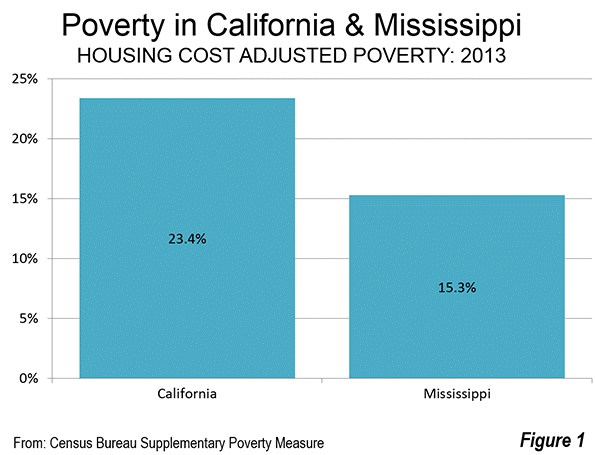
Middle income households have been forced to accept lower standards of living while less fortunate have been driven into poverty by the high cost of housing. Housing costs have risen in some markets compared to others that the federal government now publishes alternative poverty estimates (the Supplemental Poverty Measure), because the official poverty measure used for decades does not capture the resulting differentials. The latest figures, for 2013, show California’s housing cost adjusted poverty rate to be 23.4 percent, nearly half again as high as the national average of 15.9 percent.

Back in the years when the nation had a “California Dream,” it would have been inconceivable for things to have gotten so bad — particularly amidst what is widely hailed as a spectacular recovery. The 2013 data shows California to have the worst housing cost adjusted poverty rate among the 50 states and the District of Columbia. But it gets worse. California’s poverty rate is now more than 50 percent higher than Mississippi, which long has set the standard for extreme poverty in the United States (Figure 1).

cox1

The size of the geographic samples used to estimate the housing adjusted poverty rates are not sufficient for the Supplemental Poverty Measure to produce local, county level or metropolitan area estimates. However, a new similar measure makes that possible.

The California Poverty Measure                           

The Public Policy Institute of California and the Stanford Center on Poverty and Inequality have collaborated to establish the “California Poverty Measure,” which is similar to the Supplemental Poverty Measure adjusted for housing costs.

The press release announcing release of the first edition (for 2011) said that: “California, often thought of as the land of plenty” in the words Center on Poverty and Inequality director Professor David Grusky, is “in fact the land of poverty.”

The latest California Poverty Measure estimate, for 2012, shows a statewide poverty rate of 21.8 percent, somewhat below the Supplemental Poverty Measure and well above the Official Poverty Measure that does not adjust for housing costs (16.5 percent).

The California Poverty Measure also provides data for most of California’s 58 counties, with some smaller counties combined due to statistical limitations. This makes it possible to estimate the California Poverty Measure for metropolitan areas, using American Community Survey data.

Metropolitan Area Estimates

By far the worst metropolitan area poverty rate was in Los Angeles, at 25.3 percent. The Los Angeles County poverty rate was the highest in the state at 26.1 percent, well above that of Orange County (22.4 percent), which constitutes the balance of the Los Angeles metropolitan area. However, the Orange County rate was higher than that of any other metropolitan area or region in the state (Figure 2). San Diego’s poverty rate was 21.7 percent. Perhaps surprisingly, Riverside-San Bernardcox2ino (the Inland Empire), which is generally perceived to have greater poverty, but with lower housing costs, had a rate of 20.9 percent. The two counties, Riverside and San Bernardino had lower poverty rates than all Southern California counties except for Ventura (Oxnard) and Imperial.
 

The San Francisco metropolitan area had a poverty rate of 19.4 percent, more than one-fifth below that of Los Angeles. San Jose has a somewhat lower poverty rated 18.3 percent (Note 1). The metropolitan areas making constituting the exurbs of the San Francisco Bay Area had a poverty rate of 18.7 percent. This includes Santa Cruz, Santa Rosa, Stockton and Vallejo. Sacramento had the lowest poverty rate of any major metropolitan area, at 18.2 percent.

The San Joaquin Valley, stretching from Bakersfield through Fresno to Modesto (Stockton is excluded because it is now a San Francisco Bay Area exurb) had a poverty rate of 21.3 percent, slightly below the state wide average of 21.8 percent. The balance of the state, not included in the metropolitan areas and regions described above had a poverty rate of 21.2 percent.

County Poverty Rates

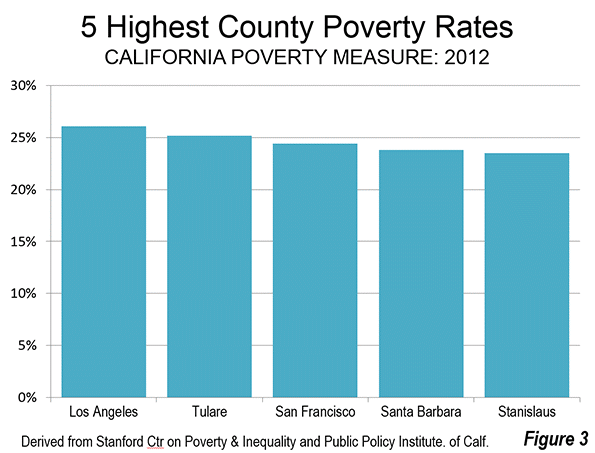
As was noted above, Los Angeles County had the highest 2012 poverty rate in the state (Note 2), according to the California Poverty Measure (26.1 percent). Tulare County, in the San Joaquin Valley had the second-highest rate at 25.2 percent. Somewhat surprisingly, San Francisco County with its reputation for high income had the third worst poverty rate in the state at 23.4 percent. This is driven, at least in part, by San Francisco’s extraordinarily high median house price to household income ratio (median multiple). In this grisly statistic, it trails only Hong Kong, Vancouver and Sydney in the latest Demographia International Housing Affordability Survey. Wealthy Santa Barbara County has the fourth worst poverty rate in the state, at 23.8 percent. The fifth highest poverty rate is in Stanislaus County, in the San Joaquin Valley (county seat Modesto), which is already receiving housing refugees from the San Francisco Bay Area, unable to pay the high prices (Figure 3).

cox3

The two lowest poverty rates were in suburban Sacramento counties (Note 2). Placer County’s rate was 13.2 percent and El Dorado County’s rate was 13.3 percent. Another surprise is Imperial County, which borders Mexico and has generally lower income. Nonetheless, Imperial County has the third lowest poverty rate at 13.4 percent. Shasta County (county seat Redding), located at the north end of the Sacramento Valley is ranked fourth at 14.8 percent. Two counties are tied for the fifth lowest poverty rate (16.0 percent), Marin County in suburban San Francisco and Napa County, in the exurban San Francisco Bay Area (Figure 4).

Weak Labor Market and Notoriously Expensive Housing

The original Stanford Center on Poverty and Inequality press release cited California’s dismal poverty rate as resulting from “a weak labor market and California’s notoriously expensive housing.” These are problems that can be moderated starting at the top, with the Governor and legislature. The notoriously expensive housing could be addressed by loosening regulations that allow more supply to be built at lower cost. True, the new supply would not be built in Santa Monica or Palo Alto. But additional, lower cost housing on the periphery, whether in Riverside County, the High Desert exurbs of Los Angeles and San Bernardino Counties, the San Francisco Bay Area exurbs or the San Joaquin Valley could begin to remedy tcox4he situation.

The improvement in housing affordability could help to strengthen the weak job market, by attracting both new business investment and households moving from other states.

Regrettably, Sacramento does not seem to be paying attention. Liberalizing land use regulations is not only absent from the public agenda, but restrictions are being strengthened (especially under the requirements of Senate Bill 375). In this environment, metropolitan areas like Los Angeles, San Francisco, San Jose and San Diego could become even more grotesquely unaffordable, and the already high price to income ratios in the Inland Empire and San Joaquin Valley could worsen. All of this could lead to slower economic growth and to even greater poverty, as more lower-middle-income households fall into poverty.

Note 1: San Benito County is excluded from the San Jose metropolitan area data. The California Poverty Measure does not report a separate poverty rate for San Benito County.

Note 2: Among the counties for which specific poverty rates are provided.

isiting professor, Conservatoire National des Arts et Metiers, Paris

Cross-posted at New Geography.